
Turning Spare Parts into a Strategic Asset

Spare parts management has long lived in the shadow of production planning, maintenance strategy, and procurement optimisation. But that is changing quickly.
As supply chains strain and capital grows more expensive, the overlooked inventories sitting on factory shelves have become a frontline test of resilience. Dr Lukas Biedermann, COO and Co‑Founder of SPARETECH, sees the shift as fundamental.
“Spare parts have become a major capital and performance lever,” he says.
“Large manufacturing companies hold $169 million in spare parts inventory on average. At the same time, 18% of parts remain unused after five years, representing locked capital with no return,” he adds.
What is changing, he explains, is not just the data but the executive perspective.
“C‑level focus is shifting toward working capital and free cash flow. At the same time, global supply chain instability is increasing both the cost of stockouts and the tendency to overstock.”
Yet, companies cannot simply solve the problem by storing more.
“They cannot store all critical spare parts because of capital constraints, storage costs, and limited space. That’s why the industry is recognising that spare parts are not just a cost factor but a driver of both balance‑sheet performance and operational reliability.”
The turning point, Biedermann argues, comes when spare parts stop being treated as passive inventory and start being recognised as a core component of reliability.
“Spare parts management becomes a reliability issue the moment the right part cannot be found quickly,” he says. “In many cases, organisations do not find the required parts at all.”
In practice, that gap forces maintenance teams to improvise.
“Urgent requests are sent through mailing lists across factories when a spare part is needed. This directly delays maintenance because poor data quality and limited transparency across sites lead to longer mean time to repair, costly emergency purchases, and an increase in unplanned downtime,” Biedermann explains.
At that point, the boundary between supply chain and operations disappears — reliability becomes inseparable from spare parts data quality, cross‑site transparency, and fast access to critical materials.
“Reliability depends on fast and accurate access to the right spare parts, which in turn relies on global transparency and reliable spare parts data within ERP and asset management systems. If that foundation breaks down, maintenance performance breaks down as well.”
According to Biedermann, one of the most persistent barriers is visibility.
“The biggest challenge is transparency,” he says, citing the SPARETECH Global Survey 2026. “53% of manufacturing organisations lack global visibility into machinery and equipment spare parts across their factories.”
The consequence is predictable and costly.
“Without that visibility, duplicate purchases occur every day. Inventory continues to grow, often by double-digit percentages year over year, while no one is able to break the cycle.”
For Biedermann, this is not simply a tooling problem but a structural one.
“Sharing spare parts across sites and avoiding duplicate purchases can only be achieved through standardisation and by continuously ensuring that clean data enters the system. Without a strong data strategy across the asset lifecycle, every plant operates in isolation.”
The operational impact of this fragmentation is most visible in maintenance performance indicators.
“If companies lack visibility and spare parts cannot be located across sites, teams in isolated factories often reorder parts instead of using existing inventory,” Biedermann says.
“Given that 18% of purchased spare parts are never used, nearly one-fifth of all materials sitting in factories at any given time could potentially be utilised elsewhere.”
He adds that when transparency improves, the effect is immediate: parts can be located faster, cross-plant sourcing becomes possible, and mean time to repair can be reduced.
“Better visibility enables faster repair decisions, and faster repairs lead directly to higher uptime and improved asset reliability.”
Despite significant investment in predictive maintenance and digital transformation, many organisations still underestimate the importance of master data, notes Biedermann.
“Data quality is one of the biggest gaps we see today,” he says when asked whether companies are overlooking fundamentals.
He points to a structural mismatch between operational speed and administrative systems: “On average, creating a material takes nine minutes of net effort, but it can take up to two or three weeks of total cycle time before a new material number is issued in the ERP system. Maintainers cannot wait that long.”
The result is a culture of workarounds that erodes data integrity. “Teams often create free‑text orders simply to obtain the required part,” he explains — a shortcut that ensures critical information never enters the system.
Sparetech helps global manufacturers address these challenges from the ground up with an integrated MRO software solution that spans every step of spare parts management. It transforms the data foundation behind every decision, strengthens governance, and optimizes inventory, sourcing, and surplus monetization.
“It provides a foundational data backbone that helps manufacturing companies improve predictive maintenance, operations management, and spare parts procurement,” Biedermann says.
However, he is careful to emphasise that technology alone is not enough when companies attempt to standardise spare parts data across regions and plants.
“Deduplicating a global material master is never easy because the first step is deciding how to set up a governance model that can sustain a clean material master after the cleansing process is complete.”
Biedermann points out that success depends on structure before execution.
“Starting with policies and guidelines and thinking backwards from the desired end state is therefore a very good approach.”
Even the most technical steps require organisational clarity.
“Once data cleansing begins and duplicates are identified, it is crucial to define clear rules. For example, which material should be considered the leading material? Should a deletion flag be applied?
How should the work be distributed across different factories?”
Real-world implementations illustrate these principles clearly. At Nestlé, transformation results were driven by a combination of data, adoption, and transparency.
“There were three key success factors,” Biedermann explains.
The first was establishing a standardised data foundation: “We cleaned and enriched the data with original manufacturer information while identifying duplicates and obsolete materials.” The second was a user-centric rollout and adoption strategy: “Together with the Nestlé team, we implemented a strong train-the-trainer program across all global regions.”
Meanwhile, the third was creating global transparency across spare parts inventories, explained Biedermann.
The behavioural impact was as important as the technical one.
“By making spare part stocks visible across factories worldwide, Nestlé enabled teams to identify existing inventory, reduce duplicate purchases, and increase the use of material plant extensions rather than creating new materials.”
Artificial intelligence is often presented as the solution to industrial inefficiency, but Biedermann offers a more grounded view.
“The most recent industry survey we conducted shows that 99% of companies have not yet seen measurable success using AI for data cleansing alone,” he says.
Still, he sees clear value in embedding AI into structured workflows.
“Within our SPARETECH workflow solution, we have introduced Standardize, an AI feature that creates fully accurate, structured short descriptions within ERP length constraints, based on the team’s defined rules, and translates those descriptions into multiple languages.”
The impact is practical rather than abstract.
“These translations are critical when printing labels for storerooms. This helps teams make better real-time decisions and prevents unnecessary spending on parts that are already available.”
Yet AI, he stresses, cannot replace governance.
“AI is certainly not the answer on its own. It is an accelerator, not the foundation.”
The real prerequisite lies elsewhere: “Success depends on having access to original manufacturer spare parts information that can be mapped to company-specific material master fields,” Biedermann says.
Without that, even the most advanced systems fail to deliver reliable outcomes.
Looking ahead, Dr Biedermann believes the gap between leading organisations and those still developing their capabilities will widen significantly. He highlights three capabilities as particularly important.
“The first is achieving full transparency across all plants and inventories. Today, only 47% of businesses report having this level of visibility in some form,” he says.
“The second is establishing a strong data foundation supported by global standards and robust master data governance processes.”
“The third is implementing standardised workflows that enable collaboration across sites and ensure data quality is maintained over time.”
He notes that these capabilities are not standalone improvements but are directly connected to financial and operational performance.
“These capabilities lead to lower spare parts inventory ratios, reduced maverick buying, and significantly lower levels of excess inventory. Ultimately, this improves free cash flow while helping organisations minimise downtime and operate more efficiently.”
Lukas Biedermann

Dr Lukas Biedermann is Co‑Founder and COO of SPARETECH, where he works to build a more efficient and collaborative ecosystem for industrial spare parts data. Before launching SPARETECH, he managed international automotive, aerospace, and manufacturing projects at Porsche Consulting, developing deep expertise in supply chain transformation, digitalisation, servitization, and CO₂ reduction. His academic work is also widely recognised: his 2018 dissertation on supply chain resilience has been downloaded more than 64,000 times.
Text: Nina Garlo-Melkas Photos: SPARETECH



Subscribe to the free Maintworld newsletter here!
Figuring out Maintenance in a brand-new Industry
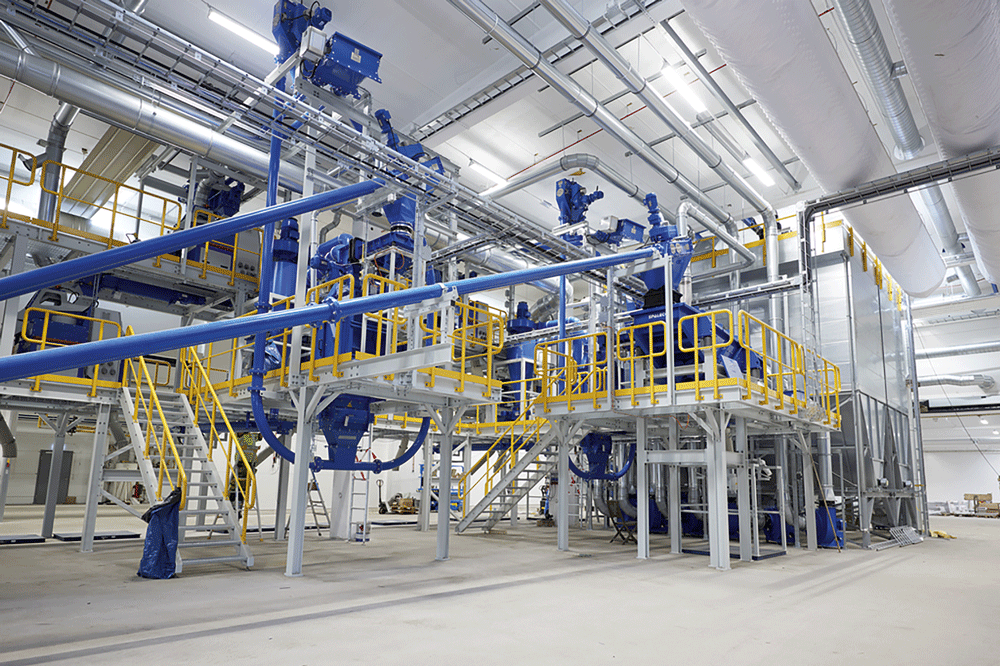
In March 2023, Stena Recycling opened a state-of-the-art battery recycling facility in Halmstad, a small city on Sweden’s west coast. Now the real work began for the company’s maintenance staff. How do you conduct maintenance in a brand-new industry?
When the sale of electric vehicles (EVs) began to accelerate, Europe began to wonder what to do with these batteries at the end of their lives. Stena Recycling, a part of the Stena Metall group, got out their drawing board.
“The EV battery recycling project started in 2012, graduated to business development in 2018, and became a real business case in 2021,” explains Marcus Martinsson, Director, Product Area Batteries for Stena Recycling Group. “We have worked with the auto industry for many years and had healthy cooperation with them during planning.”
The new EU Batteries Regulation came into force in August 2023, just a few months after the Halmstad plant opened, and the Critical Raw Materials Act became effective the next spring. The combination of legislation has helped spur demand for modern battery recycling facilities.
“When we decided to make this investment, we wanted to do it right,” Martinsson continues. “We wanted to make a high-capacity, cutting-edge facility, design our own processes, and take advantage of our economy of scale. We wanted a facility capable of ‘moving the needle’.”
Stena Recycling had been in the circular economy business for 85 years, but recycling lithium-ion batteries was a new challenge. Maintenance experts were given the keys to this shiny new facility and asked to figure it out.
“This is such a new process and there is so much new technology that there are no established maintenance procedures. There is so much we don’t know. Our maintenance staff are helping to develop the entire plan,” explains Carina Petersson, Plant Manager for Stena Recycling’s Halmstad facility.
Halmstad was already the home of their Nordic Recycling Center, where they recycle materials such as non-ferrous metals and plastics. The new battery recycling center fits right in. With an annual capacity of 10,000 tonnes, it can process batteries from the company’s facilities in Italy, Germany, Poland, Denmark, Norway, and Finland.

“There are two steps to the process,” says Petersson. “First, we have the pre-treatment centers in seven countries around Europe. Here they evaluate the batteries and see if they can be reused for other purposes or should go on to recycling in Halmstad.”
An old battery might not meet EV standards but still be perfectly good for other energy storage uses. If they can’t be reused, they are earmarked for recycling. Before the batteries are shipped, though, they must be discharged.
“Fire is the highest risk,” Petersson says. “Batteries might get hot when discharging and there is a risk of thermal runaway and fire. We do the discharging slowly, in a separate building, under carefully controlled conditions. Our staff are well-trained and have clear guidelines.”
(In fact, improperly disposed of lithium-ion batteries is a growing threat to recycling facilities. People throw away old electrical devices in regular trash, for example, only to have those batteries cut in shredders. When punctured, the batteries can release toxic gases, a jet of fire, or even explode. Maintenance crews are frustrated at how often they have to deal with battery fires in their facilities.)
Once the discharged battery arrives at Halmstad, the second stage begins. The modules are dismantled, with the aluminium rack going on to regular aluminium recycling.
“It is a manual and labor-intensive process, as each producer has their own pack design,” Petersson says. “Some packs are too large for the shredder and have to be cut with a saw. We have to be very careful, because if you accidently cut a cell it can leak electrolyte, a fluid chemical which is low in pH-value and corrosive.”
The modules and cells go into a shredder. The risk of fire remains, so the conveyer belts carry material in sealed tubes in a nitrogen-rich, low-oxygen environment to make fires less likely to start.

If thermal cameras detect a fire, powder or sprinkler, fire suppression systems will be triggered.
Special care is taken with black mass, a dark, granular material which makes up the majority of a battery’s value. After mechanical separation it goes on to a partner who does a chemical separation via a hydro-metallurgical process. The critical raw materials can now be used again in new batteries.
Maintenance workers have to carry out their tasks in a potentially hazardous environment. The cobalt dust from black mass can be carcinogenic, so all workers wear protective suits. The ventilation system also creates over-pressure and under-pressure areas to reduce the spread of dust, similar to clean rooms in hospitals.
To better understand this working environment, Stena Recycling is participating in a long-term academic study on the potential health risks of recycling lithium-ion batteries. Administered by occupational health authorities, the University of Gothenburg and Sahlgrenska University Hospital, the study will monitor workers across key activities in the process and evaluate any health effects.
“This is an entirely new industry, and we are still learning,” Petersson says. “We have had good cooperation with the union, which is extremely important. All the workers are involved in developing the safety procedures. Every morning we have a safety review where we talk about any incidents, what happened, how it was handled, what we can do better.”
The material goes into a tumble dryer and the electrolyte condensed out before materials are separated by size. Advanced sensors and machine learning systems developed in-house make the sorting process more automated. Stena Recycling’s IT department maintains their proprietary software.
“We have planned maintenance as well as unplanned maintenance,” says Petersson. “Each activity is classified by who can do the maintenance: the regular operators, our own maintenance team, or outside specialists. They carefully document incidents, such as with before and after photos, so we can understand what happened.”
The company utilizes some industry-standard solutions, such as Maintmaster’s CMMS and OEE software. These help plan and organize inspections, predictive and preventative maintenance, training and development, inventory management, and documentation.
“We are developing the maintenance work together with the maintenance department and the engineers. They are the experts!” Petersson says. “We are continuously developing and improving the maintenance at our facility. Our work includes technical development, digitalization, advanced system monitoring, and the integration of AI-driven tools. As new technologies are introduced, they require innovative approaches and new ways of working, even for highly experienced maintenance mechanics and maintenance engineers. Continuous learning, adaptability, and close cooperation between operational, engineering, and maintenance team are essential to ensuring safe, reliable, and efficient operations.”
Although lithium-ion battery recycling is a newer industry the company already has 75 million tonnes of recycling experience. Still, sometimes they are caught by surprise: EV batteries are lasting longer than anyone had expected. On average, an EV lasts 15 years before it is recycled, just two years less than a petrol-powered car.
“This industry is still developing, and they are constantly working on new types of batteries with new chemistries,” concludes Petersson. “It is exciting to follow all these new developments. When these new batteries come to the end of their lives, they will need to be recycled, too, so we will be ready for them.
What’s in black mass?
• Graphite
• Nickel
• Cobalt
• Manganese
• Lithium
• Trace metals like copper and impurities such as glue
Text: David J. Cord Photos: James Froment and Stena Recycling
Subscribe to the free Maintworld newsletter here!
The Future of Maintenance: Automating Industry’s Last Manual Workflow
As global production continues to expand, industrial companies face a growing paradox: more assets to maintain, but fewer skilled technicians available to do the work.
Despite decades of automation across manufacturing, logistics, and supply chain operations, maintenance remains heavily dependent on human coordination and decision-making. While artificial intelligence (AI) is transforming many aspects of industrial operations, maintenance stands out as one of the last major workflows still managed largely manually.
Industrial organizations are increasingly challenged to maintain uptime, efficiency, and safety across expanding asset fleets while operating with constrained resources. Against this backdrop, a new opportunity is emerging: the automation of the maintenance workflow itself. This article explores how AI-native technologies can transform maintenance from a fragmented, labour-intensive function into an intelligent, autonomous workflow, offering a blueprint for automating industry’s last major manual process.
Industrial maintenance is approaching a critical inflection point. Asset fleets continue to grow, production environments are becoming more complex, and experienced technicians are retiring faster than they can be replaced. This widening skills gap is creating mounting pressure on organizations to do more with less.
Historically, maintenance has scaled through people. More assets required more technicians, planners, and supervisors. However, that model is becoming increasingly difficult to sustain. Industrial companies now face a fundamental question: how can they maintain a growing number of assets without proportionally increasing headcount?
While production processes have benefited from decades of automation, maintenance workflows still rely on people to interpret information, coordinate activities, and drive decisions. As a result, maintenance remains one of the last industrial functions yet to experience end-to-end automation.
Predictive maintenance technologies have already delivered substantial value by enabling organizations to identify anomalies and potential failures before they occur. Yet automation typically stops at fault detection. Once an alert is generated, humans still perform most of the work required to turn insight into action.
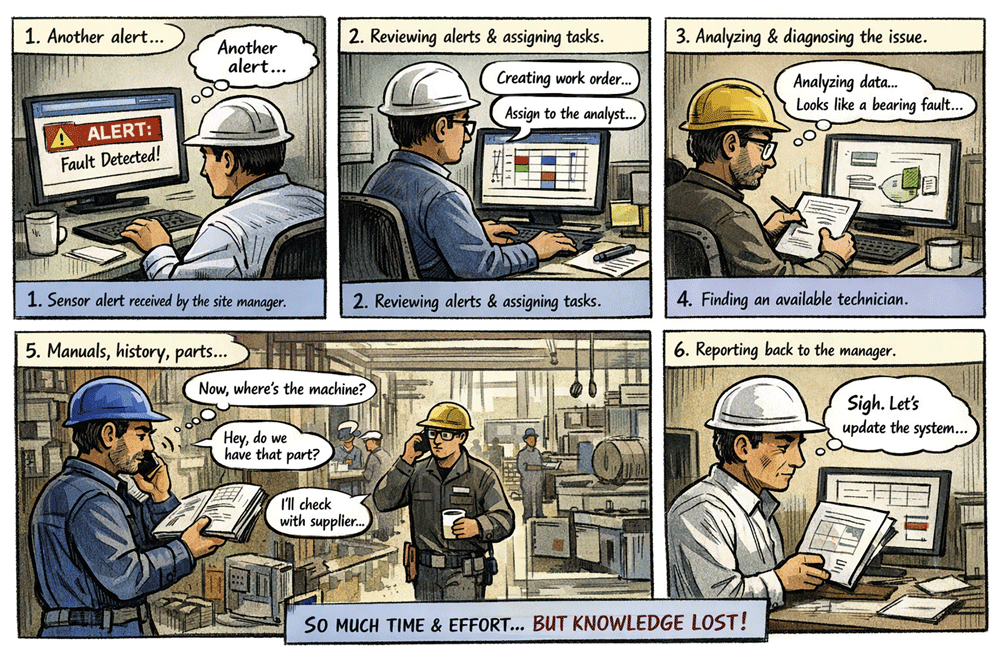
Today, site managers interpret alerts, determine priorities, create work orders, and assign tasks. Technicians spend valuable time gathering information from maintenance records, manuals, sensor data, and spare parts systems before they can begin repairs. They coordinate with planners, suppliers, and colleagues across multiple disconnected systems, often relying on manual communication and personal experience.
This fragmented workflow creates delays, inefficiencies, and inconsistent outcomes. Information remains siloed. Knowledge is rarely documented in a structured manner. Every maintenance event requires a series of manual handovers that slow execution and limit organizational learning.
The result is a clear automation gap. While fault detection has become increasingly automated, the broader maintenance process remains largely manual. This gap represents one of the most significant remaining opportunities for industrial transformation.
Artificial intelligence is creating the foundation for a new era of maintenance – one in which the entire workflow can be automated from fault detection through resolution. For the first time, the technologies required to automate maintenance comprehensively are becoming available.
Modern AI systems can combine sensor readings, maintenance history, operational data, technical documentation, and other information sources into a unified understanding of each asset and situation. Using natural language processing, they can interpret unstructured technician notes and transform them into structured insights that support decision-making and continuous improvement.
AI can also identify subtle patterns that indicate potential failures, evaluate alternative courses of action, and initiate workflows automatically. Through continuous learning, these systems improve over time, becoming increasingly accurate and effective with every maintenance event.
The challenge is no longer whether AI can support maintenance. The challenge is how to integrate AI into the maintenance workflow in a structured, scalable manner. This is where an agentic approach becomes essential.
Automating maintenance requires more than predictive analytics alone. It requires a coordinated system capable of analysing situations, making decisions, planning actions, and supporting execution. A practical blueprint for achieving this vision combines AI-native technologies into a connected maintenance ecosystem.
The journey begins with the assets themselves. Equipment must be equipped with sensors, connectivity, and edge intelligence that enable it to continuously generate meaningful condition data.
This physical layer forms the foundation for higher levels of automation. Without reliable asset intelligence, autonomous maintenance cannot exist.
The next step is providing context. Traditional predictive maintenance solutions rely primarily on vibration, temperature, and similar condition signals. While valuable, these signals alone are insufficient for autonomous decision-making. AI can enrich condition data with maintenance history, lifecycle information, operating conditions, and product documentation, creating a more complete understanding of asset health.
With this broader context, AI can move beyond anomaly detection and begin identifying root causes, recommending actions, and tailoring decisions to specific assets and operational environments.
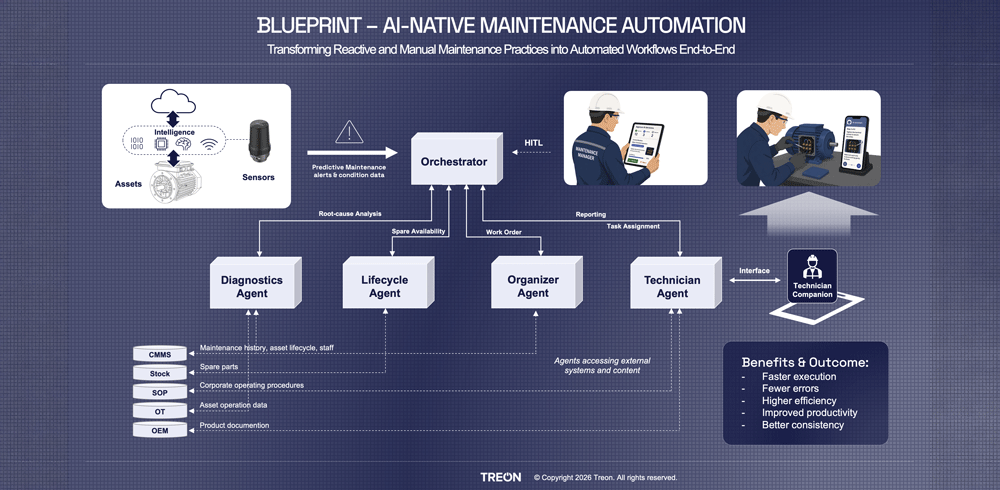
At the heart of automated maintenance is agentic orchestration. Rather than relying on humans to coordinate every step of the process, a network of specialized AI agents collaborates to execute maintenance workflows.
A Diagnostics Agent analyses incoming alerts, enriches them with contextual data, and identifies likely root causes. A Lifecycle Planner Agent evaluates long-term asset health and determines whether repair, overhaul, or replacement represents the best course of action. A Maintenance Organizer Agent schedules work, assigns resources, and optimizes execution. A Technician Agent supports field personnel by generating repair instructions and providing guidance throughout the intervention.
These agents are coordinated by an Orchestration Agent that maintains shared context, manages workflows, and ensures seamless collaboration across the entire system. Decisions that previously required numerous manual interactions can be completed automatically in seconds. Human roles evolve from coordinating work to supervising outcomes and continuously improving the system’s performance.
Automated maintenance is not about replacing people. It is about amplifying their capabilities. AI-powered companions provide intuitive interfaces that help technicians and maintenance teams interact with the underlying agentic system.
For field technicians, this means receiving assigned tasks, viewing complete asset histories, identifying required spare parts, and accessing location-specific guidance through a single application. AI companions can also provide step-by-step repair instructions, eliminating the need to navigate multiple systems or search through lengthy manuals.
By removing administrative and information-gathering tasks, AI allows technicians to focus on the work that creates value. It helps less-experienced workers perform with greater confidence and consistency while preserving institutional knowledge that might otherwise be lost through workforce turnover.
The future of maintenance is not simply predicting failures earlier. It is automating the entire maintenance workflow. The next phase of industrial transformation will extend automation beyond production lines and into maintenance itself – one of the last major workflows still dependent on manual coordination and decision-making.
By combining intelligent assets, contextual AI, agentic orchestration, and AI-powered productivity companions, organizations can transform maintenance into an autonomous process that spans fault detection, diagnosis, planning, execution, and validation. Every maintenance event generates structured insights that improve future decisions, enabling a continuous cycle of learning and optimization.
This shift represents more than incremental improvement. It marks the transformation of maintenance from industry’s last major manual workflow into an intelligent, scalable, and increasingly autonomous system. For industrial companies facing growing asset complexity and workforce constraints, automating maintenance may become one of the most important productivity gains of the coming decade.
ABOUT Treon
Treon is a global leader in AI-driven Smart Industry solutions, helping businesses boost productivity, enhance operational visibility, and long-term sustainability. Its fully integrated Prescriptive Maintenance cloud solutions combine advanced AI analytics, a mobile-first user experience, automated workflows, and wireless vibration sensors delivered as a managed service with scalable subscription pricing. Treon supports more than 200 customers worldwide across the manufacturing, material handling, and logistics sectors. Learn more at www.treon.fi.
Mikko Nurmimäki

Mikko Nurmimäki is Product Marketing Director at Treon, where he leads the customer value proposition and go-to-market for AI-driven predictive maintenance solutions in industrial sectors. He brings extensive experience in IoT, wireless technologies, semiconductors, telecommunications, and smart industry solutions. Prior to joining Treon, he held senior marketing roles at Silicon Labs, Spirent Communications, and Ericsson.
Text: Mikko Nurmimäki Photos: Mikko Nurmimäen arkisto
Subscribe to the free Maintworld newsletter here!
From Pilots to Impact

Industrial AI will not transform maintenance on its own. According to Martin Lundqvist, CEO of Arundo Analytics, lasting value comes when companies manage AI with the same discipline they already apply to their most critical assets.
Industrial AI will not create value simply by being powerful. According to Martin Lundqvist, the real breakthrough comes when companies start treating AI with the same discipline they already apply to critical assets.
It is three o’clock in the morning. Somewhere in a plant, a vibration alarm goes off on a critical compressor train. A maintenance technician is woken up and asked to decide. Is the compressor really in trouble, or is the sensor faulty? Should spare parts be ordered? Should production be slowed down? Should the assets be stopped immediately, or can the decision wait until morning?
For Martin Lundqvist, this is where industrial AI either proves itself or fails.
“AI needs to be seen as a way to make better decisions consistently and to do them in day-to-day operations,” he says.
Lundqvist spoke at EuroMaintenance 2026 in Luleå, Sweden. His presentation, From Pilots to Impact: How to Turn AI into Operational Advantage in Industrial Operations, explored why so many industrial AI initiatives fail to move beyond the pilot stage. His central message was simple: run AI like an asset.
According to Lundqvist, AI cannot be treated as another software experiment or an isolated IT project. It should be managed like any business-critical asset, with clear ownership, monitoring and lifecycle management.
“When companies implement AI into their maintenance processes, they should treat it much like they would a new piece of equipment,” he says.
To maintenance professionals, this way of thinking is nothing new.
“Maintenance isn’t behind on AI. AI is behind on maintenance.”
The maintenance profession has spent more than a century learning how to operate equipment that simply cannot fail. It understands ownership, operating envelopes, changing control and lifecycle management. Most AI initiatives, Lundqvist argues, lack exactly this kind of discipline.
The real opportunity lies in combining two worlds that have traditionally worked separately: advanced analytics and practical maintenance expertise.
“When you bring these two skills together, I have witnessed something very nice unfold.”
The timing could hardly be more important as industrial companies face labour shortages while experienced maintenance professionals retire in growing numbers. At the same time, maintenance teams sit on enormous amounts of operational knowledge that rarely comes together when critical decisions are made.
“We have a human skills issue, and we have a data coordination issue. Modern AI can help address both.”
Just a few years ago, AI in maintenance was largely associated with predictive maintenance and anomaly detection. Today, Lundqvist believes the frontier has shifted.
“The frontier has shifted from prediction to reasoning.”
An experienced maintenance engineer rarely bases a decision on a single vibration signal. Instead, they combine alarm histories, work orders, manuals, maintenance records, operating conditions and observations from previous shifts before deciding what to do.
Modern AI is becoming capable of working in much the same way. Rather than producing another prediction score, it can collect evidence, connect information and help people understand a situation more quickly.
“The promise is faster time to understanding.”
The value is not that AI suddenly becomes infallible. It does not. The value is that a technician who previously spent days collecting information can receive a structured overview in minutes, leaving more time for analysis and decision-making. But this is also where Lundqvist becomes cautious.
“You can’t just blindly trust the information.”
Unlike conventional software, AI systems are probabilistic. They sometimes connect the wrong dots or generate convincing but incorrect conclusions. In maintenance, where poor decisions can lead to production losses or even safety incidents, that matters.
“The better AI becomes at reasoning across industrial context, the more disciplined we must become about consequences.”
For that reason, Lundqvist argues that organisations should stop chasing perfect accuracy and instead focus on trustworthy decision support.
He summarises his approach in five practical principles: start with the decision, not the technology; design for consequences rather than perfect accuracy; add context instead of simply collecting more data; integrate AI into existing workflows; and ensure every recommendation is explainable.
The first principle is perhaps the most important. Many organisations begin with ambitions such as “we need more AI”. A better starting point is a concrete operational decision. For example: How should maintenance priorities for a critical compressor change based on its current condition? Once that decision is defined, it becomes much easier to determine who owns it, what information is required and where AI can genuinely improve the process.
The second principle is equally pragmatic: assume AI will sometimes be wrong. Rather than trying to build a perfect system, organisations should design one that fails safely and only makes recommendations when sufficient trusted information is available.
“Don’t spend forever trying to make the system perfect,” Lundqvist says. “Design for the consequences instead.”
Another common misconception concerns data. Many companies believe they lack sufficient data, while Lundqvist argues they usually lack context. A vibration measurement is simply a number until the system understands which compressor produced it, how it normally operates, what maintenance has recently been performed and how the asset fits into the wider production process.
“Context is what really unlocks AI. Not necessarily having more data but having better context.”
The fourth principle is one maintenance professionals immediately recognise. AI should become part of the existing workflow, not another destination. Manufacturing sites already have established ways of detecting problems, diagnosing faults and planning maintenance. Adding yet another dashboard simply creates another system to monitor.
“If everything you develop ends up sitting outside the workflow, then you’re not developing capabilities, you’re developing liabilities.”
Instead, AI should fit naturally into maintenance management systems, planning processes and control room routines.
The fifth principle is explainability. Maintenance engineers cannot simply accept a recommendation because an algorithm produced it. If AI suggests postponing maintenance or shutting down an asset, users need to understand why.
“If an AI recommends something that you can’t understand, you’re simply not going to follow it.”
Lundqvist has also noticed another common denominator in successful implementations. Almost every successful project has what he calls an AI ambassador. The role is rarely formal. It may be a maintenance engineer, a reliability specialist or someone from the data organisation. What matters is that the person understands the industrial process, has credibility within the organisation and genuinely believes data-driven decision support can improve operations. According to Lundqvist, that individual often makes the difference between an interesting pilot and a successful transformation.
Industrial AI has no shortage of pilots, it has a shortage of impact and many organisations choose the wrong problem to solve or develop AI in isolation from the people who understand the assets best. The result may be technically impressive but fails to fit everyday operations.
Maintenance offers a better starting point because the objectives are already clear: keep assets running, reduce failures, improve reliability and support production safely and efficiently. The same applies to measuring success. Rather than inventing new AI metrics, companies should continue using the KPIs that already matter.
“If AI doesn’t improve those KPIs, then why are you building it?”
Lundqvist believes organisations should ask three questions before scaling any AI solution. Has it measurably improved business performance? Do the people using it genuinely feel it helps them?
And can it realistically be deployed across multiple sites? Scaling, he emphasises, is not simply copying software from one factory to another. Each site has different equipment, maintenance practices, operating constraints and organisational cultures.
“Successful scaling means repeating the learning process rather than merely copying technology.”
One success story comes from a European PVC manufacturer. The company began by optimising production schedules according to changing electricity prices at a single site. After proving the concept, it expanded the solution across eight plants, generating approximately eight million euros in annual savings within twelve months.
According to Lundqvist, one reason for that success was that AI did not arrive as a stand-alone digital initiative. The company already had a strong Operational Excellence programme, and AI became another tool supporting continuous improvement.
That may be the most important lesson of all. Successful industrial AI is less about technology than operational discipline. It succeeds when organisations treat AI as another capability to be managed rather than another innovation to be demonstrated.
Lundqvist is equally careful not to exaggerate where AI is heading. He does not expect maintenance professionals to disappear or fully autonomous “lights out” factories to become commonplace any time soon. Instead, he imagines what he calls a “dimmed lights” factory where maintenance professionals remain firmly in control but increasingly work alongside AI agents capable of gathering evidence, reviewing documentation, analysing operational data and presenting structured recommendations.
“AI recommends, humans decide. It is a future based on augmentation rather than replacement.”
Experienced maintenance engineers, Lundqvist believes, are better prepared for that future they may realise. Their profession has always required balancing uncertainty, interpreting incomplete information and making decisions with significant consequences. Those are precisely the skills needed to govern industrial AI responsibly.
His conclusion is ultimately optimistic. Industrial companies do not need to reinvent themselves before embracing AI. Many of the capabilities they need already exist inside their maintenance organisations: ownership, accountability, operational discipline and a culture of continuous improvement. The challenge is to recognize that the same principles apply to artificial intelligence. Because in the end, successful AI is not measured by how intelligent it appears. It is measured by whether the people on shift trust it enough to make better decisions. And that, Lundqvist believes, is something maintenance professionals have been mastering for decades.
Five disciplines for trustworthy industrial AI
1. Start with the decision Define the operational decision AI should improve before selecting technology.
2. Design for consequences Assume AI will occasionally be wrong and build safeguards around its recommendations.
3. Context beats more data The missing ingredient is usually context rather than additional data.
4. Integrate AI into existing workflows Support existing maintenance processes instead of creating separate dashboards.
5. Make recommendations explainable Engineers need to understand why AI suggests a particular action before they can trust it.

Martin Lundqvist
Martin Lundqvist is CEO of Arundo Analytics, an AI software company helping asset-intensive industries improve maintenance, reliability and operational performance through advanced analytics and artificial intelligence.
Before joining Arundo, he was a Partner at McKinsey & Company, leading digital and analytics initiatives across industrial, telecom, banking and the public sector. He holds an MSc in Industrial
Engineering and Management from Linköping University and studied Computer Science at ETH Zürich.
Text: Mia Heiskanen Photo: Martin Lundqvist photo archive, SHUTTERSTOCK
Subscribe to the free Maintworld newsletter here!
If Everything Is Critical, Nothing Is: Fixing Asset Criticality at Its Root
Ask any asset manager or reliability engineer about the biggest hurdle in developing effective asset integrity management programmes, and the honest answer is rarely a shortage of standards or software.
It is the sheer, grinding effort of criticality assessment. In a world-scale plant carrying tens of thousands of tagged items, ranking every pump, valve, transmitter and gauge one by one is slow, subjective and, worst of all, inconsistent. Two competent engineers assessing the same loop will often disagree, and by the time the exercise is finished, the plant has already changed.
I have spent much of my career convinced that this bottleneck is self-inflicted. If your maintenance team is stuck in constant firefighting, its backlog forever crowded with “high-priority” work orders, the first place to look is your criticality ranking, not your people. The problem is not that risk ranking is hard. It is that we ask the wrong layer of the plant the wrong question.
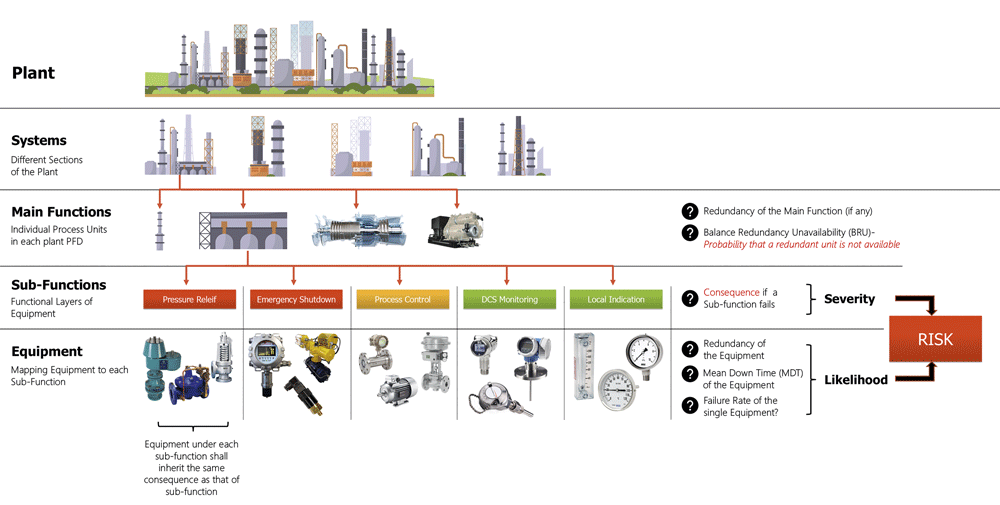
Stop asking equipment about consequence. Consequence, the severity of a failure, is not really a property of a valve or a transmitter. It is a property of what that item is trying to achieve. A pressure-relief valve and the small pressure gauge beside it may look worlds apart, but if both serve the same overpressure-protection function, the consequence of losing that function is identical.
So why assess it twice?
That single observation reframes the whole exercise. Instead of moving through a plant device by device, we decompose it functionally: Plant → Systems → Main Functions → Sub-Functions → Equipment. Each system is a recognisable section of the plant. Each main function is an individual process unit on the PFD. Each sub-function is a functional layer of protection or control: pressure relief, emergency shutdown, process control, DCS monitoring, local indication. Every piece of equipment is then mapped to the sub-function it serves.
The pay-off is what I call consequence inheritance. Severity is assessed once, at the sub-function level, where it genuinely lives. Every item beneath that sub-function automatically inherits the same consequence. A complex having tens of thousands of tags collapses to a manageable set of sub-functions, and the ranking is consistent by construction, because it is derived rather than re-argued. Assess the severity of the consequence of “emergency shutdown of Unit 200 failure” once, and all the associated equipment like trip valves, the logic solver and the field transmitters carry that consequence without a single extra debate.
The scale effect is striking. A process unit holding two or three thousand tagged items typically resolves to only a few sub-functions. Consequence is settled at that level in an afternoon rather than a quarter, and because the logic is transparent, an auditor can trace it end to end without re-opening every equipment. The effort is spent where judgement adds value, defining functions and their failure consequences, instead of being burned on repetitive, error-prone data entry.
Let equipment answer the question it can. Equipment cannot tell you consequence, but it can tell you likelihood. Here we work with the information about the equipment: its failure rate, its redundancy, and its mean down time (MDT), which is how long the plant stays exposed while a failure is repaired.
Redundancy deserves particular care. A duty-standby arrangement only protects you if the standby is genuinely available. I therefore fold in Balance Redundancy Unavailability (BRU): the probability that a nominally redundant unit is, in fact, not available when called upon. Redundancy assumed on paper but unavailable in practice is one of the quieter ways integrity programmes are lulled into false confidence.
Combine an inherited severity with a computed likelihood and you have risk, plotted directly onto the organisation’s own risk matrix. Nothing exotic: just a defensible, repeatable position in every cell, traceable back to the function it protects.
None of this is improvised. The framework is anchored in NORSOK Z-008 for risk-based maintenance prioritisation and ISO 14224 for the reliability and failure-data taxonomy that feeds the likelihood calculation. Standards give the method credibility with auditors and, just as importantly, portability between plants and between assessors. The entire workflow can be automated in a purpose-built Excel engine, turning what was once a multi-week manual campaign or a highly priced outsourced service into an assessment that can be run, reviewed and refreshed as the plant evolves.
The outcomes speak in the language leadership cares about: faster completion, consistent rankings, inspection and maintenance effort steered toward the equipment that genuinely carries risk, and, critically, a rationale you can defend in front of a regulator or an insurer.
We are entering an era where sensors, data and algorithms promise to run our maintenance decisions for us. But an algorithm fed inconsistent criticality will simply optimise the wrong things faster and at greater scale. The discipline of asking each layer of the plant only the question it can honestly answer (consequence from function, likelihood from equipment) is exactly what keeps that emerging intelligence pointed in the right direction.
High-performance asset integrity is not about assessing harder. It is about assessing smarter, once, and letting structure carry the rest.
Text: Shaiq Bashir Photo and figure: Shaiq Bashir PHOTO ARCHIVE

Shaiq Bashir
Shaiq Bashir is Instrument Engineering Lead (Major Projects) at Qatar Fertiliser Company (QAFCO), with over 17 years in asset management, instrumentation, automation and asset integrity management across world-scale chemical facilities. A Chartered Engineer (Engineers Ireland and Engineers Australia), TÜV-certified Functional Safety Engineer and Certified Reliability Leader, he has deep experience developing, implementing and auditing asset strategies, maintenance regimes and performance programmes.
Subscribe to the free Maintworld newsletter here!
Machines That Understand Maintenance: How LLMs and RAG Are Rewriting Diagnostics, Troubleshooting, and Field Support

The sentient computer HAL 9000 in Stanley Kubrick’s 1968 film 2001: A Space Odyssey remains one of cinema’s most memorable visions of artificial intelligence. HAL knew the spacecraft around it, monitored systems, interpreted events, related information to the operational world in which it was acting, and relayed information to the crew.
They are not HALS, but today’s machines can talk convincingly about engineering. A Large Language Model (LLM) can explain cavitation, bearing defects, or motor overheating and produce a plausible troubleshooting sequence. It gets more interesting when we move from asking our LLM “What causes high vibration in a centrifugal pump?” to asking it “Why is P-204 vibrating today?”
Answering the first requires general knowledge about pumps. Answering the second requires more specific knowledge of a particular physical asset: its configuration, current operating state, previous failures and interventions, alarms, measurements, and manufacturer recommendations. Knowing about pumps is not the same as knowing this pump.
To be useful to maintenance, our LLM must have the ability to determine what knowledge and evidence apply to a particular asset, in a particular condition, at a particular moment, and what actions legitimately follow from that knowledge and evidence. The challenge is to get it to relate knowledge and evidence to this machine, in this condition, now.
The knowledge we already have. Maintenance organizations have spent decades becoming digital, accumulating condition monitoring systems, CMMS/EAM databases, and predictive models. Yet when a difficult failure occurs, one person still searches a manual, another hunts for an old work order, and eventually somebody asks, “Who worked on this machine last time?”
The problem is fragmentation. Manuals, CMMS, condition monitoring, FMEA/RCM, alarms, procedures, and human experience collectively form an enormous technical memory, but the engineer must still reconstruct the scenario. Organizations do not simply need more data; they need better ways to convert distributed technical memory into decision-relevant evidence when it matters.
Generative AI offers a way to access this memory, allowing technicians to interrogate technical knowledge in ordinary language. The trap is that model fluency can make us confuse the ability to formulate an answer with the possession of evidence needed to defend it.
Fluency is not evidence. An LLM may explain bearing lubrication perfectly without knowing which lubricant was actually applied. It may generate a beautifully structured maintenance instruction while being unaware that the OEM revised the procedure six months ago. It may provide a tightening torque that looks entirely plausible but has no defensible source
LLMs are exceptionally good at producing plausible language, but linguistic plausibility is not engineering validity. Once generated, language influences physical decisions; hallucination stops being a natural language processing quality issue and becomes a question of decision integrity, reliability, and operational risk.
This is where Retrieval-Augmented Generation (RAG) becomes important. Rather than relying exclusively on information encoded inside the model, RAG retrieves relevant material from authorized sources before constructing an answer. In maintenance, those sources may include manuals, procedures, work orders, inspections, historical failures, and standards.
But retrieval alone does not amount to understanding. Consider our vibrating P-204. A general LLM can explain why pumps vibrate. A RAG system can retrieve what the OEM says about this pump family. A contextual system can determine whether P-204 itself has experienced this pattern before and under what conditions. An investigative system can ask which measurement would best discriminate between competing hypotheses. A trustworthy system can then take the accumulated evidence and determine whether it is sufficient for a recommendation and whether it has authority to do anything with that recommendation.
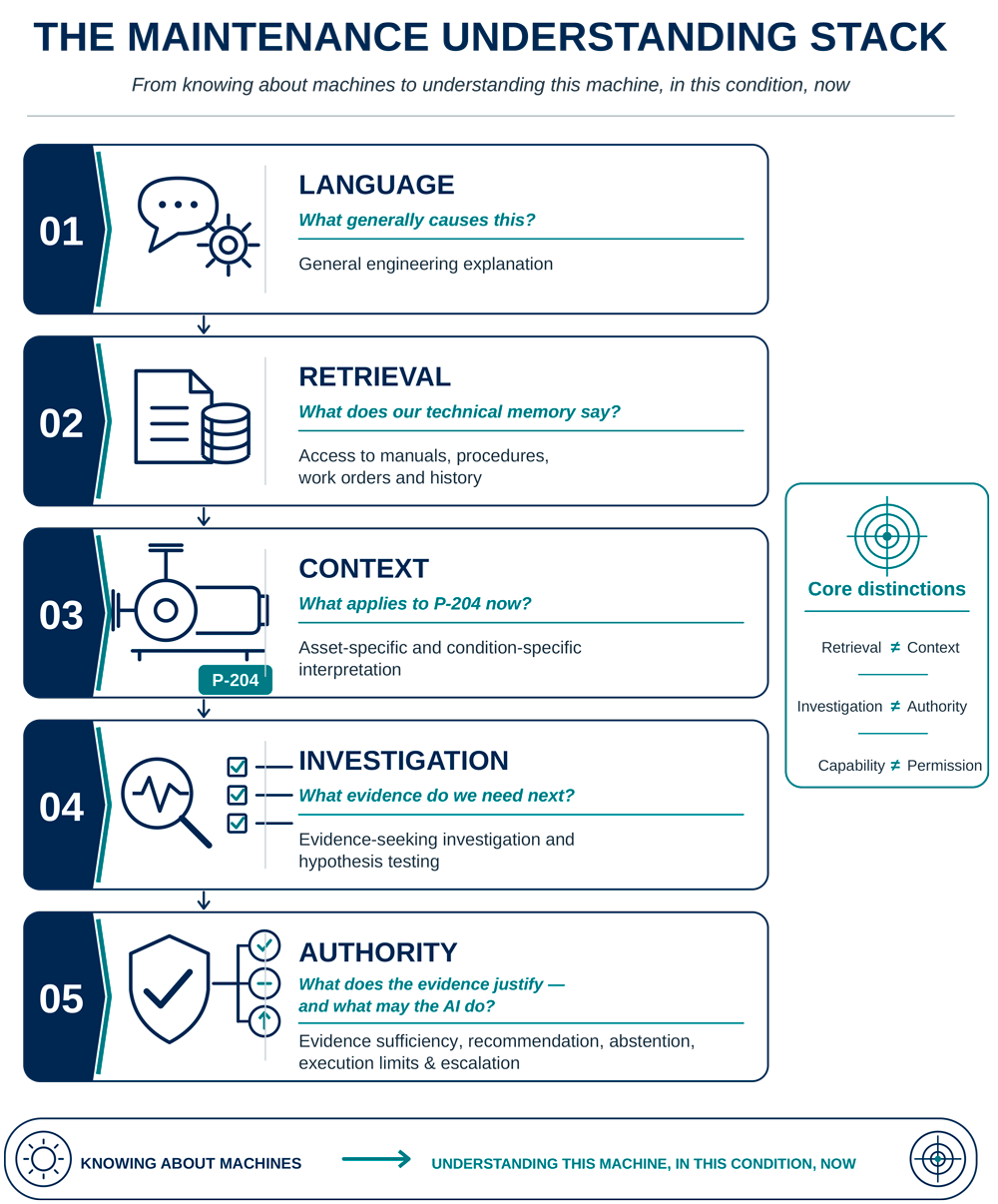
Together, these capabilities form what I call the Maintenance Understanding Stack: Language, Retrieval, Context, Investigation, and Authority.
Language covers general engineering knowledge; retrieval accesses technical memory; context determines what applies to P-204 now; investigation identifies what evidence is needed next; authority asks what the evidence justifies and what the system may do.
This is not an AI maturity staircase climbing towards autonomy. The levels represent increasingly demanding claims about knowledge and legitimate action. A system may retrieve the correct manual without establishing that it applies to P-204; an agent may investigate effectively while still lacking enough evidence for a decision, and a justified recommendation may remain outside its authority.
Retrieval is not context. Investigation is not authority. Capability does not imply permission.
Maintenance knowledge is relational. Connecting an LLM to thousands of PDFs is not enough because maintenance knowledge is relational, not merely textual. A useful chain looks like asset • condition • symptom • evidence • failure hypothesis • action. Semantic retrieval can find related material, while exact identifiers, alarm codes, and structured relationships help determine what actually belongs to the case at hand.
For the engineer, the requirement is simple: a recommendation must be traceable backwards through an evidentiary chain: recommendation • reasoning • evidence • original source or measurement. A fluent explanation is not enough. If the system recommends checking the coupling of P-204, the engineer should be able to inspect the spectrum, procedure, inspection result, or work order supporting that recommendation. And if several causes remain plausible, the system should identify what observation would discriminate among them, not jump from similarity to diagnosis.
Sometimes the most intelligent answer is “I don’t know”. Suppose the technician asks whether P-204 can continue operating until a planned shutdown the following morning. The system retrieves the manual, previous interventions, and similar cases, but discovers that the latest vibration spectrum is 12 hours old ,and the current operating load is unavailable.
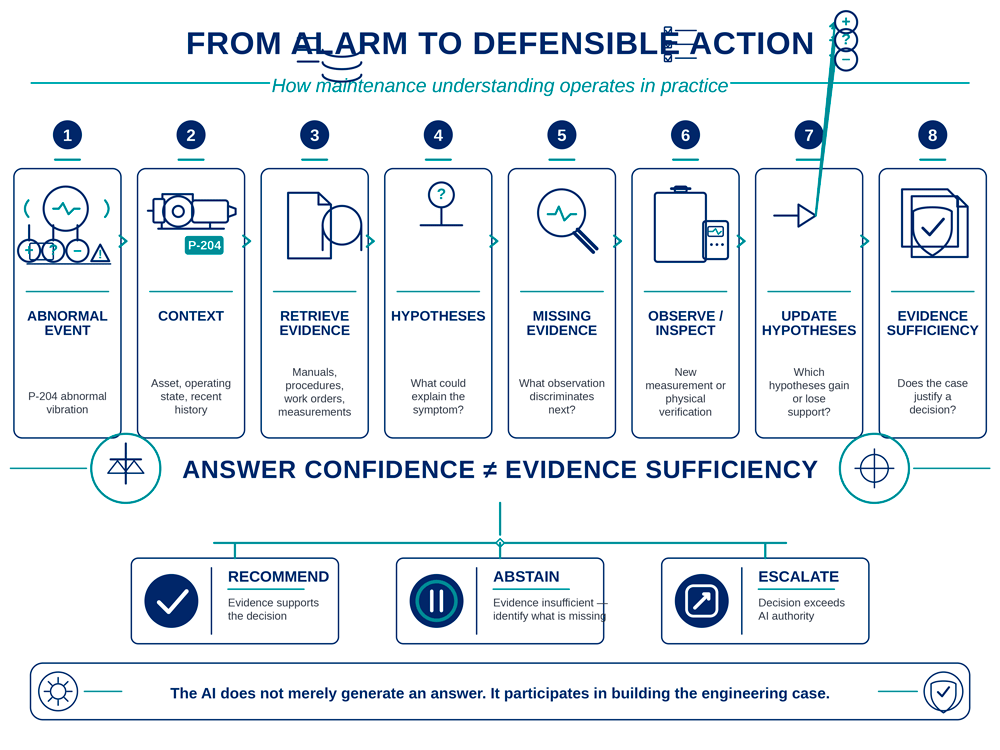
A conventional chatbot is optimized to answer the question of shutdown. But a trustworthy maintenance system should recognize a different problem: answer confidence and evidence sufficiency are not the same thing. The relevant question is not “Can the model answer?” but “Does the evidence available now justify the decision being requested?”
The correct response may be to withhold the continued-operation recommendation, explain why it cannot yet be justified, and request a current spectrum and operating load. Once those observations arrive, the investigation can resume.
I call this engineering-aware abstention: the ability to withhold a recommendation because evidence is insufficient while identifying what additional observation or measurement is required. This is stronger than simply saying “I am uncertain.” A competent industrial assistant should know what is missing, why it matters, and what should be obtained next.
In maintenance, intelligence is not only knowing an answer. It is knowing when the evidence is insufficient to answer.
From retrieval to investigation. The next step is agency. The distinction is simple but fundamental: RAG gives the system access to relevant knowledge. Agency allows it to use that knowledge in pursuit of an objective.
To solve the riddle of P-204, this means participating in an evidence-seeking investigation. The abnormal vibration is observed; relevant history and procedures are retrieved; plausible hypotheses are considered; missing or discriminating evidence is identified; a measurement or inspection is requested; the result updates the hypotheses; the system then recommends, abstains, or escalates according to the strength of the case.
The sequence is essentially observe • retrieve • hypothesize • identify missing evidence • obtain evidence • update • recommend / abstain / escalate. What matters is that the AI participates in the process by which the engineering answer is reached. It does not merely produce a better paragraph at the end.
The LLM does not replace vibration analysis, reliability models, CMMS/EAM, FMEA, RCM, or physical inspection. Specialized systems still produce engineering evidence; the role of
LLM/RAG/agentic systems is to connect, contextualize, retrieve, interpret, and orchestrate their outputs around the problem being investigated.
Authority is part of intelligence. A system capable of investigating a problem is not necessarily allowed to act on its conclusion. Capability does not imply permission. Depending on criticality, consequence, uncertainty, evidence quality, and organizational rules, the system may inform • recommend • prepare • request approval • execute within defined authority • escalate. Authority belongs inside the Maintenance Understanding Stack. A technically defensible recommendation does not automatically confer the right to execute it. Nor should human-in-the-loop be treated as an inconvenience that disappears when AI improves. For many industrial decisions, human-governed agency may be the correct final architecture. Humans retain physical verification, judgement, consequence assessment, and accountability; machines assume more of the burden of finding and connecting knowledge.
A model of intelligent machines that is perhaps closer to what maintenance actually needs is KITT, a car with AI in the TV series Knight Rider. KITT was extraordinarily capable: it monitored the vehicle, interpreted situations, warned protagonist Michael Knight, proposed actions, and intervened when necessary. Yet the partnership mattered as much as the intelligence. KITT was not valuable because it eliminated the human from the loop, but because machine capability and human judgement complemented each other. Industrial maintenance may ultimately require something similar: not autonomous machines replacing engineers, but increasingly capable technical partners operating within clearly defined boundaries of evidence and authority.
When the technical memory of the organization becomes active. Today, the engineer often acts as the mediator between maintenance information systems, synthesizing their input. To understand a difficult event, the engineer moves among condition monitoring, historian, CMMS/EAM, inspection records, manuals, and previous interventions, mentally reconstructing a coherent picture from systems that were never designed to reason together.
The deeper opportunity is to create a cognitive integration layer over the technical memory of the plant.
The manuals, measurements, work orders, failure histories, procedures and engineering analyses already exist. Traditionally, that technical memory is passive: it waits until a human knows where to look and how to reconstruct its relevance. An active technical memory can participate in determining what knowledge applies to P-204, what evidence is missing, what should be investigated next, and what the accumulated information actually justifies.
The real disruption of generative AI in maintenance may not be that machines become better at answering questions. It may be that the accumulated technical memory becomes an active participant in maintenance decisions.
Prediction can tell us that something may fail. Specialized diagnostics provide evidence about what is happening. Retrieval connects that evidence with technical memory. Context determines what applies to this asset now. Investigation seeks what is still missing. Authority determines what legitimately follows. Humans retain judgement and assume responsibility for consequences.
Ultimately, industrial maintenance needs something less theatrical and more useful than HAL 9000. It needs a system that knows which asset to focus on, connects events with defensible evidence, recognizes when that evidence is insufficient, understands the limits of its authority, and knows when a human must decide.
At that point, machines will stop merely talking about maintenance and begin, in a meaningful industrial sense, to understand it.
Text: Prof. Diego Galar Figures: Prof. Diego Galar Photo: shutterstock
Subscribe to the free Maintworld newsletter here!
When knowledge walks out the door

As experienced maintenance professionals retire, decades of knowledge can disappear with them. European master’s Thesis Award winner Louis Morias believes generative AI could help industrial companies preserve that expertise, but technology alone is not the answer.
For Louis Morias, one of the biggest opportunities for artificial intelligence in maintenance has little to do with replacing people. It is about retaining what people know.
During his research into generative AI in industrial maintenance, Morias repeatedly encountered the same concern: experienced operators and technicians may have accumulated decades of knowledge about machines, failures and solutions, yet much of it has never been formally documented.
“You have people who have been in the same company for 20 or 30 years. They know everything. They don’t need documentation because they simply know how things work,” Morias explains.
The problem becomes particularly visible when rare failures occur. An experienced technician may have encountered the same problem two or three times during a career, even if it happens only once every five or ten years. A newcomer has no such history to draw on, and the answer may exist only in someone else’s memory.
Morias explored this challenge in the research that earned him the European Master’s Thesis Award at EuroMaintenance 2026 in Luleå. His academic path combines business engineering and data analytics with a second master’s degree focusing on smart operations and maintenance. His interest in industrial environments began through Formula Student, where working with real-world data showed him how different industrial analytics can be from the relatively clean datasets found in sectors such as banking or retail.
His research also revealed an interesting divide in attitudes towards AI. Maintenance service providers tended to see it as an immediate business opportunity, while manufacturing companies responsible for their own maintenance were considerably more cautious. Service providers expected AI to have an impact quickly; manufacturers were more likely to talk first about pilots and only later about production use.
“Agentic AI combined with maintenance technologies, could help industry operate with fewer people as the workforce ages.”
Yet Morias sees practical applications already emerging. Root cause analysis reports and historical maintenance information can be digitalised and incorporated into AI-based systems, allowing technicians to search for previous incidents and identify possible causes and solutions much faster. The challenge is that many organisations must first create a knowledge base on which such systems depend.
“You cannot start from scratch and simply say, ‘I’m going to build an AI solution.’ You have to make sure the knowledge that gives your company its competitive edge is in the system.”
Concerns about hallucinations should not prevent experimentation either, he argues. With appropriate guardrails, source information and human validation, AI does not need to be perfect to create value. Even when an expert must verify its recommendation, substantial time can still be saved.
Looking ahead, Morias expects the discussion to move increasingly from generative AI towards agentic AI, where systems can reason through more complex problems and take actions autonomously. Combined with sensor data and other maintenance technologies, this could eventually help industry operate effectively with fewer people as Europe’s workforce ages.
Receiving the award in Luleå was an unexpected honour for Morias, and EuroMaintenance itself also made an impression. It was his first time at the event, which he describes as well organised and rich in interesting speakers and conversations. He particularly valued meeting maintenance professionals from Belgium and the Netherlands and learning more about industry in northern Sweden and Scandinavia.
The prominence of AI throughout the conference also reflected how quickly the conversation has changed.
“When I started my thesis, AI was still much more of a niche subject. Now it is becoming mainstream, and people everywhere are asking where it is going in their own industry.”
For Morias, that question has a distinctly European dimension. If industry can use AI to preserve expertise, improve productivity and compensate for demographic change, he believes it could become an important part of maintaining Europe’s competitiveness.
Subscribe to the free Maintworld newsletter here!