
Circular sludge systems don’t fail on technology—but do on insufficient maintenance
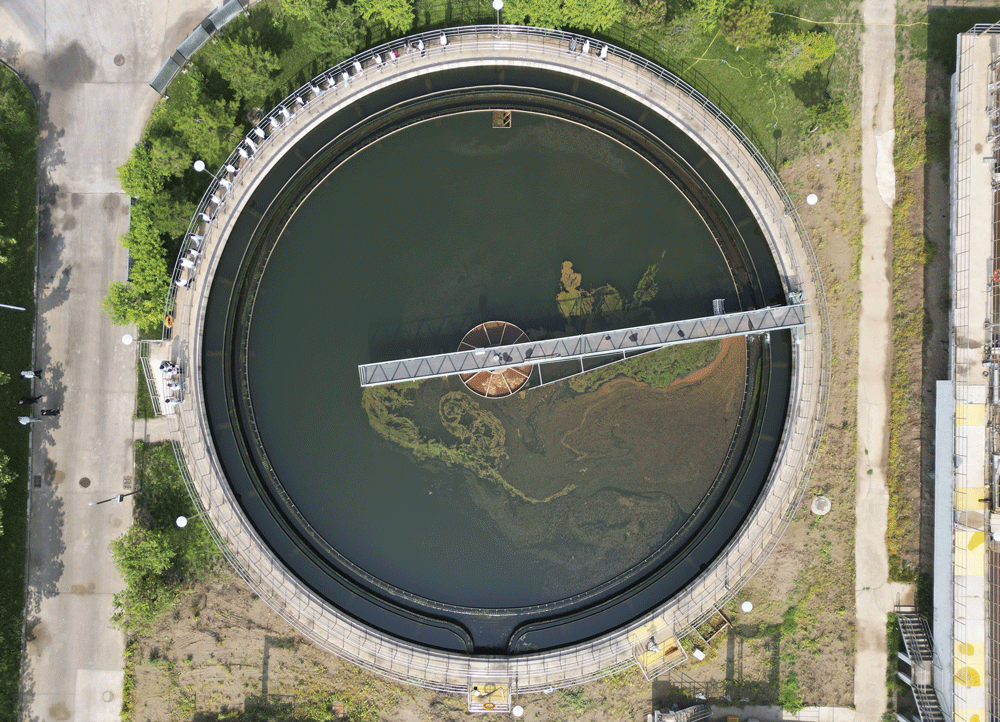
In wastewater treatment, the circular economy depends less on new technology than on the ability to keep existing systems running consistently and without interruption.
Globally, the amount of municipal sewage sludge produced each year is growing rapidly as cities expand, living standards rise, and wastewater treatment infrastructure continues to develop. At the same time, traditional disposal methods such as landfilling and incineration are increasingly viewed as unsustainable, driving the sector toward resource recovery as the new standard for sludge management.
“This is not just a conceptual change. It is an operational one,” says Water & Sanitation Expert Eng. Ayman Abdallah AbuRowaa in a previous Maintworld article, Sewage Sludge Isn’t Waste Anymore—Utilities Are Becoming Resource Factories (MW2/26).

Across the world, wastewater utilities are investing in circular sludge systems designed to recover these resources and reduce environmental impact.
Yet the performance of these systems rarely depends on innovation alone. In practice, it depends on something far less visible: maintenance discipline, AbuRowaa says.
On paper, circular sludge systems seem straightforward: anaerobic digestion produces biogas, nutrient recovery systems extract phosphorus, and advanced processes convert residuals into usable products.
In practice, however, these processes only deliver their promised value when operated within narrow stability windows. Advanced wastewater treatment can recover energy (biogas), fertilisers, minerals, and metals embedded in the wastewater stream—but only when systems are reliably maintained and operated.
“The digester, for instance, is really a living reactor. The methanogens doing the work are slow-growing and fussy about their environment, so most maintenance is about keeping conditions boring and stable,” AbuRowaa notes.
That “boring stability” is, in reality, what determines whether circularity succeeds or fails.
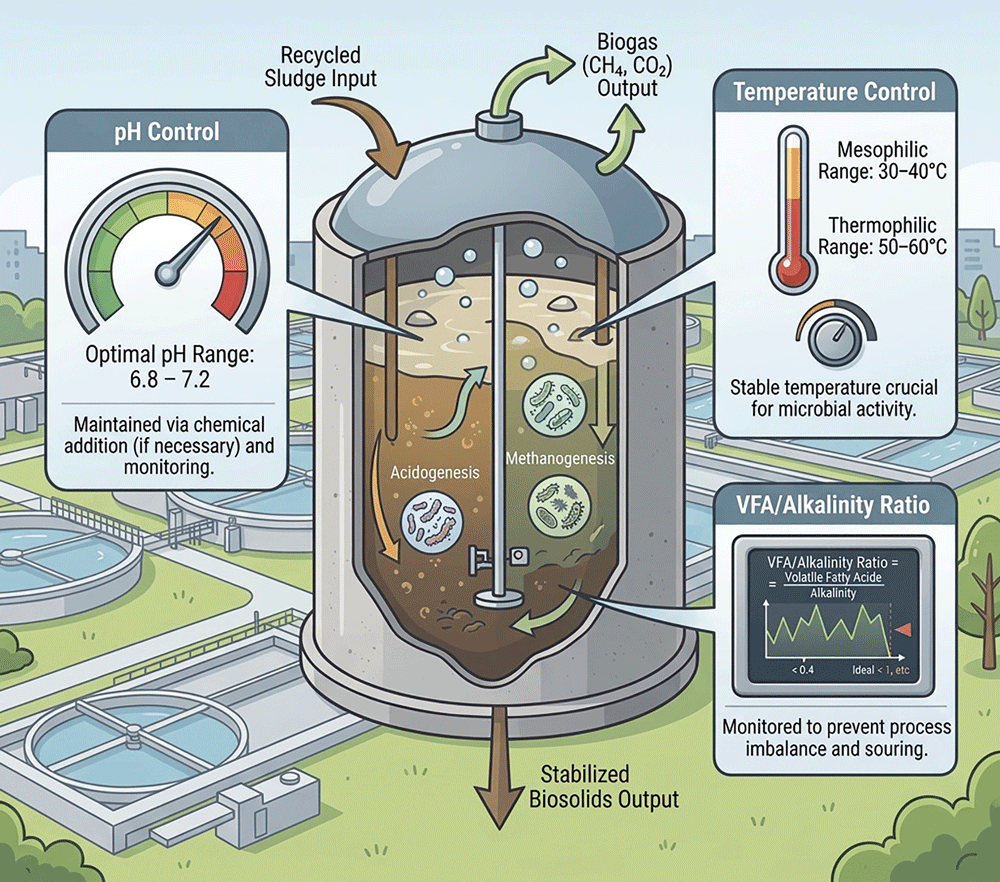
The anaerobic digester, for instance, which is the core unit in many circular sludge systems, requires tightly controlled operating conditions. Operators of the system must keep pH within a narrow range of roughly 6.8–7.2, maintain stable temperatures in either the mesophilic (30–40°C) or thermophilic (50–60°C) range, and closely monitor the ratio of volatile fatty acids (VFAs) to alkalinity.
“A sudden rise in VFAs is often an early warning sign that acid-producing bacteria are outpacing the methanogens responsible for methane production—a situation that can quickly lead to process failure if left unchecked,” AbuRowaa stresses.
Studies on anaerobic digestion performance consistently show that even small deviations in temperature, organic loading rate, or alkalinity can reduce methane yields by tens of per cent and trigger significant process upsets.
This highlights a key reality of the process: the challenge is not the technology itself but the ability to keep it operating within narrow, tightly controlled parameters.
When these conditions are maintained, biogas recovery from wastewater and sludge can deliver substantial energy output. Case studies demonstrate an annual generation potential of around 130
GWh from combined heat and power (CHP) recovery at a single wastewater treatment plant, while also avoiding tens of thousands of tonnes of CO₂-equivalent emissions each year.
If anaerobic digestion is the biological heart of circular sludge systems, dewatering is the economic hinge.
Dewatering reduces the water content of sludge before transport, further treatment, or disposal. Technologies such as belt presses, centrifuges, and filter presses are commonly used to separate solids from liquids.
At first glance, dewatering appears to be a mechanical step. In reality, it has system-wide consequences.
Even relatively small deviations in performance can significantly alter downstream economics. A small increase in moisture content can raise transport costs, increase energy consumption in drying processes, and reduce the efficiency of subsequent treatment stages.
AbuRowaa notes that because sludge is heavy and expensive to transport, these changes compound quickly. A few percentage points of additional water content can shift an entire project from profitable to marginal.
“Dewatering is often a prerequisite for further treatment, which means a clogged belt press or a fouled membrane can stall the entire recovery chain. Even a 2–3% drop in dry solids content can increase transport costs by 10–15% and raise thermal drying energy demand by up to 25%,” AbuRowaa explains.
He adds that dewatering equipment is also highly sensitive to wear, fouling, and misalignment. Without consistent maintenance, performance gradually declines rather than failing abruptly. This can make problems harder to detect until costs have already increased.
Struvite precipitation is another key process technology in circular sludge systems, used to recover phosphorus from wastewater as magnesium ammonium phosphate (MAP). When properly controlled, it produces a marketable slow-release fertiliser and helps reduce scaling in downstream equipment.
However, the same chemistry that enables recovery can also create operational challenges.
Struvite forms when the concentrations of magnesium, ammonium, and phosphate reach supersaturation. Under controlled conditions, crystallisation occurs in dedicated reactors, allowing struvite to be harvested as a product. When control is lost, precipitation occurs in unintended locations such as pipes, pumps, and centrifuges.
This uncontrolled scaling can restrict flow, increase pumping energy demand, and lead to blockages that require mechanical cleaning or equipment shutdowns.
The key challenge is operational precision. Struvite systems require tight control of reagent dosing, mixing intensity, and supersaturation levels. Even small deviations can shift the system from targeted crystallisation to uncontrolled deposition.
As AbuRowaa notes, the chemistry itself is not the issue. The difficulty lies in maintaining stable operating conditions within narrow limits over extended periods.
Across anaerobic digestion, dewatering, and nutrient recovery, a common pattern emerges: performance is governed less by design and more by upkeep.
Circular sludge systems are often presented as technological upgrades—install a digester, add nutrient recovery, optimise outputs. But in reality, they are continuous biological and chemical environments that respond constantly to operational conditions.
“Anaerobic digesters and struvite reactors are running 24/7,” AbuRowaa says. “They punish neglect.”
Maintenance in this context is not limited to repairing equipment after failure. It includes monitoring, calibration, cleaning, process control, and early detection of deviations. It is what keeps systems within the narrow boundaries where they function effectively.
When maintenance is strong, circular systems deliver reliable energy production, stable nutrient recovery, and predictable operating costs. When it is weak, even advanced technology cannot compensate.
The idea of the circular economy in wastewater treatment is often associated with innovation—new reactors, new separation technologies, new recovery pathways. But the reality is more grounded.
Circularity depends on stability. Stability depends on maintenance.
Technology defines what is possible. Maintenance determines what is achieved.
In sludge systems, the difference between success and failure is rarely found in design documents or equipment specifications. It is found in day-to-day operational discipline: maintaining steady temperatures, preventing fouling, maintaining balance in biological systems, and ensuring that small deviations do not become system-wide failures.
In the end, circular sludge systems do not fail because they are too complex. They fail when they are not kept stable enough to work at all.
Maintenance failures in sludge systems do more than disrupt operations, AbuRowaa stresses. They can also undermine the environmental benefits that circular economy initiatives are designed to deliver.
“A linear plant with excellent maintenance produces better environmental outcomes than a circular plant with poor maintenance.”
Life cycle assessment (LCA) studies support this view. Optimised maintenance practices can reduce greenhouse gas emissions by up to 25% without requiring any new technology investments. The
Massahi et al. (2023) review confirms this: innovative sludge management technologies can significantly reduce GHG emissions, with sludge-as-feedstock for energy production that replaces fossil fuels and yields substantial reductions in net emissions. Conversely, environmentally damaging traditional methods that require high energy inputs amplify the carbon footprint of the entire wastewater sector.
Next issue MW 4/26: The Future of Sludge Management: From Resource Recovery to Contaminant Control. We continue our circularity theme by exploring how emerging contaminants are reshaping sludge management and why sludge has become an increasingly important part of climate policy.
Text: Nina Garlo-Melkas Photos: HSY, Ayman Abdallah AbuRowaa



Subscribe to the free Maintworld newsletter here!
Latest