
Huawei Launches Intelligent RAIL 2.0 at InnoTrans 2026
Huawei aims for a “new generation” of scenario-based solutions targets construction, passenger and freight transport, and maintenance.
At InnoTrans 2026, the world’s largest rail transport exhibition held from September 22 to 25, Huawei unveiled Intelligent RAIL 2.0, a new generation of solutions designed to provide multi-scenario intelligent solutions for the global rail industry. The launch event brought together industry organizations such as UIC (International Union of Railways) and UITP (International Association of Public Transport), along with global customers and ecosystem partners, to explore the future of the industry.
Industry voices on digital foundations and AI standardization
Jean-Michel Evanghelou, Director Digital Systems & Innovation, and Financial Control & Project Operations from UIC, stated that FRMCS will be the first step for rail operators to build a solid digital foundation. He added that AI applications will continue to deepen and integrate into the core systems of the rail industry, making the standardization of AI applications increasingly important.

Mohamed Mezghani, Secretary-General of UITP, and Lidia Signor, Head of Multimodal Transport at UITP, also attended the event. Lidia Signor delivered a speech titled “Global Metro AI Intelligence and Automation,” highlighting that UITP, in collaboration with the China Association of Metro (CAMET), has released a research report titled “AI-Driven Smart Rail Transport.” The report showcases how AI solutions have been deployed in various systems, including metro construction, operation and maintenance, improving the operational efficiency and safety levels of rail transport systems.
Industry trends point toward intelligence and integration
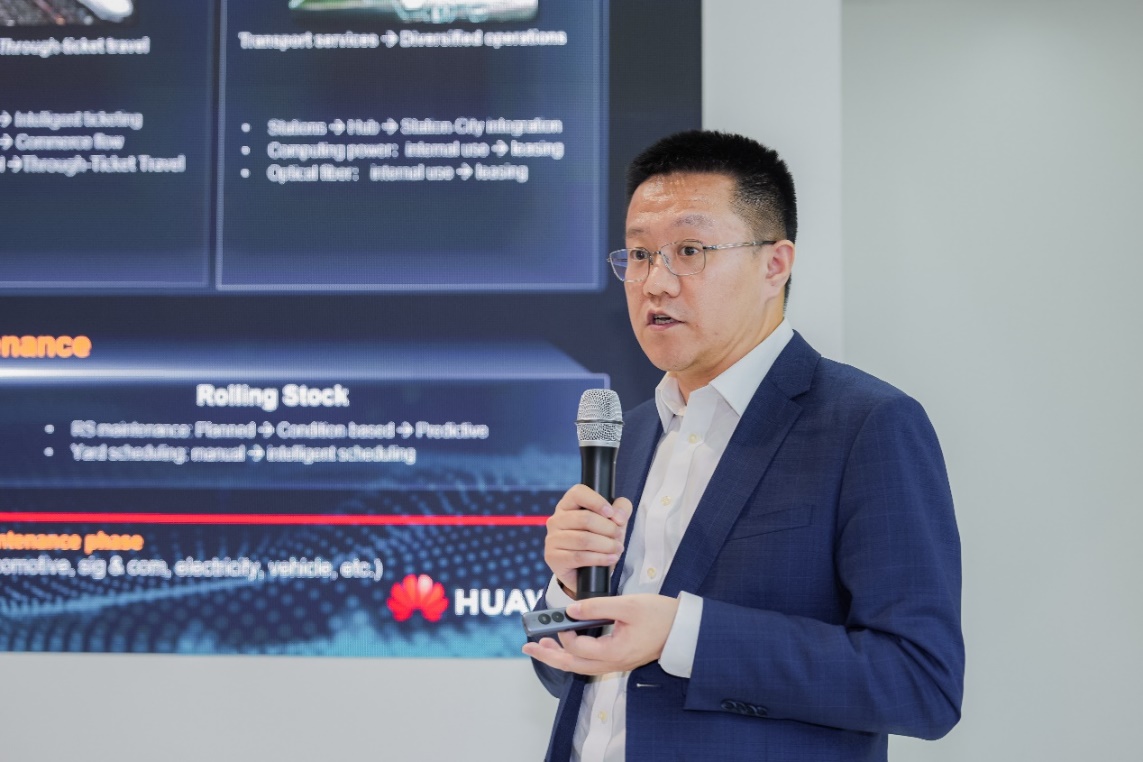
In his keynote speech, Raymond Zuo, President of Huawei’s Smart Rail BU, pointed out that as human society enters the era of intelligence, more and more stakeholders are exploring ways to integrate digital and intelligent technologies into their core business processes to address traditional pain points. Looking at the trends, infrastructure will evolve from GSM-R to FRMCS, equipment maintenance will shift toward condition-based and predictive maintenance, freight will develop toward an end-to-end service-oriented logistics model that includes multimodal transport, passenger services will move toward seamless travel experiences, and engineering construction will increasingly adopt digital and intelligent technologies to enhance safety and operational efficiency.
The “intelligent RAIL” strategy and RAIL 2.0
Based on its innovative practices with leading global customers, Huawei has proposed the “intelligent RAIL” innovation strategy. This strategy leverages digital and intelligent technologies to continuously enhance railway safety (Reliable), efficiency (Automated), integrated services (Integrated-serviced) and long-term evolution (Long-termed). By defining key technologies across generations, Huawei launched the new generation Intelligent RAIL 2.0 at the conference, which includes 20 scenario-based solutions.
These solutions focus on three core areas — construction, passenger and freight transportation, and facility and equipment maintenance — addressing long-standing industry challenges and pain points. The scenario-based solutions are jointly developed by Huawei and its partners, with Huawei focusing on communication and digital platforms and partners specializing in industry applications, to provide modular and combinable solutions tailored to the needs of industry customers based on specific business scenarios.
Global footprint and outlook
To date, Huawei has served more than 50 major railway customers worldwide and over 300 urban rail lines, covering more than 180,000 kilometers of track. The company positions itself not only as a leading global provider of ICT products but also as a trusted partner for digital transformation in the intelligent era.
Looking ahead, Huawei will continue to implement its “platform + ecosystem” strategy, working together with global customers and partners to deepen industry collaboration, gain insights into the evolving technological trends in the rail industry, and promote the deep integration of cutting-edge technologies with rail scenarios. By continuously iterating and innovating its solutions, Huawei aims to empower global rail transportation to move toward a safer, more efficient and greener intelligent future.



Subscribe to the free Maintworld newsletter here!
Latest