
If Everything Is Critical, Nothing Is: Fixing Asset Criticality at Its Root
Ask any asset manager or reliability engineer about the biggest hurdle in developing effective asset integrity management programmes, and the honest answer is rarely a shortage of standards or software.
It is the sheer, grinding effort of criticality assessment. In a world-scale plant carrying tens of thousands of tagged items, ranking every pump, valve, transmitter and gauge one by one is slow, subjective and, worst of all, inconsistent. Two competent engineers assessing the same loop will often disagree, and by the time the exercise is finished, the plant has already changed.
I have spent much of my career convinced that this bottleneck is self-inflicted. If your maintenance team is stuck in constant firefighting, its backlog forever crowded with “high-priority” work orders, the first place to look is your criticality ranking, not your people. The problem is not that risk ranking is hard. It is that we ask the wrong layer of the plant the wrong question.

Stop asking equipment about consequence. Consequence, the severity of a failure, is not really a property of a valve or a transmitter. It is a property of what that item is trying to achieve. A pressure-relief valve and the small pressure gauge beside it may look worlds apart, but if both serve the same overpressure-protection function, the consequence of losing that function is identical.
So why assess it twice?
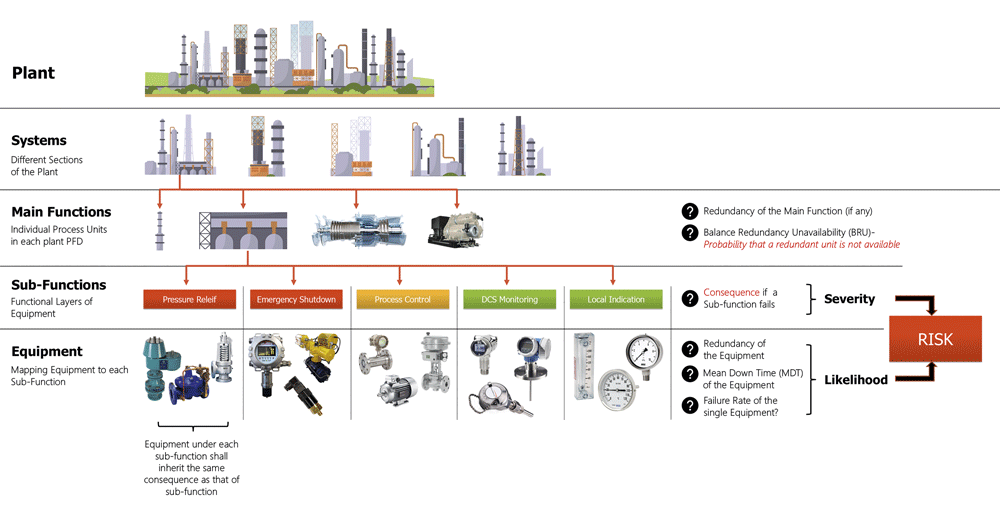
That single observation reframes the whole exercise. Instead of moving through a plant device by device, we decompose it functionally: Plant → Systems → Main Functions → Sub-Functions → Equipment. Each system is a recognisable section of the plant. Each main function is an individual process unit on the PFD. Each sub-function is a functional layer of protection or control: pressure relief, emergency shutdown, process control, DCS monitoring, local indication. Every piece of equipment is then mapped to the sub-function it serves.
The pay-off is what I call consequence inheritance. Severity is assessed once, at the sub-function level, where it genuinely lives. Every item beneath that sub-function automatically inherits the same consequence. A complex having tens of thousands of tags collapses to a manageable set of sub-functions, and the ranking is consistent by construction, because it is derived rather than re-argued. Assess the severity of the consequence of “emergency shutdown of Unit 200 failure” once, and all the associated equipment like trip valves, the logic solver and the field transmitters carry that consequence without a single extra debate.
The scale effect is striking. A process unit holding two or three thousand tagged items typically resolves to only a few sub-functions. Consequence is settled at that level in an afternoon rather than a quarter, and because the logic is transparent, an auditor can trace it end to end without re-opening every equipment. The effort is spent where judgement adds value, defining functions and their failure consequences, instead of being burned on repetitive, error-prone data entry.
Let equipment answer the question it can. Equipment cannot tell you consequence, but it can tell you likelihood. Here we work with the information about the equipment: its failure rate, its redundancy, and its mean down time (MDT), which is how long the plant stays exposed while a failure is repaired.
Redundancy deserves particular care. A duty-standby arrangement only protects you if the standby is genuinely available. I therefore fold in Balance Redundancy Unavailability (BRU): the probability that a nominally redundant unit is, in fact, not available when called upon. Redundancy assumed on paper but unavailable in practice is one of the quieter ways integrity programmes are lulled into false confidence.
Combine an inherited severity with a computed likelihood and you have risk, plotted directly onto the organisation’s own risk matrix. Nothing exotic: just a defensible, repeatable position in every cell, traceable back to the function it protects.
None of this is improvised. The framework is anchored in NORSOK Z-008 for risk-based maintenance prioritisation and ISO 14224 for the reliability and failure-data taxonomy that feeds the likelihood calculation. Standards give the method credibility with auditors and, just as importantly, portability between plants and between assessors. The entire workflow can be automated in a purpose-built Excel engine, turning what was once a multi-week manual campaign or a highly priced outsourced service into an assessment that can be run, reviewed and refreshed as the plant evolves.
The outcomes speak in the language leadership cares about: faster completion, consistent rankings, inspection and maintenance effort steered toward the equipment that genuinely carries risk, and, critically, a rationale you can defend in front of a regulator or an insurer.
We are entering an era where sensors, data and algorithms promise to run our maintenance decisions for us. But an algorithm fed inconsistent criticality will simply optimise the wrong things faster and at greater scale. The discipline of asking each layer of the plant only the question it can honestly answer (consequence from function, likelihood from equipment) is exactly what keeps that emerging intelligence pointed in the right direction.
High-performance asset integrity is not about assessing harder. It is about assessing smarter, once, and letting structure carry the rest.
Text: Shaiq Bashir Photo and figure: Shaiq Bashir PHOTO ARCHIVE

Shaiq Bashir
Shaiq Bashir is Instrument Engineering Lead (Major Projects) at Qatar Fertiliser Company (QAFCO), with over 17 years in asset management, instrumentation, automation and asset integrity management across world-scale chemical facilities. A Chartered Engineer (Engineers Ireland and Engineers Australia), TÜV-certified Functional Safety Engineer and Certified Reliability Leader, he has deep experience developing, implementing and auditing asset strategies, maintenance regimes and performance programmes.



Subscribe to the free Maintworld newsletter here!

Latest