
The Future of Maintenance: Automating Industry’s Last Manual Workflow
As global production continues to expand, industrial companies face a growing paradox: more assets to maintain, but fewer skilled technicians available to do the work.
Despite decades of automation across manufacturing, logistics, and supply chain operations, maintenance remains heavily dependent on human coordination and decision-making. While artificial intelligence (AI) is transforming many aspects of industrial operations, maintenance stands out as one of the last major workflows still managed largely manually.
Industrial organizations are increasingly challenged to maintain uptime, efficiency, and safety across expanding asset fleets while operating with constrained resources. Against this backdrop, a new opportunity is emerging: the automation of the maintenance workflow itself. This article explores how AI-native technologies can transform maintenance from a fragmented, labour-intensive function into an intelligent, autonomous workflow, offering a blueprint for automating industry’s last major manual process.

Industrial maintenance is approaching a critical inflection point. Asset fleets continue to grow, production environments are becoming more complex, and experienced technicians are retiring faster than they can be replaced. This widening skills gap is creating mounting pressure on organizations to do more with less.
Historically, maintenance has scaled through people. More assets required more technicians, planners, and supervisors. However, that model is becoming increasingly difficult to sustain. Industrial companies now face a fundamental question: how can they maintain a growing number of assets without proportionally increasing headcount?
While production processes have benefited from decades of automation, maintenance workflows still rely on people to interpret information, coordinate activities, and drive decisions. As a result, maintenance remains one of the last industrial functions yet to experience end-to-end automation.
Predictive maintenance technologies have already delivered substantial value by enabling organizations to identify anomalies and potential failures before they occur. Yet automation typically stops at fault detection. Once an alert is generated, humans still perform most of the work required to turn insight into action.
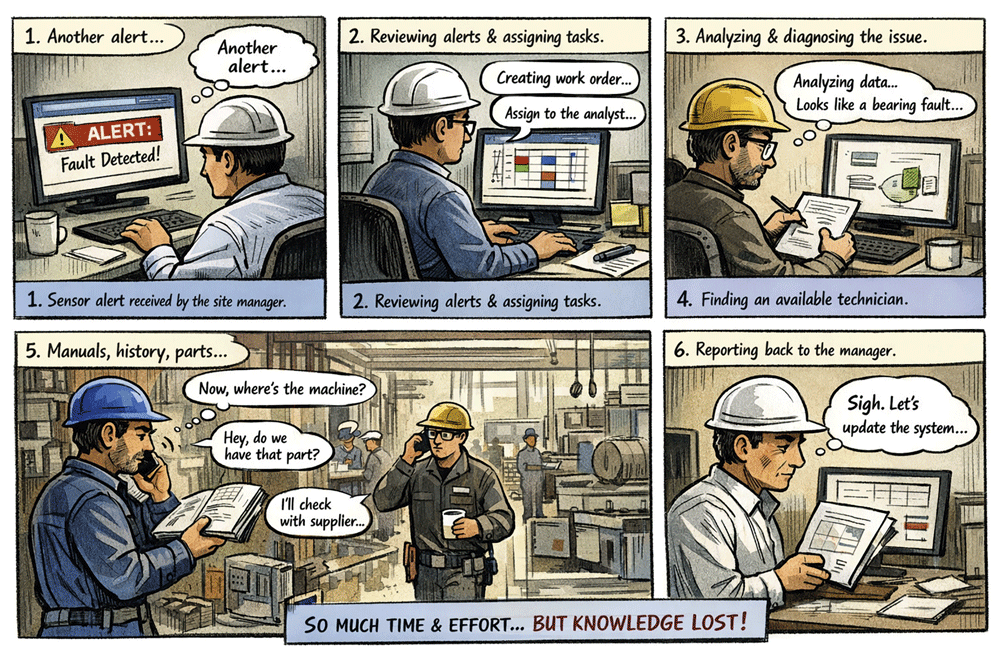
Today, site managers interpret alerts, determine priorities, create work orders, and assign tasks. Technicians spend valuable time gathering information from maintenance records, manuals, sensor data, and spare parts systems before they can begin repairs. They coordinate with planners, suppliers, and colleagues across multiple disconnected systems, often relying on manual communication and personal experience.
This fragmented workflow creates delays, inefficiencies, and inconsistent outcomes. Information remains siloed. Knowledge is rarely documented in a structured manner. Every maintenance event requires a series of manual handovers that slow execution and limit organizational learning.
The result is a clear automation gap. While fault detection has become increasingly automated, the broader maintenance process remains largely manual. This gap represents one of the most significant remaining opportunities for industrial transformation.
Artificial intelligence is creating the foundation for a new era of maintenance – one in which the entire workflow can be automated from fault detection through resolution. For the first time, the technologies required to automate maintenance comprehensively are becoming available.
Modern AI systems can combine sensor readings, maintenance history, operational data, technical documentation, and other information sources into a unified understanding of each asset and situation. Using natural language processing, they can interpret unstructured technician notes and transform them into structured insights that support decision-making and continuous improvement.
AI can also identify subtle patterns that indicate potential failures, evaluate alternative courses of action, and initiate workflows automatically. Through continuous learning, these systems improve over time, becoming increasingly accurate and effective with every maintenance event.
The challenge is no longer whether AI can support maintenance. The challenge is how to integrate AI into the maintenance workflow in a structured, scalable manner. This is where an agentic approach becomes essential.
Automating maintenance requires more than predictive analytics alone. It requires a coordinated system capable of analysing situations, making decisions, planning actions, and supporting execution. A practical blueprint for achieving this vision combines AI-native technologies into a connected maintenance ecosystem.
The journey begins with the assets themselves. Equipment must be equipped with sensors, connectivity, and edge intelligence that enable it to continuously generate meaningful condition data.
This physical layer forms the foundation for higher levels of automation. Without reliable asset intelligence, autonomous maintenance cannot exist.
The next step is providing context. Traditional predictive maintenance solutions rely primarily on vibration, temperature, and similar condition signals. While valuable, these signals alone are insufficient for autonomous decision-making. AI can enrich condition data with maintenance history, lifecycle information, operating conditions, and product documentation, creating a more complete understanding of asset health.
With this broader context, AI can move beyond anomaly detection and begin identifying root causes, recommending actions, and tailoring decisions to specific assets and operational environments.
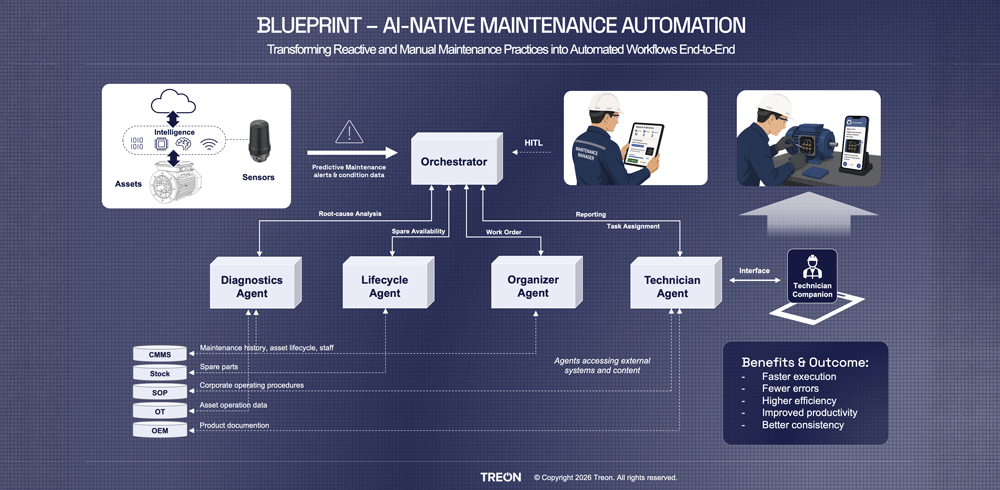
At the heart of automated maintenance is agentic orchestration. Rather than relying on humans to coordinate every step of the process, a network of specialized AI agents collaborates to execute maintenance workflows.
A Diagnostics Agent analyses incoming alerts, enriches them with contextual data, and identifies likely root causes. A Lifecycle Planner Agent evaluates long-term asset health and determines whether repair, overhaul, or replacement represents the best course of action. A Maintenance Organizer Agent schedules work, assigns resources, and optimizes execution. A Technician Agent supports field personnel by generating repair instructions and providing guidance throughout the intervention.
These agents are coordinated by an Orchestration Agent that maintains shared context, manages workflows, and ensures seamless collaboration across the entire system. Decisions that previously required numerous manual interactions can be completed automatically in seconds. Human roles evolve from coordinating work to supervising outcomes and continuously improving the system’s performance.
Automated maintenance is not about replacing people. It is about amplifying their capabilities. AI-powered companions provide intuitive interfaces that help technicians and maintenance teams interact with the underlying agentic system.
For field technicians, this means receiving assigned tasks, viewing complete asset histories, identifying required spare parts, and accessing location-specific guidance through a single application. AI companions can also provide step-by-step repair instructions, eliminating the need to navigate multiple systems or search through lengthy manuals.
By removing administrative and information-gathering tasks, AI allows technicians to focus on the work that creates value. It helps less-experienced workers perform with greater confidence and consistency while preserving institutional knowledge that might otherwise be lost through workforce turnover.
The future of maintenance is not simply predicting failures earlier. It is automating the entire maintenance workflow. The next phase of industrial transformation will extend automation beyond production lines and into maintenance itself – one of the last major workflows still dependent on manual coordination and decision-making.
By combining intelligent assets, contextual AI, agentic orchestration, and AI-powered productivity companions, organizations can transform maintenance into an autonomous process that spans fault detection, diagnosis, planning, execution, and validation. Every maintenance event generates structured insights that improve future decisions, enabling a continuous cycle of learning and optimization.
This shift represents more than incremental improvement. It marks the transformation of maintenance from industry’s last major manual workflow into an intelligent, scalable, and increasingly autonomous system. For industrial companies facing growing asset complexity and workforce constraints, automating maintenance may become one of the most important productivity gains of the coming decade.
ABOUT Treon
Treon is a global leader in AI-driven Smart Industry solutions, helping businesses boost productivity, enhance operational visibility, and long-term sustainability. Its fully integrated Prescriptive Maintenance cloud solutions combine advanced AI analytics, a mobile-first user experience, automated workflows, and wireless vibration sensors delivered as a managed service with scalable subscription pricing. Treon supports more than 200 customers worldwide across the manufacturing, material handling, and logistics sectors. Learn more at www.treon.fi.
Mikko Nurmimäki

Mikko Nurmimäki is Product Marketing Director at Treon, where he leads the customer value proposition and go-to-market for AI-driven predictive maintenance solutions in industrial sectors. He brings extensive experience in IoT, wireless technologies, semiconductors, telecommunications, and smart industry solutions. Prior to joining Treon, he held senior marketing roles at Silicon Labs, Spirent Communications, and Ericsson.
Text: Mikko Nurmimäki Photos: Mikko Nurmimäen arkisto



Subscribe to the free Maintworld newsletter here!
Latest