Will AI Save Industrial Knowledge Before It Walks Out the Door?
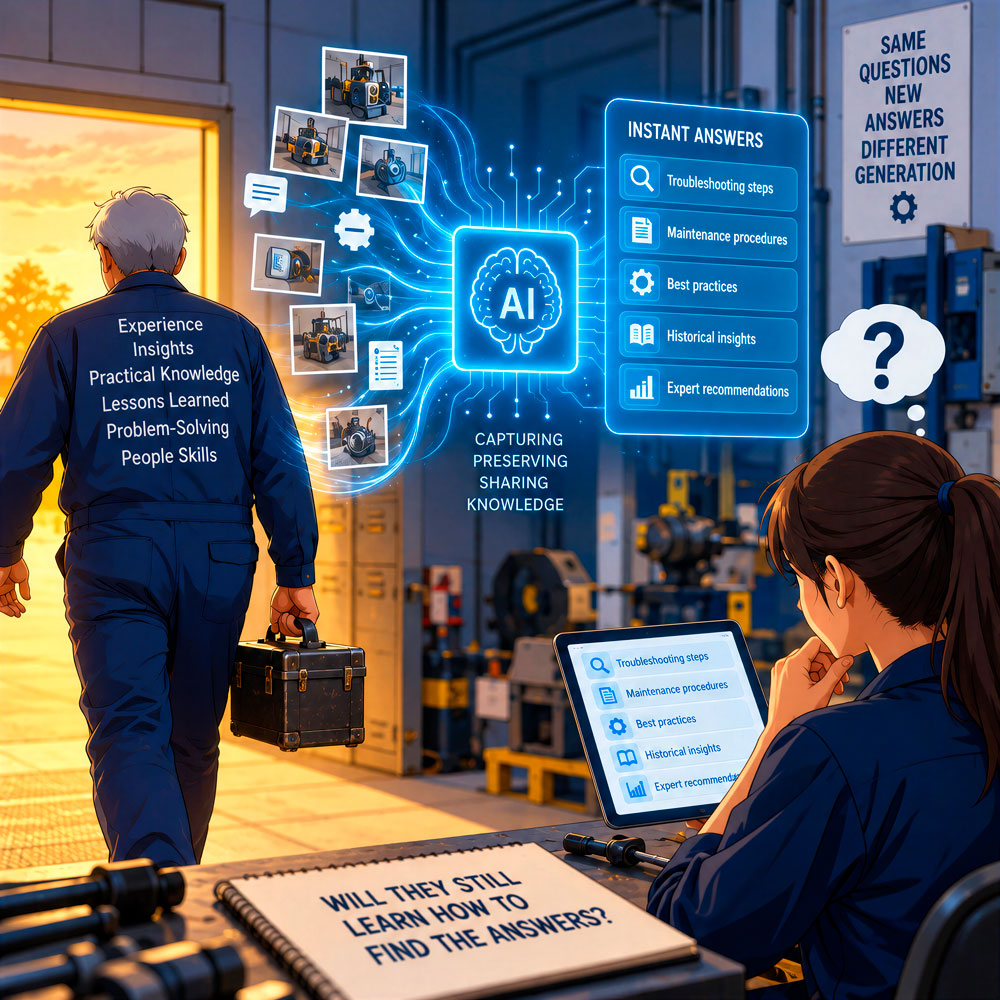
When experienced maintenance professionals retire, they take more than years of service with them. They may also take knowledge that has never been written down. AI promises a new way to capture that expertise, but it raises an uncomfortable question: if machines increasingly provide the answers, how will the next generation learn to find them?
An experienced maintenance technician may hear that something is wrong before a sensor raises an alarm. A veteran operator knows when a process is behaving differently even though the numbers still appear normal. A skilled technician may make countless small adjustments without consciously thinking about them. This is expertise accumulated through years of experience, observation, problem solving and sometimes mistakes. It is difficult to document because the people who possess it may not even recognise how much they know.
For industrial companies, this presents an increasingly urgent problem as experienced workers retire. In maintenance and asset management, the consequences can reach far beyond recruitment.

Knowledge of an asset’s history, recurring failures and unusual behaviour may have accumulated over decades and still reside partly in the minds of a relatively small number of people.
Hugo Dozois-Caouette, CTO and co-founder of MaintainX, argues that manufacturers may even be defining the problem incorrectly.
“Manufacturing doesn’t have a skills gap. It has a knowledge-transfer gap.”
Dozois-Caouette says that the skills and workers exist, but companies often lack a systematic way to move expertise from those who possess it to those who need it. The question is not simply whether experienced employees will retire. It is whether their knowledge will retire from them.
Much of the most valuable industrial knowledge is knowledge that was never written down. Work instructions describe how a task should be performed under defined conditions. Experienced workers also know what happens when those conditions are not quite right.
Matt Malchano, Vice President of Software at Boston Dynamics, describes some of the expertise most at risk as “hands-on process-oriented knowledge” in an article published by the Association for Advancing Automation.
“A distinction that you see when you look at humans is that we know how to do complicated tasks with many variations, and we’re able to adapt to uncertainty in those tasks.”
Malchano points out that many of these skills are passed from person to person as the next individual is trained for the role. They are not necessarily written down in an employee handbook.
That distinction matters in maintenance. Troubleshooting rarely consists simply of following a perfect sequence of documented steps. The technician combines information from the machine, maintenance history, measurements, previous failures and personal experience to decide what matters. AI may offer a new way to preserve more of that reasoning.
Maintenance histories, work orders, manuals, inspection reports, sensor information and technicians’ observations can potentially be brought together so that workers no longer need to know exactly where the relevant information is stored. Instead, a technician could ask: Has this machine behaved like this before? What caused the problem last time? What did the technician notice before the previous failure?
The bigger opportunity may be to capture knowledge that does not yet exist in a database. A senior operator performing a maintenance or calibration task could, for example, be recorded while completing the work. AI and analytics tools could then help analyse how the task is actually performed and turn the material into a standard operating procedure, training guide or step-by-step content.
An EY analysis by Adam Cooper, EY Americas Manufacturing Transformation Business Leader, describes knowledge as the “true way of working” retained in the minds of veteran workers: insights and intuition from the shop floor that rarely make it into manuals and playbooks. The implication is significant. AI does not necessarily have to replace the experienced technician. It could make part of that technician’s accumulated experience available to hundreds of other people.
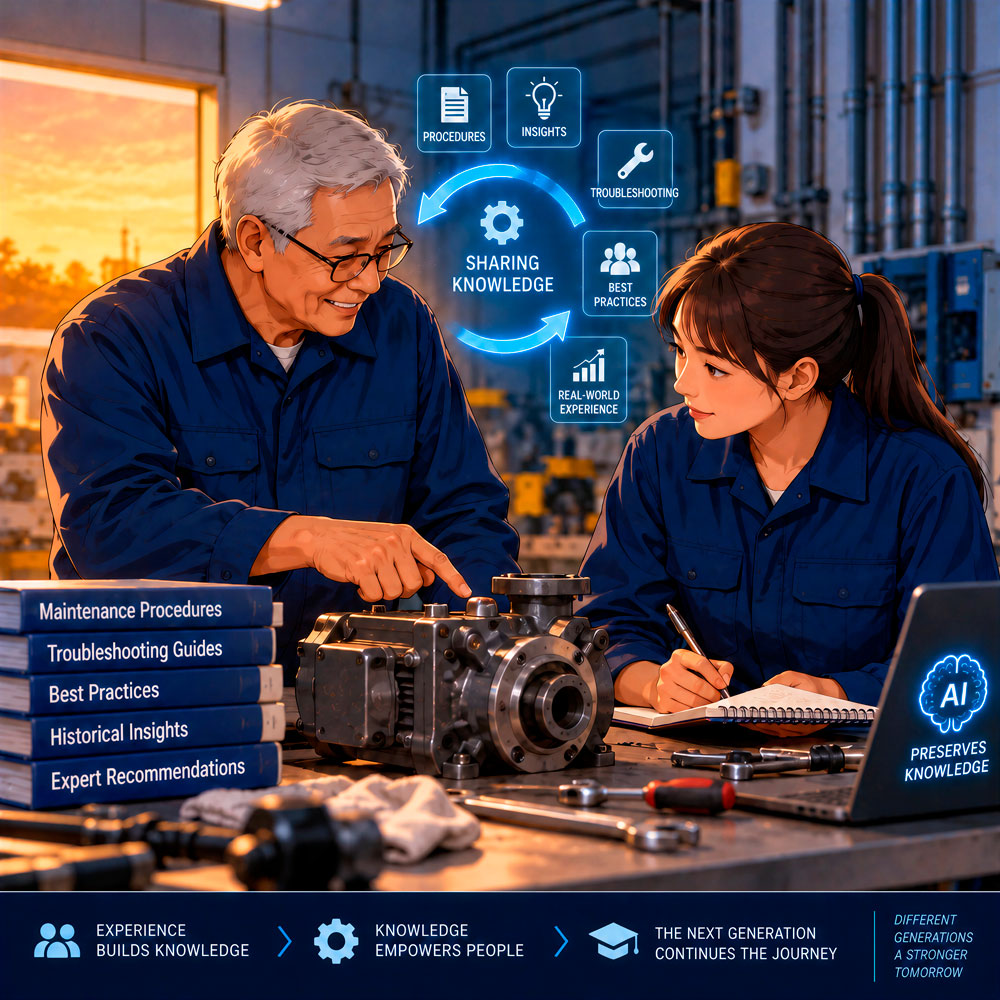
Jan Teun Koningen, Chair of the European Health, Safety and Environment Committee at EFNMS, points to the safety dimension. “When experienced maintenance professionals retire, companies risk losing what they call “tribal knowledge” about unusual or company-specific equipment. Industrial automation can be particularly vulnerable because documentation for older systems is often incomplete and reconstructing how they work can be difficult.”
Koningen mentions findIQ as one example of how AI is being applied to this problem. The German company has developed a platform designed to structure expert knowledge about industrial equipment and make it available for troubleshooting, maintenance and service. The example shows the potential of such tools, but safety-critical knowledge still needs expert validation, clear ownership and regular updating. Preserving an outdated or incorrect instruction can be as risky as losing the knowledge altogether.
This leads to a more difficult question: where will tomorrow’s experts come from? The professionals currently getting the most out of AI developed much of their judgement before generative AI existed. They learned by doing difficult work themselves, solving problems, making mistakes and gradually recognising patterns. What happens if AI removes part of that learning process? Niam Yaraghi, a nonresident senior fellow at the Brookings Institution, calls this phenomenon “borrowed expertise.”
“The productivity miracle we are observing is produced, in large part, by people whose expertise was built before AI existed.”
Yaraghi points out that these professionals are particularly good at directing AI because they have spent years developing the judgement needed to know what a good answer looks like and where a convincing AI response may be wrong. Organisations are benefiting from a stock of human expertise accumulated over decades while AI may simultaneously allow others to avoid some of the difficult developmental work through which expertise has traditionally been built.
AI may therefore make junior employees productive faster without necessarily making that employee an expert faster. For maintenance and asset management, the distinction is crucial. Finding the answer to a known problem is not the same as recognising a problem nobody has encountered before. Following an AI recommendation is not the same as knowing when the recommendation is wrong.
The more capable AI becomes, the more important that distinction may become. Perhaps AI should therefore be seen as a bridge, not a substitute? Experienced workers provide context, judgement and lessons learned. Digital systems preserve and organise part of that knowledge. Younger employees gain access to organisational experience that previously depended on knowing whom to ask. But access to experience is not the same thing as experience itself.
The challenge for industrial companies may therefore have two parts. They need to capture critical knowledge before experienced employees leave, while still giving younger professionals enough opportunities to solve difficult problems themselves. Otherwise, industry could succeed in building increasingly sophisticated systems for preserving yesterday’s expertise while weakening its ability to create tomorrow’s. Perhaps the most important question is not whether AI can preserve industrial knowledge. It is whether we can use AI to transfer knowledge without removing the experiences through which knowledge becomes expertise
Text: Mia Heiskanen Illustration: Shutterstosck AI



Subscribe to the free Maintworld newsletter here!