
Maintenance Is Inspiring and Progress Requires It
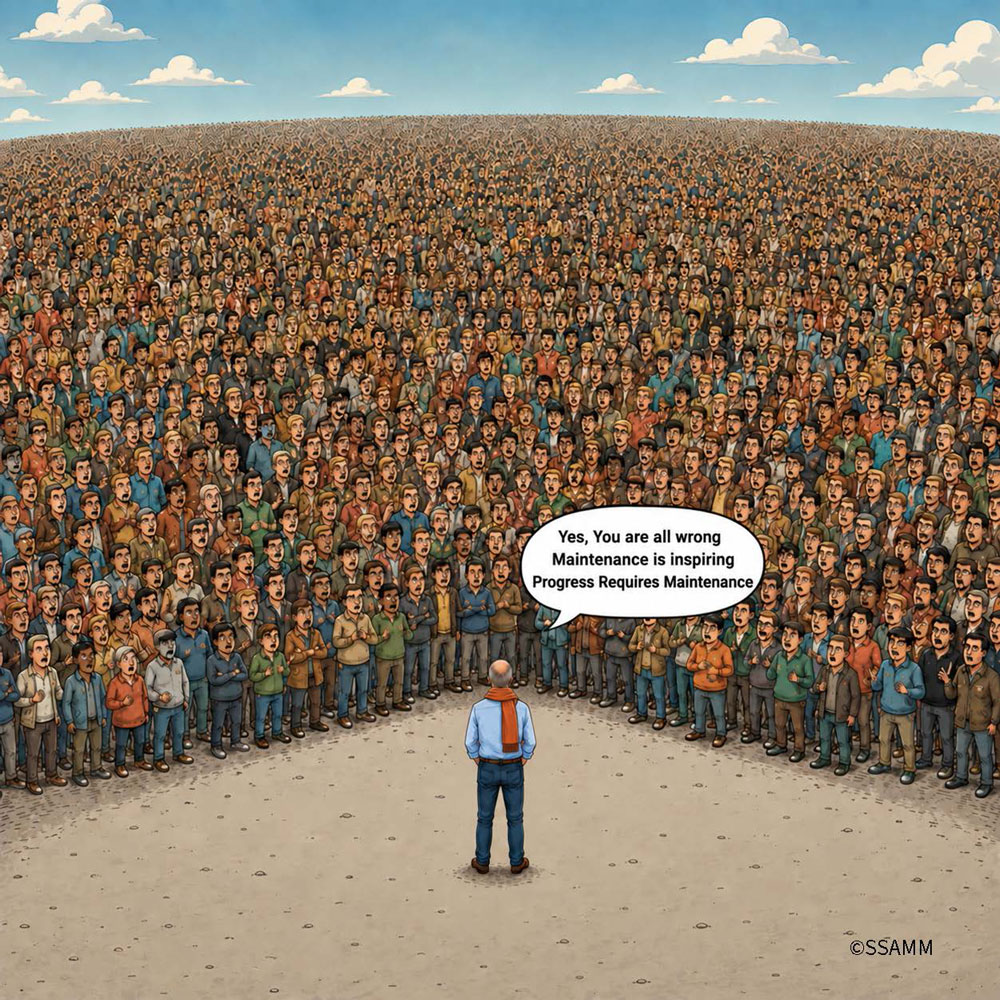
A single image started a much larger conversation. In it, one person stands before an overwhelming crowd and says: “Yes, you are all wrong. Maintenance is inspiring.” The visual was deliberately provocative, but it was never directed against individuals. It challenged a stubborn narrative: “Maintenance is not sexy.”
I have heard that phrase from managers, directors, public leaders and even maintenance professionals. It is usually meant positively: maintenance may not be attractive, but it is essential. Yet language shapes status. Every repetition first places our profession in a lower category — unattractive, secondary and costly — and only then tries to defend it. The expression is also dated and needlessly gendered.
The response surprised me. The solitary figure did not remain alone. Professionals in several countries added their own voices. Some stressed systems thinking and the connection between strategy, people, risk, equipment and outcomes. Others spoke about collaboration between maintenance, operations, engineering and management. They described maintenance as precise, challenging, innovative, value-creating and, yes, enjoyable. Their shared point was clear: design intentions are tested only when assets meet the physical world.

That is also why maintenance cannot be reduced to repairing what has failed. It influences maintainability in design, investment decisions, reliability, risk acceptance, resources, renewal and disposal. For an asset-intensive organisation, Asset Management cannot succeed when maintenance is treated as an operational afterthought.
The standard architecture reinforces this position. The ISO 55000 series provides the overarching Asset Management System framework. The CEN/TC 319 standards provide the maintenance-specific language, processes, management, engineering, performance indicators and competences. Standardising the overarching system while leaving one of its most decisive life-cycle functions to local interpretation is inconsistent.
My deepest concern, however, is the next generation. We need technicians, engineers, reliability professionals and managers who are curious, digitally capable and willing to accept responsibility for complex systems. We will not attract them by apologising for our own profession. Modern maintenance combines practical mastery with data, condition monitoring, artificial intelligence, systems thinking and human judgement.
My generation should therefore stop repeating a frame that diminishes the people, education and knowledge on which our future depends. Maintenance is not what remains after the important decisions have been made. It belongs at the table where those decisions are made and where strategy is translated into safe, reliable and lasting performance.
About the author
Jan Stoker is a senior lecturer, researcher and strategic advisor in Asset & Maintenance Management. He is the founder of SSAMM, Chair of the EFNMS European Training Committee and a Visiting Fellow at Cranfield University. His work focuses on the integration of Maintenance, Asset Management, life-cycle decision-making, competence development and international standards.
Copyright © 2026 Jan Stoker (SSAMM). All rights reserved.



Subscribe to the free Maintworld newsletter here!