
Designed to Be Maintained
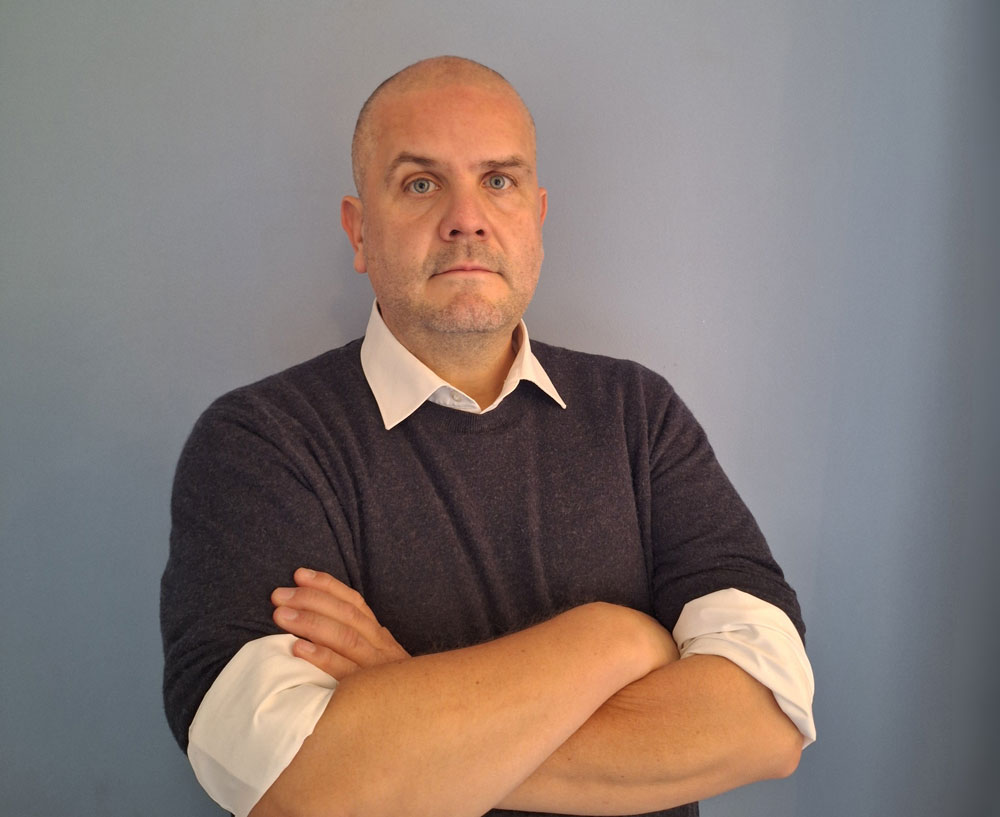
Maintenance professionals often work where others do not: at height, inside confined spaces and wherever equipment happens to fail. For Jan Teun Koningen, Chair of the EFNMS European Health, Safety & Environmental Committee, safer maintenance starts long before anyone picks up a tool.
Jan Teun Koningen did not deliberately set out to build a career in maintenance. Like many people in the profession, he found his way into it almost by accident. With a background in industrial engineering and management and a master’s degree in change management, Koningen entered the field through a university assignment in the early 2000s. The task was to investigate what asset management could mean for an organisation. It became the starting point for a career that has remained closely connected to maintenance, reliability and operational asset management ever since.
He began his career in maintenance and reliability engineering consulting and moved through project management, team management and eventually a COO position. International assignments took him into the oil and gas industry and included establishing operations in Houston and Singapore. Later, he co-founded a consulting company of his own. Today, he works for FrieslandCampina in the Netherlands, where he leads a team of project managers responsible for capital projects at one of the world’s largest dairy factories. Despite the changes in roles, companies and responsibilities, there has been a common thread.

“Almost everything I did has a relationship with operational asset management,” Koningen says.
He has always been attracted to industrial environments and to the tangible nature of factories: places where something is actually produced. Maintenance sits at the heart of that reality.
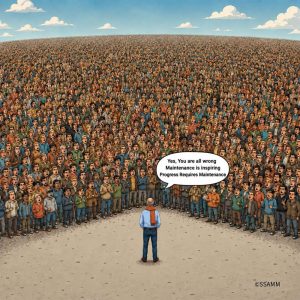
“There is always a lot of talk about maintenance not being very sexy,” he says. “But if you look at the developments in digitalisation and AI over the past couple of years, maintenance is very inspiring.”
More importantly, its impact is difficult to ignore.
“The contribution of maintenance to the result of the company is large if you do it right. And if you do it wrong, you notice it immediately.”
Koningen became involved with the European Federation of National Maintenance Societies (EFNMS) through the Dutch maintenance society NVDO. After years of international work, the
European network offered an opportunity to put that experience to use while collaborating with maintenance professionals from different countries. He joined EFNMS in 2018 and has chaired its
European Health, Safety & Environmental Committee (EHSEC) for approximately three years.
The committee has a somewhat different role from several other EFNMS committees. While much of the federation’s work concerns areas such as competence, training and certification, EHSEC concentrates heavily on the content of maintenance work itself and on practical issues that can make it safer.
One of its current priorities is LOTOTO, or Lockout, Tagout, Tryout. The basic principle is straightforward: before maintenance begins, workers must be protected from every source of hazardous energy associated with the equipment. That does not mean electricity alone. Pressure, temperature and other forms of stored energy must also be isolated, and the isolation needs to be verified before work starts. For Koningen, the issue illustrates something fundamental about maintenance safety. Maintenance professionals rarely perform their jobs in predictable working environments.
“If you look at the maintenance guy, he must go where things break down. And that’s never a normal working area.”
It may mean working at height, entering an enclosed space or finding equipment in a difficult part of a production installation. The workplace changes with the problem. Protecting the person doing the job therefore requires systematic preparation as well as technical safeguards.
Yet LOTOTO is part of a considerably larger idea that Koningen would like the industry to embrace: maintainability. If an asset requires maintenance throughout its life, he argues that the ability to perform that maintenance should be considered when the asset is designed. Can technicians reach the component safely? Can it be repaired? Are suitable tools and spare parts available? Can the work be carried out without creating unnecessary hazards or excessive downtime?
“The umbrella that we try to promote is maintainability,” Koningen explains. “You would like to make sure already from a design phase that the item is maintainable.”
This makes maintainability more than a maintenance department’s concern. Decisions made during engineering and procurement can determine the conditions under which maintenance professionals will work years later.
It also connects safety with sustainability. Equipment that can be inspected, serviced and repaired effectively is more likely to remain useful for longer. In Koningen’s view, designing for maintainability can therefore contribute both to safer work and to lower consumption of materials and energy.
The committee is trying to push these ideas beyond discussion. Some of its members participate in work within the European Committee for Standardization (CEN) and contribute maintenance expertise to standards. The committee also works with the European Agency for Safety and Health at Work (EU-OSHA), helping to ensure that maintenance professionals are represented in wider occupational safety and health initiatives.
The partnership gives the committee another route to reach maintenance organisations across Europe. EFNMS itself is supported by national maintenance societies of very different sizes and levels of development, while EU-OSHA works through a European network that includes national focal points. Combining those networks can help translate European initiatives into information, events and practical material for maintenance professionals.
One emerging subject is mental health. EU-OSHA’s 2026–2028 Healthy Workplaces Campaign, together for mental health at work, focuses on psychosocial risks and the creation of supportive and mentally healthy working environments. As part of its cooperation with EU-OSHA, EHSEC is preparing a survey focused specifically on maintenance professionals. The aim is to understand the mental health challenges they face and to provide information that national maintenance societies can use in their own activities. The European campaign officially launches in October 2026. The committee also maintains links with universities, with several professors participating in its work. Koningen sees this as another way to connect practical industrial experience with research and to identify questions that deserve closer attention.
Another challenge is the uneven approach to safety competence across Europe. Some countries have personal safety certification schemes that workers must complete before entering industrial sites. According to Koningen, comparable systems do not exist consistently throughout Europe.
A more harmonised approach, potentially resembling a European safety passport, could strengthen basic safety awareness among a workforce that increasingly operates across national borders.
The committee is exploring cooperation in this area with the European Network of Safety and Health Professional Organisations (ENSHPO).
Standards and certificates, however, can only go so far. Koningen emphasises that organisational safety culture remains crucial. This becomes particularly interesting as industry faces a generational transition. Experienced maintenance professionals carry enormous amounts of practical knowledge, including an intuitive understanding of hazards developed through years of working with equipment. When they retire, part of that knowledge can disappear with them.
But Koningen sees another side to the transition as well. Experienced workers may know risks exceptionally well, yet people who have spent decades working in a particular way can sometimes find new safety requirements harder to adopt. Younger employees, without the same established routines, may be more willing to accept stricter procedures from the beginning.
“The experienced people do know the risks from experience,” he says. “So it’s a bit of both.”
The challenge is therefore not simply to preserve everything from the previous generation. It is to transfer valuable practical knowledge while continuing to improve working practices and safety culture.
Technology adds another dimension. Koningen does not believe that digitalisation or artificial intelligence automatically makes workplaces safer. But he sees significant opportunities when technology is applied to the right problems.
In warehouses, for example, cameras and AI-based systems can distinguish between pedestrians, forklifts and automated vehicles and warn people before dangerous encounters occur. In maintenance, drones can replace some inspections that would otherwise require scaffolding or workers to be lifted to difficult or hazardous locations. The next step could be greater use of robots not only for inspection but also for repair tasks. Condition monitoring may have an equally important, if less visible, effect. Better information about asset health allows maintenance teams to anticipate failures more accurately. That makes work easier to plan and reduces the amount of reactive corrective maintenance.
And planning matters for safety. If maintenance teams know what work is coming, they have more time to identify hazards, prepare the job, arrange the correct resources and isolate equipment properly. The safety benefit of AI may therefore come not only from removing people physically from dangerous situations but also from helping organisations replace emergency work with planned interventions.
This brings the discussion back to maintainability. Koningen would like the concept to gain the same kind of attention that the industry already gives to asset management, reliability management and maintenance management. Digital tools may provide increasingly sophisticated information about asset condition, but someone still must translate that information into safe and effective work.
“The devil is in the detail and is in preparing the maintenance work,” he says.
Understanding failure mechanisms through methods such as reliability-centred maintenance (RCM) and failure mode, effects and criticality analysis (FMECA) is important. So is understanding the risks involved in performing the actual task and ensuring that the installation has been designed, or adapted, so that the work can be carried out properly.
Koningen has a concrete ambition for EHSEC: ultimately, he would like maintainability to become the subject of a European standard. Behind that ambition is a broader conviction about the value of maintenance itself. Koningen points out that much of the maintenance that keeps modern society functioning remains largely invisible. Infrastructure works, factories produce, electricity flows and services remain available precisely because someone is maintaining the assets behind them. Usually, the public notices that work only when something stops functioning.
“We need to make sure that those people stay safe.”
For him, there is also an environmental argument. If society becomes better at maintaining its assets, extending their useful lives and reducing unnecessary replacement, fewer resources and less energy may be required. The logic that increasingly encourages repairability in consumer products has relevance far beyond household goods. Making industrial assets easier to maintain from the start could help factories operate more safely, use resources more effectively and keep valuable equipment productive for longer. That makes maintainability something larger than a technical design criterion. It becomes a link between reliability, safety and sustainability.
And perhaps that is also why Koningen stayed in maintenance after stumbling into the profession more than two decades ago. The work may often remain unseen, but its consequences are everywhere.



Subscribe to the free Maintworld newsletter here!

Latest