
Learn first, automate second
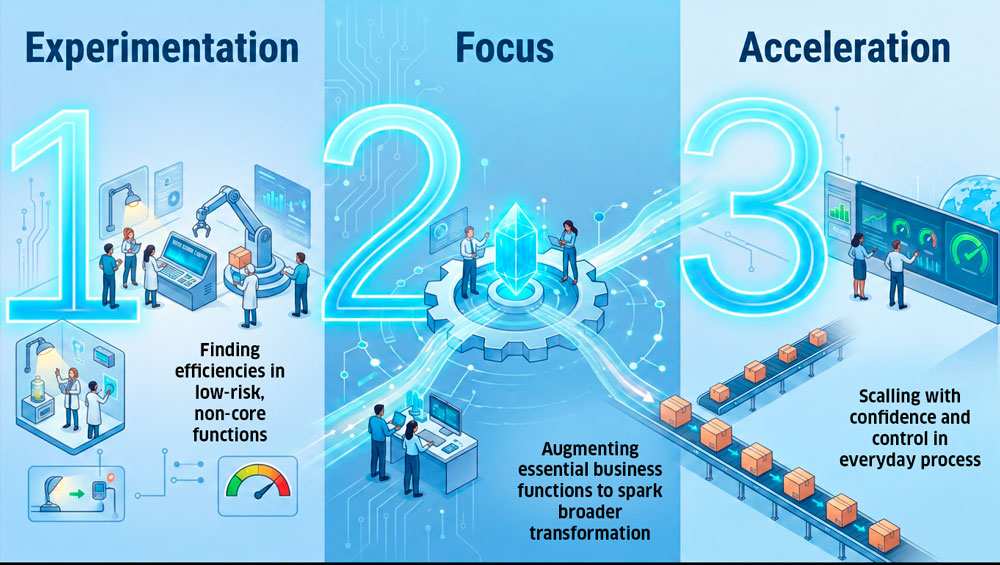
For maintenance organizations, the path to successful AI adoption may have less to do with technology and more with learning. The companies gaining the greatest advantage are often not those pursuing the biggest projects, but those willing to start small, build trust, and solve real problems for users.
What if the companies that benefit most from AI are not the ones investing the most, but the ones learning the fastest?
Industrial organizations have traditionally approached new technologies with caution. In sectors where equipment reliability, worker safety, and regulatory compliance are non-negotiable, skepticism is often justified. Yet as artificial intelligence continues to mature at remarkable speed, a new question is emerging: can organizations afford to remain observers while others gain experience?

For Andreas Steen, who works with industrial customers across the Nordic region with IBM’s AI and ISV partnerships, the answer is straightforward. Alongside Dora Nagy Eliasson, IBM’s Asset
Lifecycle Management Specialist for Maximo customers in Sweden and Norway, he regularly advises industrial organizations on how to implement AI safely and turn it into tangible business value.
“The most successful thing is that you need to get started,” says Steen. “No matter the risk level or company size, this is a learning curve. If you wait too long, you’ll be left behind.”
The advice may sound surprisingly simple. After all, discussions about AI often revolve around complex algorithms, cybersecurity concerns, governance frameworks, and ambitious transformation programs. Yet the companies making the greatest progress are often not the ones trying to solve everything at once. They are the ones willing to experiment, learn, and gradually build confidence.
Few business functions are better positioned to benefit from AI than maintenance and asset management. According to Steen, industrial organizations possess something many other sectors would envy: decades of operational data. Maintenance logs, work orders, asset histories, condition monitoring data, inspection reports, and operational records together form a rich foundation for AI-driven applications. Yet many organizations remain hesitant, often believing their data is not of sufficient quality. In practice, the reality is usually more nuanced.
“We see that industrial companies often have better structured data than many other industries,” says Steen. “In many ways, they have an excellent opportunity to succeed with AI.”
The challenge is that the data rarely sits in one place. Asset information may reside in one system. Workforce information may be stored somewhere else. Operational planning may happen in a third application. Sustainability reporting, procurement data, and inventory management often have their own environments. For years, organizations have pursued large integration projects to connect everything together.
But what if perfect integration is not the only path forward? One of the most interesting developments in generative AI is its ability to work across fragmented environments. Instead of requiring every system to be permanently connected, AI can retrieve information from multiple sources when needed and present it in a usable format. This raises an interesting question for maintenance leaders: how much value has been delayed while waiting for perfect conditions?
Many organizations have spent years discussing digital transformation. Some have postponed initiatives because systems were not fully integrated. Others have waited until data quality improved.
Yet AI introduces a different way of thinking. Instead of demanding perfection before starting, organizations can begin learning while simultaneously improving their foundations. Nagy Eliasson sees this as one of the most important shifts.
“It will get better when you start using AI,” she says. “AI can actually help organizations identify data quality issues and improve the quality of future data.”
This perspective turns a common assumption upside down as organizations are discovering that AI itself can become a tool for improving data quality. According to Nagy Eliasson, it can identify missing information, flag inconsistencies, and help users capture better information in the future.

“The key word is future. Many maintenance organizations continue to struggle with manual reporting processes. A technician completes a task, writes notes on paper, and the information eventually finds its way into a system. Along the way, details may be lost, delayed, or misunderstood”, she emphasizes.
Imagine a different scenario where a technician receives a work order on a mobile device. Instructions are immediately available. Time spent on the task is recorded automatically. Photos can be attached directly to the work order. Once the task is completed, the information becomes instantly available for planners, supervisors, and analysts. The productivity gain is obvious. Less obvious is the effect on future decision making. Every complete task contributes more accurate information for future maintenance planning.
“If the technicians see value in the tool and use it, it will generate more qualitative data into the system. Focusing on the user creates benefits for everybody”, Steen says.
This focus on the end user may be one of the most overlooked aspects of AI adoption. Many technology initiatives begin with management reporting. Dashboards become more sophisticated.
Analytics become more detailed. Yet the quality of those outputs ultimately depends on the quality of information entering the system.

The people creating that information are often technicians, operators, planners, and supervisors. This creates another interesting thought experiment. What if the first successful AI project in your organization has nothing to do with predictive maintenance? What if the biggest benefit comes from helping employees find information faster, reducing the time spent completing reports or simplifying onboarding for new technicians?
Many organizations today face a significant knowledge transfer challenge. Experienced employees are approaching retirement while younger workers enter increasingly complex operating environments.
Valuable expertise often exists in manuals, maintenance histories, and the minds of experienced personnel. According to IBM experts, the challenge is not the absence of knowledge. It is a challenge of access.
“A younger technician might not know where to find the right information, but AI can help provide the right instruction at the right moment,” says Seen and continues with an example:
“Imagine a new employee standing in front of an unfamiliar asset. By scanning a QR code, the technician can immediately access maintenance instructions, inspection procedures, historical records, or troubleshooting guidance. Information that once required to search through folders, manuals, and databases can become available in seconds. The knowledge remains the same, the accessibility changes dramatically.”
This is perhaps where AI becomes most valuable. Not by replacing expertise, but by making expertise available when and where it is needed.
Steen points out that AI can also help organizations unlock value from existing documentation. Instead of asking employees to search through hundreds of pages of manuals, AI can transform technical documentation into practical, step by step instructions that are easier to understand and use. In this way, decades of accumulated knowledge can become more accessible to a new generation of maintenance professionals.
“Of course, industrial organizations cannot ignore legitimate concerns. One of the first questions customers typically ask concerns data ownership and confidentiality. Maintenance records, production information, and operational data are among the most sensitive assets many organizations possess”, he emphasizes.
According to Steen, confidence begins with clarity about how data is handled.
“One concern is always what happens with my data,” he says. “For IBM, the answer is very clear. Customer data remains the customer’s data. We do not use customer data to train models.”
This principle is reflected in IBM Maximo, where organizations can determine the scope of information available to AI services. As Nagy Eliasson explains, customers can choose whether AI operates only within their own maintenance and asset management environment or whether it can access broader enterprise systems and external information sources. The choice remains with the customer.
This flexibility may become increasingly important as organizations seek to balance innovation with governance, cybersecurity requirements, and operational safety.
Interestingly, Steen believes that skepticism often decreases once people begin using AI in their own work. He points to IBM’s internal experience as an example. As its own “Client Zero,” IBM uses AI and AI agents across functions ranging from HR and finance to software development and customer support, testing new capabilities internally before making them available to clients. In HR, for example, managers can now rely on AI-powered assistance rather than navigating systems they may only use infrequently.
“I use IBM’s own AI tools all the time,” he says. “Previously it could take me two or three days to complete an HR related task because I didn’t know the process and I rarely used the system. Now
I can do it in five minutes because the AI guides me through the process.”
According to Steen and Dora Nagy, experiences like these are important because they move the discussion away from abstract promises into everyday reality. Trust is rarely built through presentations. It is built when people discover that a tool genuinely helps them do their job better. Yet trust remains essential, especially in industrial environments where the consequences of mistakes can be significant.
Maintenance professionals are responsible for assets worth millions of euros. In some sectors, mistakes can have serious safety consequences. The idea of allowing an AI system to make complete autonomous decisions understandably creates discomfort. The emerging answer is thus not full automation but collaboration where AI proposes. Humans decide.
This concept, often described as “human in the loop,” may become one of the defining principles of industrial AI. Systems can analyze data, identify patterns, generate recommendations, and prepare plans. Human experts remain responsible for reviewing, validating, and approving actions. Consider a practical example where an AI system identifies signs that a critical asset may fail within two weeks. A traditional approach might simply generate an alert. A more advanced approach could go further. The system could recommend inspection activities, identify required spare parts, estimate labour requirements, and suggest an optimal maintenance window. Yet the final decision still belongs to a human planner. The value lies not in replacing judgement but in supporting it.
Steen believes this distinction is crucial.
“Find proper use cases that have real value,” he says. “Relevant but safe. That’s where you should start.”
He offers another example. Imagine a machine that is predicted to fail in two weeks, while its next planned maintenance stop is scheduled four weeks from now. Predicting failure is useful, but understanding why the asset is deteriorating may be even more valuable. If the root cause can be identified, operators may be able to adjust workloads, improve operating conditions, or modify processes to extend the asset’s life to the planned maintenance window. In other words, the real value comes not from knowing what will happen, but from understanding what can still be influenced.
Perhaps that is the most important lesson for maintenance organizations today.
The future will not arrive through one dramatic AI project. It will emerge through hundreds of practical decisions. A technician receives better instructions, a planner gains earlier visibility into emerging problems, a new employee finds information more easily, a supervisor spends less time searching and more time improving operations. Taken individually, these improvements may seem modest. Taken together, they can fundamentally change how maintenance organizations learn, share knowledge, and make decisions.
The companies that succeed may not be those with the largest budgets or the most advanced algorithms. They may simply be the ones willing to start learning first.
Text: Mia Heiskanen Photos: IBM



Subscribe to the free Maintworld newsletter here!