
Learnings from refinery turnarounds
After decades of refinery turnarounds, Christer Olsson has reached a simple conclusion: successful shutdowns are won long before the plant comes to a halt. Technology has transformed the tools, but detailed planning, competent people and genuine commitment remain at the heart of turnaround performance.
Christer Olsson’s experience with refinery turnarounds reaches back to 1976. By then, he had already worked on the operations side of the refinery business, first as an operator and later in control room and supervisory roles. Moving from operations into maintenance gave him a perspective that would shape much of his later career: maintenance and operations may see the same plant very differently, but neither can succeed without the other.
His first turnaround also gave him an early lesson in the limitations of planning systems. The system in use at the time had not been designed for the fast-moving environment of a refinery turnaround. Information was processed elsewhere and returned too slowly to support day-to-day decisions. Resource planning was also heavily driven by costs, which could mean crews being moved from one area to another even when the practical work demanded continuity.

“You cannot wait. You must be updated all the time,” Olsson recalls.
The technology was primitive by today’s standards, but the underlying problem is still familiar. A plan only has value if it reflects what is happening and allows people to act accordingly. Olsson learned to follow progress closely, question the plan when necessary and take responsibility when circumstances demanded it.
His definition of responsibility was influenced by another lesson from those early years. Working with American colleagues exposed him to a more hierarchical management culture than he was accustomed to in Sweden. He remembers being asked why he was dealing with matters that were supposedly outside his formal responsibility. His answer was straightforward: responsibility should be taken where it is needed. That does not mean ignoring rules or authority. It means creating an organization in which people understand their responsibilities well enough to act instead of waiting for someone higher up the hierarchy to solve every problem.
Over the following decades, Olsson participated in major refinery turnarounds as well as numerous smaller shutdowns and maintenance projects. For him, improvement became a continuous process.
“You do something, you check it, you learn, and then you improve the next time.”
A major turning point came through refinery benchmarking. In the late 1980s, Olsson’s refinery performed exceptionally well in the Solomon benchmarking study. By 1990, however, its relative performance had deteriorated significantly. Management responded with a broad transformation. Maintenance was given a clearer focus, capital projects were separated from their core responsibilities, and the organization began reconsidering how work, competence and responsibility should be structured.
One important question concerned turnaround intervals. The refinery had traditionally operated for three years between major turnarounds, while some European refineries were achieving longer intervals. Extending the interval required more than simply changing a schedule. Safety requirements had to be addressed together with authorities, and the refinery had to demonstrate that its equipment and maintenance practices could support the change.
The interval was eventually extended, first to four years and later to six. At the same time, the company invested heavily in people. Around 280 craftsmen underwent extensive training covering areas such as computers, leadership, drawings, planning and decision making. The intention was to enable them to assume greater responsibility and work more independently as coordinators.
Supervisors moved towards engineering and support roles, while management itself received leadership training. For Olsson, this illustrates a principle that remains central to successful turnaround management: competence cannot simply be assumed.
“If you don’t find the right competence, you have to train to the level of it.”
He gives gasket handling as a practical example. Poor installation can result in leaks with consequences for safety, reliability and availability. Instead of assuming that everyone arriving at a turnaround understood the work to the required standard, Olsson brought together experienced specialists from maintenance and operations to demonstrate correct practices. Training material was produced, workers were trained and their competence was verified.
Asked what distinguishes the most successful turnarounds he has experienced, Olsson does not hesitate: planning and scheduling.
“The devil lies in the details.”
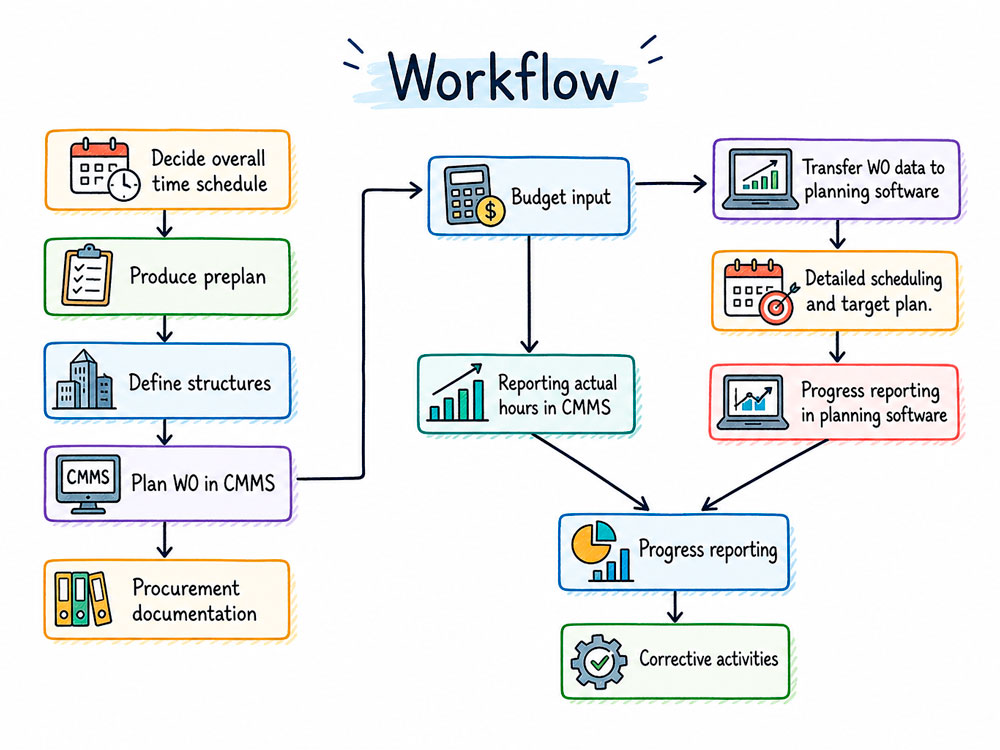
For a major refinery turnaround, he says, preparation may begin around two years before the actual shutdown. The process must cover far more than the technical work itself. Scope, organization, procurement, documentation, resources, competence, quality, environment, safety, security, cost control and lessons from previous turnarounds all need to be addressed.
Olsson advocates a comprehensive quality plan that defines how the turnaround will be managed. Known work should be prepared systematically in the computerized maintenance management system, with work orders linked to equipment, activities, responsibilities, competencies, estimated hours, materials, tools and costs. Long lead items need to be identified early. Interfaces between maintenance, operations, contractors and support functions must also be clear. This depth of preparation can appear excessive to people who have not experienced a major turnaround. Olsson sees it differently. Most turnaround work is already known in advance. If that work is thoroughly prepared, management can focus its attention on what does not go according to plan.
One turnaround in 2003 remains a particularly strong example for him. Contractors were brought directly into the planning process and worked with experienced planners before the shutdown. Responsibilities and competence requirements were agreed in advance. Once the turnaround began, Olsson could see each morning which activities were progressing according to plan and which required intervention.
“If 90 percent is doing well, I can concentrate on the 10 percent that isn’t.”
That is very different from an organization where everyone is busy, but nobody has a reliable picture of overall progress. Olsson recalls asking a contractor after the first week what felt different about that turnaround.
The answer was revealing: “Nobody’s running.” People knew what they were supposed to do. The organization could see where it was against the schedule, and management could concentrate on deviations instead of trying to control everything simultaneously.
This also explains why being ahead of schedule is not automatically a sign of success. A turnaround is a tightly connected system of activities, resources and dependencies. If one task moves ahead unexpectedly, it may occupy equipment or people needed elsewhere. Progress therefore must be evaluated against the entire plan rather than celebrated in isolation.
“The plan is important not because of the plan itself, but because of what it makes you do.”
For Olsson, one of the biggest warning signs is when a turnaround organization begins to say that everyone is simply working as fast as possible. Without reliable planning and follow up, a four- or five-week turnaround can quickly start to feel like operating in a vacuum. Detailed planning creates the opposite condition: people know where they are, managers see deviations and the organization maintains control.
The same principle applies to the digital infrastructure supporting the turnaround. When CMMS became an essential management tool, Olsson challenged IT personnel over acceptable downtime. If the planning and maintenance system is the main tool used to control thousands of activities, its availability is not merely an IT issue. It is part of turnaround risk management.
Digitalization has nevertheless changed what is possible. In Olsson’s early career, work orders and reporting were largely paper based. Today, digital systems can provide information almost continuously. Managers can follow progress much more closely and connect maintenance data with scheduling systems. In a large turnaround involving thousands of contractors and tens of thousands of activities, that visibility can be enormously valuable. But Olsson is cautious about assuming that better technology automatically means better management.
The problem is data quality. A number stored in a system may appear authoritative, but behind it is usually a person who entered or reported something. If people do not understand why accurate reporting matters, technology cannot correct the weakness at its source. A recorded two-hour task is useful only if two hours reflects reality.
“When you see data in the system, you think it is true. But you have people reporting things that create the data.”
This is also how Olsson views the growing possibilities of AI. New technology can provide new ways to evaluate information and support decision making, but it does not remove the need for competent people, reliable input and disciplined processes. The fundamentals of turnaround management remain remarkably stable: prepare properly, create a clear organization, train people, involve contractors and operations, and make sure everyone understands how their contribution affects the whole.
Commitment is a word Olsson returns to repeatedly. He illustrates it with the old breakfast analogy of the hen and the pig: in eggs and bacon, the hen is involved, but the pig is committed.
Successful turnarounds need people who feel responsible for the result, not merely people who have been assigned tasks. That requires clear responsibilities, appropriate competence and genuine participation in planning.
The same thinking helped Olsson bridge the traditional divide between maintenance and operations. Having worked on both sides, he understood how easily each function could blame the other. His response was to bring operations into planning and look at shutdowns, startups and maintenance activities as shared processes. When both sides understand the constraints of the other, they can often change their own plans to improve the overall result.
Much of Olsson’s career has followed that pattern: finding something that could work better, bringing people together and creating a structure that allows them to improve it. Later, as a consultant and trainer, his role changed from being the manager making decisions to what he describes as a provider of “information and possibilities.”
The tools available to maintenance professionals today would have been unimaginable when he entered his first turnaround in 1976. Yet his central lesson is strikingly resistant to technological change. Good turnaround management is not about reacting faster to chaos. It is about doing enough work beforehand that chaos does not become the normal way of operating.
And perhaps that is why two expressions particularly bother Olsson: “We have always done it that way” and “We have never done it that way.” Both close the door to improvement. After decades of planning, shutdowns, organizational changes and lessons learned, his advice is instead to remain open and actively search for new possibilities.
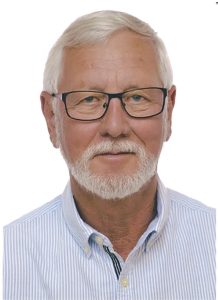
Christer Olsson
From 1996 – approx. 2015: Member of board the Swedish Maintenance Society , member of EFNMS General Assembly for Sweden,
From a 2009 – approx. 2020: Chairman EFNMS committee EMAC (Maintenance Assessment Committee)
Text: Mia Heiskanen Photos: Christer Olsson



Subscribe to the free Maintworld newsletter here!