

How industrial firms maintain a strategic position in the supply network in digitally-enabled service innovation

Industrial services involve using technologies such as the Internet of Things (IoT), cloud computing, and predictive analytics to create new, value-added services for customers.
For example, information and communication technologies are used in logistics to increase efficiency and mitigate information asymmetry in supply chains, digital twins create virtual representations of physical assets to enhance performance monitoring and lifecycle management, or predictive maintenance services that utilize machine learning to predict failures provide much more reliable and efficient models of service delivery.
To develop and deliver services, industrial firms often need external digital expertise while retaining responsibility for the customer relationship and service outcomes. Thus, this digital shift becomes highly complex as it forces industrial firms into entirely new collaboration structures in their supply networks, requiring them to manage relationships among multiple new and existing partners, such as external service providers, technology providers (such as software developers, IT consultants, data integrators), and the customer organizations.

Research in large Finnish industrial firms in machine manufacturing and automation industries reveals that success depends not only on technical skill and digital capabilities, but also on mastering network position and relational strategy. Industrial firms’ critical new role is to act as the strategic connector between these parties.
The key gaps in the supply network: When the industrial firm brings together customers, internal development teams, and technology providers, collaboration challenges are inevitable. These challenges are not just minor communication obstacles; they are deep, strategic disconnections that must be actively managed:
Relational gaps are direct disconnects in interaction, usually between the technology provider and the customer. Industrial firms often need to manage and regulate who can engage with customers to keep communication channels clear. However, this can limit the flow of essential insights and expectations, such as sharing customer feedback with the technology provider.

Knowledge gaps refer to a limited or disconnected flow of contextual knowledge, like customer insights, system history, or non-technical needs. Technology providers may have limited access to this information due to intellectual property or competition threats. However, these transparency issues can hinder providers’ ability to assess the viability of solutions.
Cognitive gaps arise because individuals from different fields use different languages, interpretations, and mental models. For example, development teams might focus on IT and cloud infrastructure, while customers emphasize usability, reliability, and cost. This makes it difficult to effectively communicate the customer’s perspective to the technical team.
Technical gaps arise from differences in technical resources, infrastructure, or access to core operational systems. While industrial firms may have access to internal and customer systems, technology providers often work at a distance and depend on the firm for testing and system integrations.
Temporal gaps occur due to inconsistent timing in participation. Technology providers might be involved only during specific phases, such as initial planning or prototyping, and have less visibility during implementation. This broken flow means providers lack the historical context of previous decisions.
The key mechanisms to manage the supply network gaps: The gaps in the supply network can either hinder innovation or provide a strategic advantage, depending on how an industrial firm manages them. To succeed in digitally-enabled service innovation, the firm must actively connect, coordinate, and mediate resources across organizational boundaries. This active brokering role is critical not only for leveraging external partners’ digital capabilities but also for building internal capabilities, reducing data risks, and directing innovation. To effectively manage the supply network gaps, industrial firms should:
Align complex workflows by establishing clear communication and coordination routines and tools across internal teams, technology providers, hardware integrators, and IT infrastructure.
Managers should create shared roadmaps, plan sprints, and maintain consistent communication channels to manage dependencies like data platforms, cloud architecture, and operational procedures.
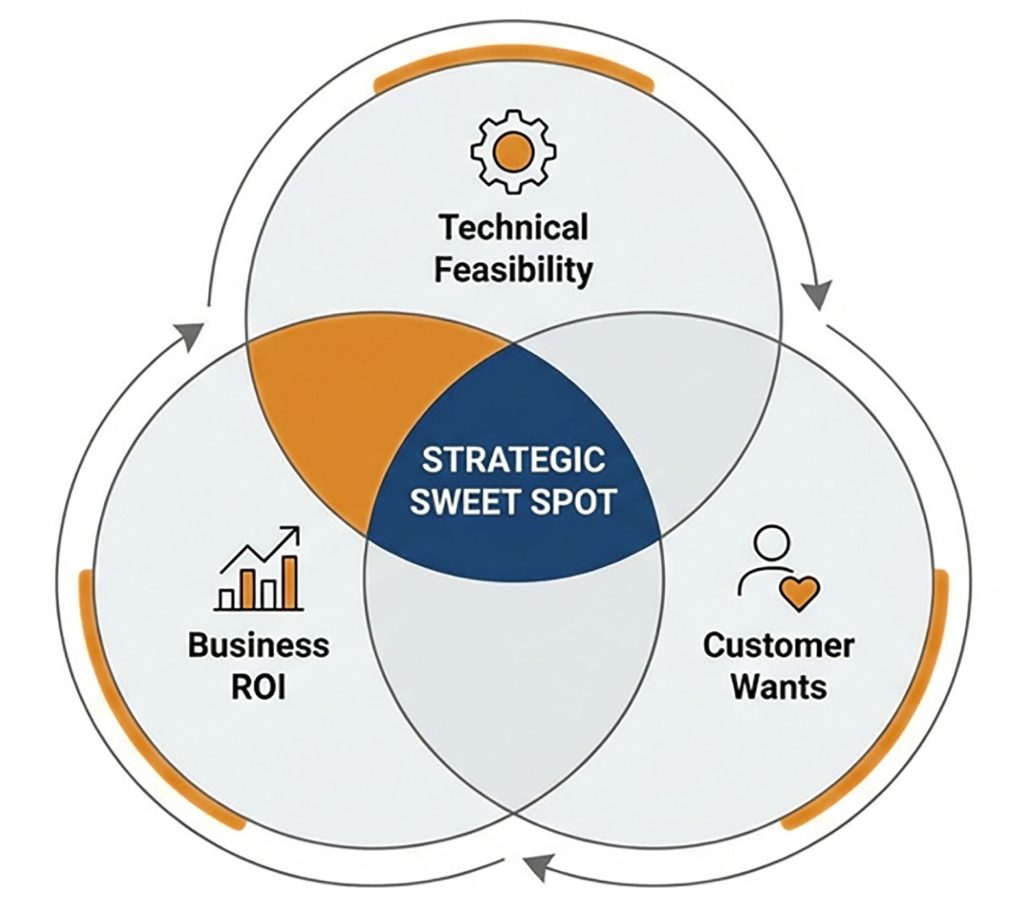
Balance competing priorities by acting as the mediator for conflicting priorities: what is technically feasible, what the business demands (ROI, margins), and what the customer wants. Managers gather input from all stakeholders, for example, through regular planning sessions and backlog reviews. These inputs support managers in decision-making, feature prioritization, and the assessment of decision impacts, enabling them to evaluate both short-term gains and long-term consequences. Through active mediation, the industrial firm maintains control over the direction of development.
Translate customer knowledge by acting as a translator, converting unclear customer needs into clear, actionable information for developers. Managers use boundary-spanning tools such as user stories, journey maps, and templates to articulate customer requirements clearly. Importantly, the firm also translates complex regulatory requirements, such as cybersecurity standards, into a language that external developers can understand and implement, ensuring the digital services meet industry and legal standards.
Maintaining a strategic position in the supply network: Maintaining a strategic position in the supply network is not just about occupying the central position. Long-term influence relies on how partners view the effectiveness of industrial firms in managing the network. For example, if technology providers think the firm is impeding collaboration by poorly gathering or understanding customer information, they will doubt the firm’s capability and, consequently, its role in the network. Conversely, if they see the firm as capable of coordinating development, understanding customers, and managing technical integration, the role of the strategic connector becomes sustainable.
Therefore, managing perceptions is crucial. Managers need to shift their focus from solely acquiring digital capabilities to building relational capabilities through communication, role and responsibility setting, translating needs, and managing complex digital systems. By turning potential gaps into strategic opportunities and demonstrating the ability to manage the network, industrial managers can secure their company’s key leadership role in the digital service ecosystem.
Summary of the research: The research is based on 21 interviews with managers in three Finnish industrial firms and their technology partners. The industrial firms were large, well-established companies recognized as leaders in their respective industrial sectors. Technology partners were providers of digital transformation and technology consulting, technology, software, and digital service design services. This research was funded by the Research Council of Finland, Project: Development of adaptable integration mechanisms for data-enabled service operations in industrial networks.
The description of the research group: The Strategic Business Development research group at the University of Vaasa concentrates on sustainable and digital servitization, business model and service innovation, strategic change and strategy processes, as well as platforms and ecosystems. Our work also explores individual agency and entrepreneurship, with a particular emphasis on how these shape and are shaped by transformations in industrial and organizational contexts.
https://www.uwasa.fi/en/research/groups-and-focus-areas/strategic-business-development
Text: Beheshte Momeni and Marko Kohtamäki Images: generated using Google NotebookLM
Beheshte Momeni,
Postdoctoral researcher at University of Vaasa
www.linkedin.com/in/beheshtemomeni
Marko Kohtamäki,
Professor of strategic management at University of Vaasa
https://fi.linkedin.com/in/markokohtamaki



Subscribe to the free Maintworld newsletter here!

Latest