
Lighthouse for Europe’s Railways
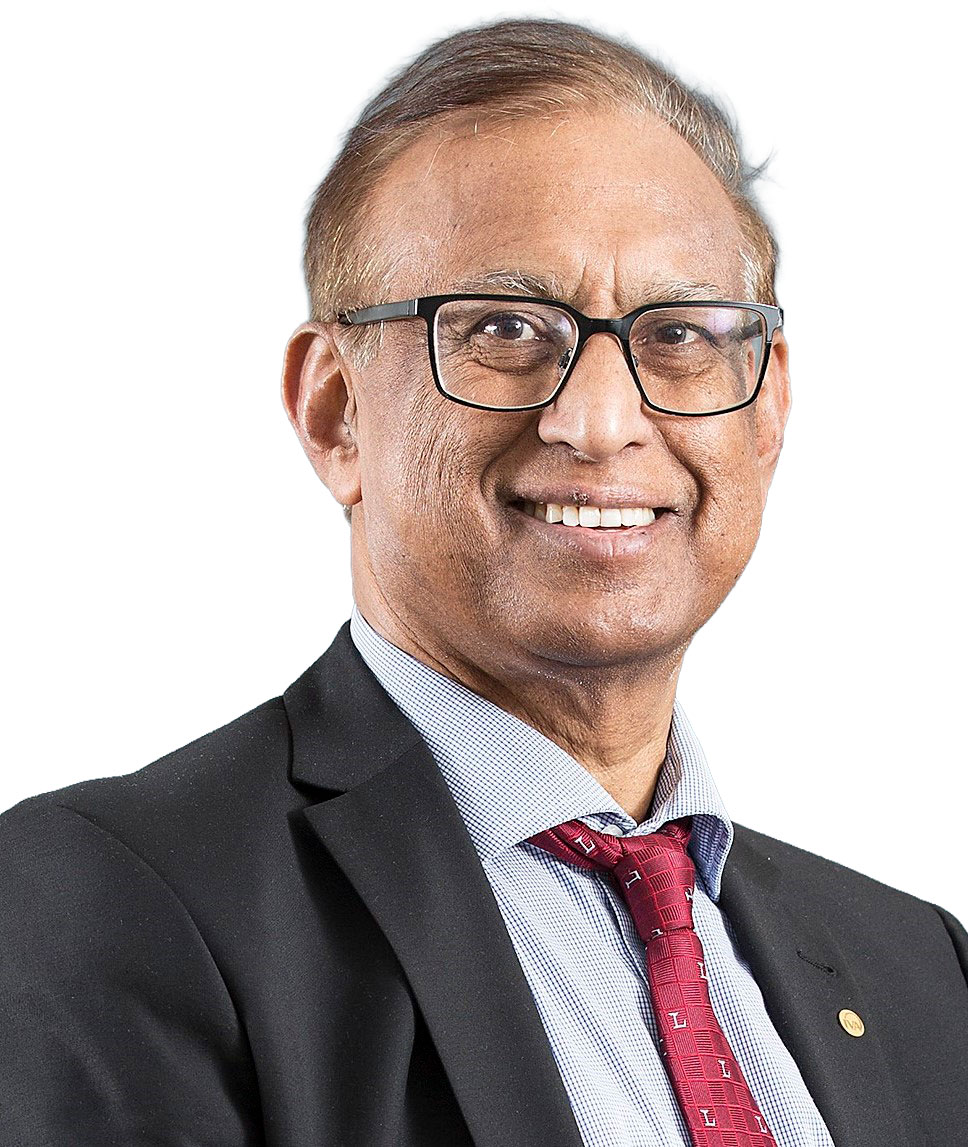
A think tank that influences decisions. A lighthouse that guides the sector. Professor Uday Kumar wants the EFNMS Railway Maintenance Committee to become both, at a time when Europe’s railways must deliver more with infrastructure that is already ageing.
Europe’s railways are expected to carry more people, reduce emissions and keep societies moving on infrastructure that is decades old. Beyond its operational role, railway infrastructure is a critical backbone for Europe, supporting not only passenger and freight transportation, but also strategic resilience, including military mobility and crisis response. This elevates maintenance from a technical function to a matter of European security, reliability, and continuity of service
Professor Uday Kumar believes the next leap will not come from technology alone, but from how well the sector transforms data, competence and collaboration into maintenance solutions that passengers never notice

Uday Kumar is not new to big systems and or high expectations. Born in India and based in Sweden for four decades, he has spent 35 years in academia focused on maintenance, led a railway research centre for more than two decades, advised government agencies and spoken in the Swedish parliament about the state of railway network in Sweden and how maintenance can improve them. His career has crossed mining, oil and gas, aviation and rail. The pattern he sees is reassuring and demanding at the same time: most of what makes maintenance work is universal, but each sector presents its own domain-specific challenges.
That combination of breadth and specificity is exactly what he wants to bring to his current role as Chairman of the EFNMS Railway Maintenance Committee, a position he took on in May 2024. His ambition is blunt: to build a committee that becomes a recognised European voice in railway maintenance, one that decision-makers listen to when setting investment priorities.
The creation of the EFNMS Railway Maintenance Committee reflects a clear need at European level. Railway systems are no longer purely national infrastructures, but interconnected networks where maintenance challenges extend beyond domestic boundaries. While organisations such as UIC, UNIFE and ERA play important roles in the railway ecosystem, EFNMS contributes a complementary perspective focused on maintenance practice, knowledge sharing, and cross-sector experience.
“The vision is to become a think tank,” he says. “When we talk, the sector and policy makers listen.” But vision is only half the job. Kumar describes the committee’s mission with a powerful metaphor: it should function as a lighthouse.
A lighthouse does not do the sailing. It does not move the ship. It does not replace the crew. It guides, especially when the conditions are difficult.
Kumar’s difficult conditions are familiar across Europe: ageing railway infrastructure and rolling stock, growing demand for rail travel, climate-related disruptions, and a shortage of people with deep railway engineering competence. Add to that the practical reality of distributed assets. A factory can be maintained in one place. A railway is a network spread across long distances, where the repair itself might take minutes but reaching the fault can take hours.
This is why he keeps returning to a world that has become central in recent years: resilience. Failures will happen. The competitive edge is how quickly the system recovers, how fast faults can be detected, diagnosed and fixed without cascading delays and disruptions.
In Kumar’s view, the committee’s work must start with a roadmap for integrating new technologies into maintenance in a way that is seamless and operationally robust.
“The promise of AI, digitalisation and advanced monitoring is real, but railways cannot afford isolated pilot projects that disrupt operations. Technology must fit the work, not the other way around”, he stresses.
He also highlights a second theme that is both technical and political: extending the life of existing infrastructure. Much of Europe’s railway network is already built. Rebuilding it is slow, expensive and material-intensive. Life extension, done intelligently, supports both performance and sustainability by reducing material consumption and aligning with broader climate and resource goals.
New technology, he argues, provides maintenance teams with deeper insight into infrastructure health, sometimes into what cannot be seen directly. Better monitoring of degradation and remaining useful life enables decisions that are more data-driven: what to maintain, when, and why. The challenge is to ensure that these insights are effectively translated into timely and actionable maintenance decisions. It also enables a shift from reactive maintenance to planned interventions that safeguard availability. This reinforces condition-based predictive maintenance as a core capability for modern railway systems.
Availability is the point where maintenance becomes visible to the public. Kumar frames it as a simple but demanding triad: railways must be attractive, affordable and available.
“Maintenance is not the only factor, but it is often the hidden constraint. The more trains you run, the less time you have for maintenance windows. The tighter the timetable, the greater the impact of any failure.”
That is also why he stresses maintenance logistics and supply chains. Resilience is not only about use of new technologies, sensors and analytics, it is all about spare parts availability, access to the right competence, and the ability to respond even when global disruptions make procurement harder. In a networked system, the weakest link is often not the failure itself, but the time it takes to restore it.
Kumar is enthusiastic about AI, but he is careful with the language. He compares it to fire: useful if handled well, destructive if handled carelessly. AI should not replace humans, he says. It should enhance human performance and decision-making capability.
“I concerned about “lazy thinking”: outsourcing reflection and judgement to tools that can respond quickly but not always wisely.”
He makes a distinction that many organisations still blur. Digitisation is converting information into digital form. Digitalisation is enabling automatic information flow and more autonomous decision-making. Digital transformation is a fully interconnected, seamless and prescriptive system, where you can understand a train’s problem in real time from another city and know what action to take.
Railways, he says, are not there yet.
The Railway Maintenance Committee’s challenge is therefore not to celebrate technology, but to guide adoption: human-centric AI, Industry 4.0 with an Industry 5.0 mindset, and integration that strengthens rather than fragments work processes.
Yet Kumar is candid about where the committee stands today. Progress has been slower than he wanted.
“Building a European committee is not like leading a single research centre with a clear mandate and budget. Stakeholders have different incentives, different cultures and different constraints.
Some potential members have had to step back due to internal limitations.”
A roadmap with milestones has been the goal, but even he admits the timeline is tight. Still, he calls himself an “eternal optimist” and his optimism is not naïve. It is operational. He has seen systems change, and he knows that maintenance improvements often arrive as a delayed effect: foundational work first, visible impact later.
One of his strongest Kumar’s warnings is about competence. As experienced railway engineers retire, organisations sometimes replace deep domain knowledge with general digital skills. Computer science competence is valuable, but it cannot substitute for understanding how physical railway systems behave.
“Technology will not solve everything,” he says. “They are only tools.”
For him, the next decade will bring more digitalisation in maintenance, but the critical question is whether the sector can also rebuild its education pipeline and make railways attractive as a career.
Someone still must design, build and maintain the physical world.
His advice to young professionals is direct: focus on intelligent maintenance solutions that reduce time and cost. The opportunity is large because the need is growing. Infrastructure is ageing, demand is rising, and the climate case for rail is stronger than ever. Maintenance is no longer a backstage function: it is a strategic capability.
A lighthouse needs a fleet
A lighthouse is only effective when ships use its guidance. Kumar’s message to the sector is that maintenance excellence cannot be achieved by isolated optimisations. It requires a European-level conversation, shared roadmaps, shared standards and shared learning across operators, infrastructure managers, industry, academia and policy. Standardisation will be a critical enabler. EFNMS
Railway Maintenance Committee will actively engage with CEN and ISO to contribute to current and future railway maintenance standards, ensuring that best practices are translated into harmonised, implementable frameworks across Europe.
In other words: not just better maintenance, but a stronger maintenance community that can steer together when conditions become challenging.
EFNMS Railway Maintenance Committee is a step in this direction
Text: Mia Heiskanen



Subscribe to the free Maintworld newsletter here!
Latest