
Learn first, automate second
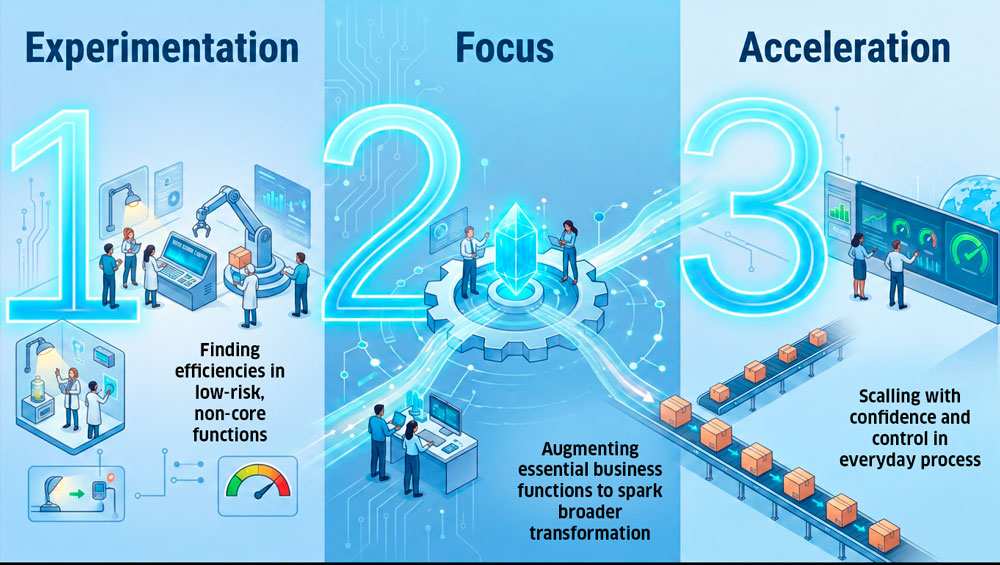
For maintenance organizations, the path to successful AI adoption may have less to do with technology and more with learning. The companies gaining the greatest advantage are often not those pursuing the biggest projects, but those willing to start small, build trust, and solve real problems for users.
What if the companies that benefit most from AI are not the ones investing the most, but the ones learning the fastest?
Industrial organizations have traditionally approached new technologies with caution. In sectors where equipment reliability, worker safety, and regulatory compliance are non-negotiable, skepticism is often justified. Yet as artificial intelligence continues to mature at remarkable speed, a new question is emerging: can organizations afford to remain observers while others gain experience?
For Andreas Steen, who works with industrial customers across the Nordic region with IBM’s AI and ISV partnerships, the answer is straightforward. Alongside Dora Nagy Eliasson, IBM’s Asset
Lifecycle Management Specialist for Maximo customers in Sweden and Norway, he regularly advises industrial organizations on how to implement AI safely and turn it into tangible business value.
“The most successful thing is that you need to get started,” says Steen. “No matter the risk level or company size, this is a learning curve. If you wait too long, you’ll be left behind.”
The advice may sound surprisingly simple. After all, discussions about AI often revolve around complex algorithms, cybersecurity concerns, governance frameworks, and ambitious transformation programs. Yet the companies making the greatest progress are often not the ones trying to solve everything at once. They are the ones willing to experiment, learn, and gradually build confidence.
Few business functions are better positioned to benefit from AI than maintenance and asset management. According to Steen, industrial organizations possess something many other sectors would envy: decades of operational data. Maintenance logs, work orders, asset histories, condition monitoring data, inspection reports, and operational records together form a rich foundation for AI-driven applications. Yet many organizations remain hesitant, often believing their data is not of sufficient quality. In practice, the reality is usually more nuanced.
“We see that industrial companies often have better structured data than many other industries,” says Steen. “In many ways, they have an excellent opportunity to succeed with AI.”
The challenge is that the data rarely sits in one place. Asset information may reside in one system. Workforce information may be stored somewhere else. Operational planning may happen in a third application. Sustainability reporting, procurement data, and inventory management often have their own environments. For years, organizations have pursued large integration projects to connect everything together.
But what if perfect integration is not the only path forward? One of the most interesting developments in generative AI is its ability to work across fragmented environments. Instead of requiring every system to be permanently connected, AI can retrieve information from multiple sources when needed and present it in a usable format. This raises an interesting question for maintenance leaders: how much value has been delayed while waiting for perfect conditions?
Many organizations have spent years discussing digital transformation. Some have postponed initiatives because systems were not fully integrated. Others have waited until data quality improved.
Yet AI introduces a different way of thinking. Instead of demanding perfection before starting, organizations can begin learning while simultaneously improving their foundations. Nagy Eliasson sees this as one of the most important shifts.
“It will get better when you start using AI,” she says. “AI can actually help organizations identify data quality issues and improve the quality of future data.”
This perspective turns a common assumption upside down as organizations are discovering that AI itself can become a tool for improving data quality. According to Nagy Eliasson, it can identify missing information, flag inconsistencies, and help users capture better information in the future.

“The key word is future. Many maintenance organizations continue to struggle with manual reporting processes. A technician completes a task, writes notes on paper, and the information eventually finds its way into a system. Along the way, details may be lost, delayed, or misunderstood”, she emphasizes.
Imagine a different scenario where a technician receives a work order on a mobile device. Instructions are immediately available. Time spent on the task is recorded automatically. Photos can be attached directly to the work order. Once the task is completed, the information becomes instantly available for planners, supervisors, and analysts. The productivity gain is obvious. Less obvious is the effect on future decision making. Every complete task contributes more accurate information for future maintenance planning.
“If the technicians see value in the tool and use it, it will generate more qualitative data into the system. Focusing on the user creates benefits for everybody”, Steen says.
This focus on the end user may be one of the most overlooked aspects of AI adoption. Many technology initiatives begin with management reporting. Dashboards become more sophisticated.
Analytics become more detailed. Yet the quality of those outputs ultimately depends on the quality of information entering the system.

The people creating that information are often technicians, operators, planners, and supervisors. This creates another interesting thought experiment. What if the first successful AI project in your organization has nothing to do with predictive maintenance? What if the biggest benefit comes from helping employees find information faster, reducing the time spent completing reports or simplifying onboarding for new technicians?
Many organizations today face a significant knowledge transfer challenge. Experienced employees are approaching retirement while younger workers enter increasingly complex operating environments.
Valuable expertise often exists in manuals, maintenance histories, and the minds of experienced personnel. According to IBM experts, the challenge is not the absence of knowledge. It is a challenge of access.
“A younger technician might not know where to find the right information, but AI can help provide the right instruction at the right moment,” says Seen and continues with an example:
“Imagine a new employee standing in front of an unfamiliar asset. By scanning a QR code, the technician can immediately access maintenance instructions, inspection procedures, historical records, or troubleshooting guidance. Information that once required to search through folders, manuals, and databases can become available in seconds. The knowledge remains the same, the accessibility changes dramatically.”
This is perhaps where AI becomes most valuable. Not by replacing expertise, but by making expertise available when and where it is needed.
Steen points out that AI can also help organizations unlock value from existing documentation. Instead of asking employees to search through hundreds of pages of manuals, AI can transform technical documentation into practical, step by step instructions that are easier to understand and use. In this way, decades of accumulated knowledge can become more accessible to a new generation of maintenance professionals.
“Of course, industrial organizations cannot ignore legitimate concerns. One of the first questions customers typically ask concerns data ownership and confidentiality. Maintenance records, production information, and operational data are among the most sensitive assets many organizations possess”, he emphasizes.
According to Steen, confidence begins with clarity about how data is handled.
“One concern is always what happens with my data,” he says. “For IBM, the answer is very clear. Customer data remains the customer’s data. We do not use customer data to train models.”
This principle is reflected in IBM Maximo, where organizations can determine the scope of information available to AI services. As Nagy Eliasson explains, customers can choose whether AI operates only within their own maintenance and asset management environment or whether it can access broader enterprise systems and external information sources. The choice remains with the customer.
This flexibility may become increasingly important as organizations seek to balance innovation with governance, cybersecurity requirements, and operational safety.
Interestingly, Steen believes that skepticism often decreases once people begin using AI in their own work. He points to IBM’s internal experience as an example. As its own “Client Zero,” IBM uses AI and AI agents across functions ranging from HR and finance to software development and customer support, testing new capabilities internally before making them available to clients. In HR, for example, managers can now rely on AI-powered assistance rather than navigating systems they may only use infrequently.
“I use IBM’s own AI tools all the time,” he says. “Previously it could take me two or three days to complete an HR related task because I didn’t know the process and I rarely used the system. Now
I can do it in five minutes because the AI guides me through the process.”
According to Steen and Dora Nagy, experiences like these are important because they move the discussion away from abstract promises into everyday reality. Trust is rarely built through presentations. It is built when people discover that a tool genuinely helps them do their job better. Yet trust remains essential, especially in industrial environments where the consequences of mistakes can be significant.
Maintenance professionals are responsible for assets worth millions of euros. In some sectors, mistakes can have serious safety consequences. The idea of allowing an AI system to make complete autonomous decisions understandably creates discomfort. The emerging answer is thus not full automation but collaboration where AI proposes. Humans decide.
This concept, often described as “human in the loop,” may become one of the defining principles of industrial AI. Systems can analyze data, identify patterns, generate recommendations, and prepare plans. Human experts remain responsible for reviewing, validating, and approving actions. Consider a practical example where an AI system identifies signs that a critical asset may fail within two weeks. A traditional approach might simply generate an alert. A more advanced approach could go further. The system could recommend inspection activities, identify required spare parts, estimate labour requirements, and suggest an optimal maintenance window. Yet the final decision still belongs to a human planner. The value lies not in replacing judgement but in supporting it.
Steen believes this distinction is crucial.
“Find proper use cases that have real value,” he says. “Relevant but safe. That’s where you should start.”
He offers another example. Imagine a machine that is predicted to fail in two weeks, while its next planned maintenance stop is scheduled four weeks from now. Predicting failure is useful, but understanding why the asset is deteriorating may be even more valuable. If the root cause can be identified, operators may be able to adjust workloads, improve operating conditions, or modify processes to extend the asset’s life to the planned maintenance window. In other words, the real value comes not from knowing what will happen, but from understanding what can still be influenced.
Perhaps that is the most important lesson for maintenance organizations today.
The future will not arrive through one dramatic AI project. It will emerge through hundreds of practical decisions. A technician receives better instructions, a planner gains earlier visibility into emerging problems, a new employee finds information more easily, a supervisor spends less time searching and more time improving operations. Taken individually, these improvements may seem modest. Taken together, they can fundamentally change how maintenance organizations learn, share knowledge, and make decisions.
The companies that succeed may not be those with the largest budgets or the most advanced algorithms. They may simply be the ones willing to start learning first.
Text: Mia Heiskanen Photos: IBM



Subscribe to the free Maintworld newsletter here!

Safety by Design: How Digitalisation is Reshaping Ship Repair at Tallinn Shipyard
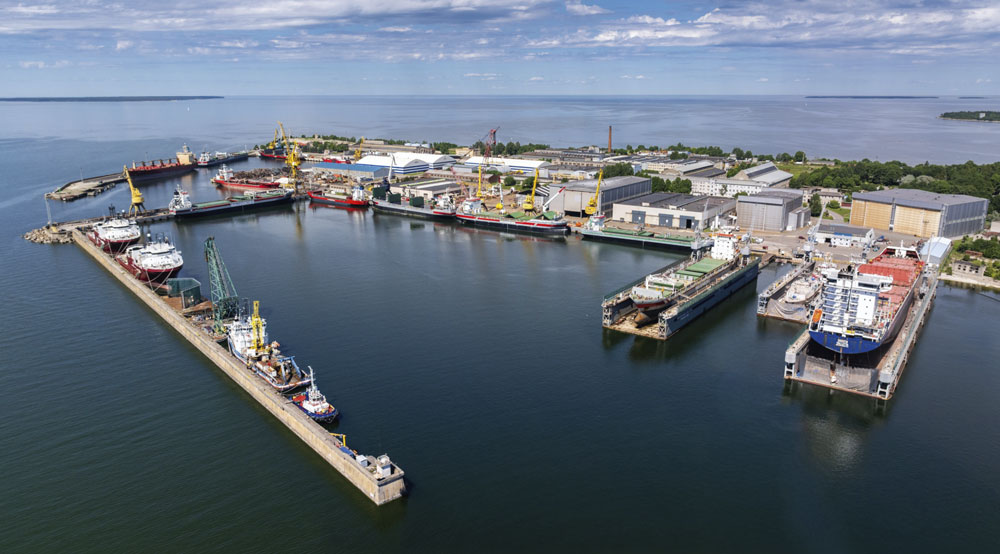
Safety in ship repair is no longer a checklist of protective gear, permits and audits. It is a strategic capability that shapes operational efficiency, customer trust and long‑term competitiveness
At Tallinn Shipyard, one of BLRT Repair Yards, this shift is already taking shape under the leadership of Chairman of the Management Board Sergei Kravchenko. The yard has modernised its safety culture through digital systems, preventive maintenance, workforce development and environmental technologies, creating an operational model in which safety and productivity reinforce one another.
Kravchenko emphasises that the biggest challenge in ship repair today is not the hazards themselves, but how organisations respond to them.
“Safety challenges in our industry have always been serious,” he says. “What matters is the attitude towards them.”
A relaxed view of risk, he warns, can trap companies in outdated practices. As shipowners, insurers and classification societies demand higher safety maturity — especially for offshore projects, complex repairs and retrofit projects aimed at reducing emissions — paper‑based systems are no longer sufficient. Tallinn Shipyard has therefore redesigned many of its core processes in recent years.
“A significant number of processes that used to depend on paper and on long human chains have been moved to digital or semi‑digital formats,” Kravchenko explains.
At Tallinn Shipyard, digital tools are at the heart of safety. Over the past five years, the shipyard has digitised numerous safety‑critical activities, including:
• Digital Near‑Miss Reporting through an in‑house platform
• Planned Preventive Maintenance for cranes, docks and production equipment
• Electronic hot‑work permits with multi‑layer verification
• Digital monitoring of active hot‑work operations
• More than 100 emergency drill scenarios integrated into routine training
These systems do not replace people; they support them by highlighting non‑conformities, reminding teams of critical steps and ensuring work cannot proceed until safety requirements are met, Kravchenko says.
One of his key messages is that maintenance is fundamental to safety. Digital PPM systems now schedule inspections, alert engineers to upcoming tasks, and improve traceability across critical assets.
“The system reminds engineers coming on shift of the work due that shift, week or month.”
The next step is predictive maintenance.
“Not just scheduled maintenance, but condition-based maintenance with failure prediction — this reduces risks for people and for production at the same time.”
Robotics will also play a growing role. Tallinn Shipyard is already using robotic welding solutions and is now working on new robotised applications for selected ship repair processes. The yard’s experience with the autonomous MC4000 water-surface cleaning vessel shows how automation can support safer operations by reducing direct human involvement in higher-risk tasks, while also strengthening environmental monitoring and response.
Kravchenko emphasises that skilled people remain the foundation of every effective safety system.

“Competence and safety are two sides of the same coin,” he says.
The link works both on a professional and on a psychological level: the higher the competence of an employee, the deeper their understanding of the seriousness and importance of the measures introduced by the yard. A competent person does not see them as “extra controls” but as a tool that protects their own life, health and the team’s reputation, Kravchenko explains.
He notes that the shortage of maritime trades — welders, pipefitters, electricians, painters — affects not only schedules and quality but also safety performance. DNV’s review of maritime safety trends (2012–2022) underscores that digitalisation and alternative fuels require parallel competence development; otherwise new risks emerge. DNV (Det Norske Veritas) is one of the world’s leading classification societies and maritime safety, risk and certification organisations.
Kravchenko notes that the Tallinn Shipyard tracks training effectiveness digitally, ensuring that “every training session, every certification, every drill is an investment in reducing the overall probability of an incident.”
Ship repair differs from shipbuilding in one crucial way: projects evolve continuously once a vessel enters dry dock. Inspections often expand the scope, creating schedule pressure that can tempt shortcuts. This dynamic introduces a distinct risk profile, where keys risks include:
• Fire during hot work
• Confined‑space hazards
• Work at height
• Lifting operations
• Dock operations and watertight integrity
• Environmental incidents such as oil spills or emissions
To counter these risks, Tallinn Shipyard embeds safety directly into workflows. Critical activities cannot proceed until permits, inspections and approvals are
completed.
“The system must be designed so that critical safety steps are built into the workflow.”
Kravchenko points out that planning is not just a commercial activity but a core safety function. Effective planning prevents incompatible work — such as welding next to coating operations — and ensures adequate resources for gas testing, ventilation and fire watch. Poor planning creates rush, and rush creates incidents.
Modern planning software and digital work orders therefore contribute directly to safer operations while improving productivity. One of the yard’s most significant innovations is its digital hot‑work management system. Electronic permits with multiple verification stages and real‑time monitoring points give supervisors visibility across the yard and improve coordination between contractors.
Digitalisation also extends to environmental safety. The autonomous MC4000 robot helps reduce the need for personnel to be directly involved in higher-risk water-surface cleanup operations.
Developed together with technology partners in Estonia, the fully electric autonomous vessel supports oil-product detection, recovery operations and environmental monitoring.
Ship repair involves many specialist companies working simultaneously in confined spaces. Poor communication can escalate risks quickly. Tallinn Shipyard addresses this through a specific model of integrated project teams that include representatives from every major trade, together with project managers and QHSE personnel. Safety objectives are approached collectively, encouraging collaboration rather than siloed priorities.
“Systems must help people do their work better and more safely,” he stresses. Technology is an amplifier, not a substitute for judgement. If culture encourages shortcuts, digital systems will be bypassed; if it encourages openness, even simple tools deliver strong results.
Kravchenko summarises the future of operational resilience succinctly: “Operational resilience will increasingly be defined not by the size of docks or the tonnage of cranes but by the maturity of this triad: people • processes • digital systems.”
Reliability, productivity and safety are no longer separate disciplines. They form one interconnected system — and shipyards that master this integration will remain competitive in any market.
About Tallinn Shipyard
Tallinn Shipyard, one of BLRT Repair Yards, members of BLRT Grupp. is a modern ship repair yard in Estonia, serving shipowners and operators across the Baltic Sea region. The yard provides repair, maintenance, modernisation and retrofit services for vessels of different types and complexity, supported by 3 floating docks of different sizes, skilled production teams, engineering expertise and specialised workshops for steel, mechanical, piping, electrical and surface-treatment works.
Tallinn Shipyard continues to modernise its operational practices in response to rising technical, environmental and safety requirements. Environmental management is part of daily yard operations, supported by technologies such as the autonomous MC4000 water-surface cleaning vessel, which helps with oil-product detection, recovery operations and environmental monitoring.
Current development priorities include stronger contractor coordination, tighter process control and wider use of digital tools across safety and maintenance workflows. This reflects a broader industry shift towards integrated planning, condition-based maintenance and more data-driven operational control.
Six Ways Tallinn Shipyard Is Digitising Safety
Over the past five years, Tallinn Shipyard has transformed many of its traditionally paper-based processes into integrated digital systems designed to improve safety, maintenance and operational efficiency. According to Chairman of the Management Board Sergei Kravchenko, the objective is not simply to introduce new technology, but to create a safer, more resilient organisation capable of taking on increasingly complex projects.
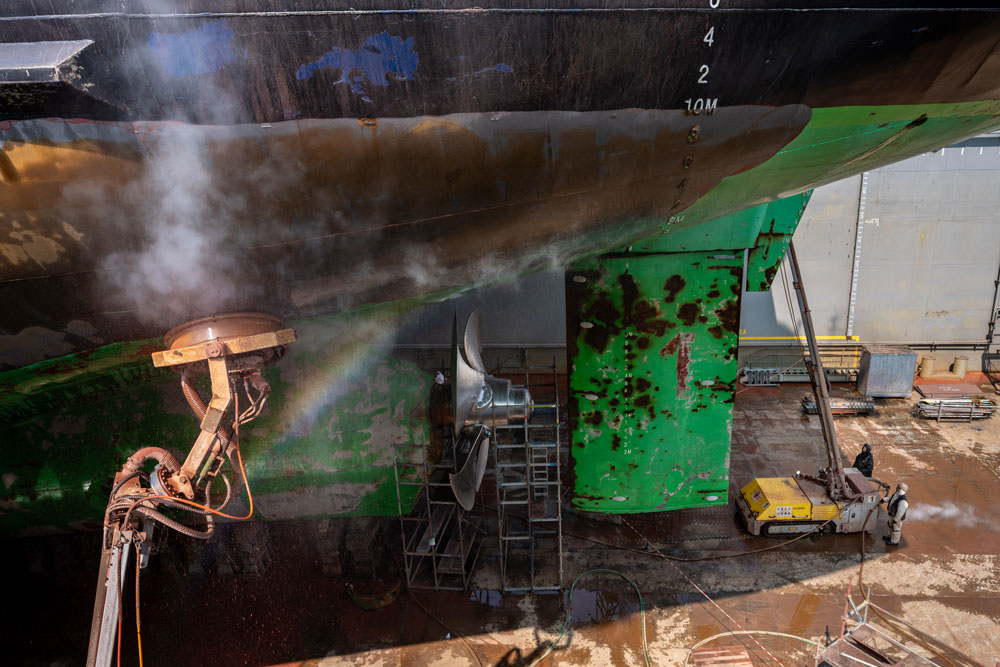
Digital Near-Miss Reporting
The shipyard has developed its own electronic near-miss reporting platform, allowing every employee to report hazardous situations quickly and easily. Each report is reviewed against established standards, with verified issues triggering corrective actions and follow-up. The system encourages proactive reporting and strengthens the yard’s safety culture.
Planned Preventive Maintenance Goes Digital
Maintenance of critical assets—including floating docks, cranes, workshops and production facilities—is now managed through a digital Planned Preventive Maintenance (PPM) system. Automated reminders and scheduled maintenance tasks help engineers ensure inspections are completed consistently, reducing the risk of equipment failures that could compromise both productivity and safety.
Passenger-Ship Safety Applied Ashore
Drawing on best practices from the passenger ferry sector, Tallinn Shipyard has incorporated more than 100 emergency drill scenarios into its safety programme. The exercises cover fires, dock emergencies, blackouts, watertight integrity and other incidents specific to ship repair, ensuring personnel are prepared for a wide range of operational risks.
Smarter Hot-Work Management
One of the yard’s most significant improvements has been replacing paper-based hot-work permits with a digital, multi-layer approval system. Electronic registration and monitoring provide supervisors with real-time visibility of ongoing hot work, improve coordination between contractors and create full traceability of permits and safety checks before high-risk activities begin.
Autonomous Environmental Protection
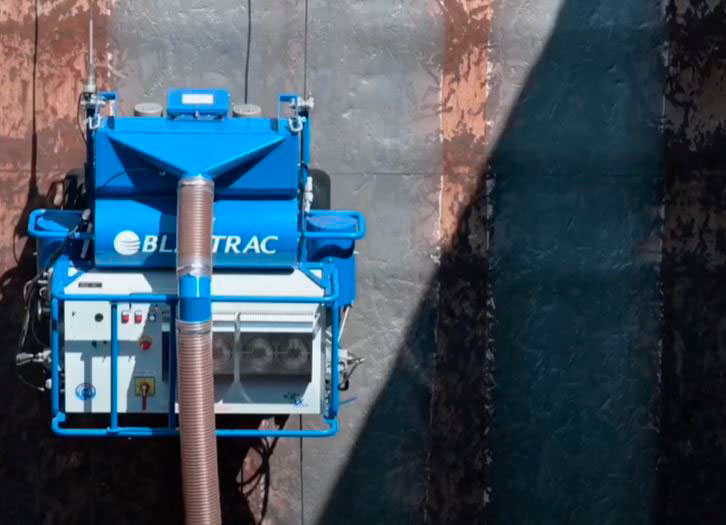
Tallinn Shipyard became the first ship repair facility to deploy the MC4000, an autonomous electric surface-cleaning robot developed developed jointly with MindChip, a spin-off of Tallinn University of Technology | TalTech, with support from the Estonian Environmental Investment Centre (KIK).
Equipped with pollution-detection sensors and oil recovery capability, the vessel continuously monitors harbour waters while reducing the need for manual intervention. Its modular design also allows future expansion with additional environmental monitoring technologies.
Building Capacity Through Safety
For Tallinn Shipyard, digitalisation is ultimately a business strategy as much as a safety initiative. Demonstrating high levels of HSE maturity is increasingly essential for securing offshore projects, specialised repairs and decarbonisation retrofits. By modernising safety processes and benchmarking against leading European shipyards, the company aims to position itself as a technologically advanced and resilient partner in the global ship repair market.
Text: Nina Garlo-Melkas
Photos: Tallinn Shipyard
Subscribe to the free Maintworld newsletter here!
Will AI Save Industrial Knowledge Before It Walks Out the Door?

When experienced maintenance professionals retire, they take more than years of service with them. They may also take knowledge that has never been written down. AI promises a new way to capture that expertise, but it raises an uncomfortable question: if machines increasingly provide the answers, how will the next generation learn to find them?
An experienced maintenance technician may hear that something is wrong before a sensor raises an alarm. A veteran operator knows when a process is behaving differently even though the numbers still appear normal. A skilled technician may make countless small adjustments without consciously thinking about them. This is expertise accumulated through years of experience, observation, problem solving and sometimes mistakes. It is difficult to document because the people who possess it may not even recognise how much they know.
For industrial companies, this presents an increasingly urgent problem as experienced workers retire. In maintenance and asset management, the consequences can reach far beyond recruitment.
Knowledge of an asset’s history, recurring failures and unusual behaviour may have accumulated over decades and still reside partly in the minds of a relatively small number of people.
Hugo Dozois-Caouette, CTO and co-founder of MaintainX, argues that manufacturers may even be defining the problem incorrectly.
“Manufacturing doesn’t have a skills gap. It has a knowledge-transfer gap.”
Dozois-Caouette says that the skills and workers exist, but companies often lack a systematic way to move expertise from those who possess it to those who need it. The question is not simply whether experienced employees will retire. It is whether their knowledge will retire from them.
Much of the most valuable industrial knowledge is knowledge that was never written down. Work instructions describe how a task should be performed under defined conditions. Experienced workers also know what happens when those conditions are not quite right.
Matt Malchano, Vice President of Software at Boston Dynamics, describes some of the expertise most at risk as “hands-on process-oriented knowledge” in an article published by the Association for Advancing Automation.
“A distinction that you see when you look at humans is that we know how to do complicated tasks with many variations, and we’re able to adapt to uncertainty in those tasks.”
Malchano points out that many of these skills are passed from person to person as the next individual is trained for the role. They are not necessarily written down in an employee handbook.
That distinction matters in maintenance. Troubleshooting rarely consists simply of following a perfect sequence of documented steps. The technician combines information from the machine, maintenance history, measurements, previous failures and personal experience to decide what matters. AI may offer a new way to preserve more of that reasoning.
Maintenance histories, work orders, manuals, inspection reports, sensor information and technicians’ observations can potentially be brought together so that workers no longer need to know exactly where the relevant information is stored. Instead, a technician could ask: Has this machine behaved like this before? What caused the problem last time? What did the technician notice before the previous failure?
The bigger opportunity may be to capture knowledge that does not yet exist in a database. A senior operator performing a maintenance or calibration task could, for example, be recorded while completing the work. AI and analytics tools could then help analyse how the task is actually performed and turn the material into a standard operating procedure, training guide or step-by-step content.
An EY analysis by Adam Cooper, EY Americas Manufacturing Transformation Business Leader, describes knowledge as the “true way of working” retained in the minds of veteran workers: insights and intuition from the shop floor that rarely make it into manuals and playbooks. The implication is significant. AI does not necessarily have to replace the experienced technician. It could make part of that technician’s accumulated experience available to hundreds of other people.

Jan Teun Koningen, Chair of the European Health, Safety and Environment Committee at EFNMS, points to the safety dimension. “When experienced maintenance professionals retire, companies risk losing what they call “tribal knowledge” about unusual or company-specific equipment. Industrial automation can be particularly vulnerable because documentation for older systems is often incomplete and reconstructing how they work can be difficult.”
Koningen mentions findIQ as one example of how AI is being applied to this problem. The German company has developed a platform designed to structure expert knowledge about industrial equipment and make it available for troubleshooting, maintenance and service. The example shows the potential of such tools, but safety-critical knowledge still needs expert validation, clear ownership and regular updating. Preserving an outdated or incorrect instruction can be as risky as losing the knowledge altogether.
This leads to a more difficult question: where will tomorrow’s experts come from? The professionals currently getting the most out of AI developed much of their judgement before generative AI existed. They learned by doing difficult work themselves, solving problems, making mistakes and gradually recognising patterns. What happens if AI removes part of that learning process? Niam Yaraghi, a nonresident senior fellow at the Brookings Institution, calls this phenomenon “borrowed expertise.”
“The productivity miracle we are observing is produced, in large part, by people whose expertise was built before AI existed.”
Yaraghi points out that these professionals are particularly good at directing AI because they have spent years developing the judgement needed to know what a good answer looks like and where a convincing AI response may be wrong. Organisations are benefiting from a stock of human expertise accumulated over decades while AI may simultaneously allow others to avoid some of the difficult developmental work through which expertise has traditionally been built.
AI may therefore make junior employees productive faster without necessarily making that employee an expert faster. For maintenance and asset management, the distinction is crucial. Finding the answer to a known problem is not the same as recognising a problem nobody has encountered before. Following an AI recommendation is not the same as knowing when the recommendation is wrong.
The more capable AI becomes, the more important that distinction may become. Perhaps AI should therefore be seen as a bridge, not a substitute? Experienced workers provide context, judgement and lessons learned. Digital systems preserve and organise part of that knowledge. Younger employees gain access to organisational experience that previously depended on knowing whom to ask. But access to experience is not the same thing as experience itself.
The challenge for industrial companies may therefore have two parts. They need to capture critical knowledge before experienced employees leave, while still giving younger professionals enough opportunities to solve difficult problems themselves. Otherwise, industry could succeed in building increasingly sophisticated systems for preserving yesterday’s expertise while weakening its ability to create tomorrow’s. Perhaps the most important question is not whether AI can preserve industrial knowledge. It is whether we can use AI to transfer knowledge without removing the experiences through which knowledge becomes expertise
Text: Mia Heiskanen Illustration: Shutterstosck AI
Subscribe to the free Maintworld newsletter here!
Driving Sustainability in Europe’s Factories

European industry is investing heavily in sustainability, from emissions targets and ESG reporting to increasingly sophisticated reporting systems. For maintenance and reliability professionals, a major opportunity remains on the factory floor.
A company can have an ambitious sustainability strategy and detailed carbon-reduction plans while still overlooking opportunities to cut energy consumption at site level.
“Corporate sustainability ambitions often fail to translate into concrete objectives and actions for maintenance and technical departments,” warns Wim Vancauwenberghe, Director at the Belgian Maintenance Association, BEMAS.
That is one of the central findings of the More4sustainability project funded by Interreg NWE, which brought together companies and organisations from Belgium, the Netherlands, France and Germany to develop a framework for translating corporate sustainability ambitions into practical action on the factory floor.
The need is clear. In 2024, industry accounted for 23.9% of the EU’s final energy consumption, with electricity and natural gas together representing around 65% of industrial final energy use.
The final MORE4Sustainability benchmark, collected in 2024, covered around 50 companies. About 60% reported having a mission, vision and values aligned with sustainability, while nearly half were actively embedding it into their organisational culture. A similar proportion had performance-management systems tracking indicators such as emissions and energy consumption.
The sample should not be considered representative of European industry as a whole: it included a relatively high share of companies already active or relatively mature in maintenance, asset management and sustainability.
“Energy Agency, industrial electric motor systems account for about 60% of global industrial electricity demand and around 25% of global electricity use.”
“A lot of companies act on sustainability, but it’s normally at a very high level,” says Rob van Dongen, a consultant at Dutch maintenance and asset-management consultancy Mainnovation.
For maintenance professionals, that points to the real sustainability gap: having emissions targets is one thing; translating them into decisions about asset performance, maintenance practices and equipment life cycles is another.
Sustainable asset management is not simply about replacing old equipment with greener alternatives.
“It is about managing industrial assets throughout their life cycle while balancing reliability, safety, cost, energy efficiency and greenhouse-gas emissions,” notes Vancauwenberghe.
That means considering what assets are purchased, how efficiently they operate, how they are maintained, when they should be upgraded and when replacement makes sense. The MORE4Sustainability Framework groups these decisions into four areas: Asset Portfolio Optimisation, Asset Health Optimisation, Energy Consumption Optimisation and GHG Emission Optimisation.
For maintenance teams, the connection is often straightforward. A leaking compressed-air network, inefficient motor, poor insulation or deteriorating pump may never appear in a sustainability strategy, yet all can directly affect energy use and emissions. According to the International Energy Agency, industrial electric motor systems account for about 60% of global industrial electricity demand and around 25% of global electricity use, leaving substantial scope for efficiency improvements.
“Maintenance and asset management can help to improve the sustainability footprint of a company,” says van Dongen.
One of the biggest barriers to sustainable asset management today is organisational.

In many companies, sustainability belongs to one department, maintenance to another, production to a third and energy management to a fourth. Each has its own goals, KPIs and budgets.
“There are quite some levers that the technical department, the maintenance department or the service department can use to contribute to energy efficiency or emissions reduction,” Vancauwenberghe says.
“But the technical department may have to make the investment while the financial savings appear in the energy, operations or sustainability budget.”
A maintenance manager may therefore face a choice between an investment that improves reliability and lowers maintenance costs and one that improves energy efficiency but requires additional work. The financial benefits of reduced energy use may appear elsewhere.
“If maintenance is evaluated primarily on maintenance cost and asset availability, there may be little incentive to use part of its budget for improvements whose financial return is booked elsewhere in the organisation,” Vancauwenberghe says.
For a department facing budget constraints, the logic is simple: “If you have only one euro, you can only spend it once.”
The challenge, then, is not simply environmental. How companies allocate capital and measure performance shapes what gets prioritised on the factory floor.
According to van Dongen, companies making progress do not treat sustainability as a separate initiative. They connect it with objectives maintenance organisations already understand: reliability, safety, energy efficiency and cost performance.
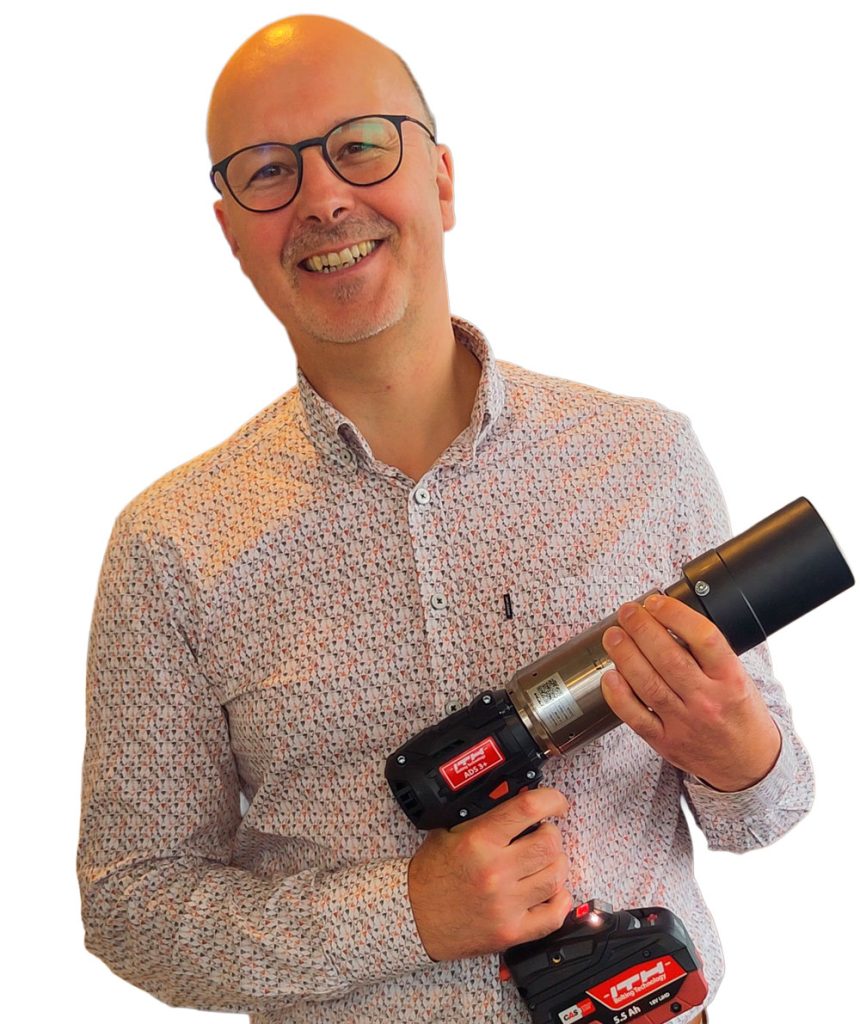
One example highlighted by the project is Royal Swinkels, the Dutch family-owned brewing company.
“If there are people on a higher level with a motivation to adopt sustainability, then sustainability will work at this moment,” van Dongen says.
But senior-level commitment is only the starting point.
“You need a driving force in the company to make sure that things will happen,” he says.
One lesson from the project may come as a surprise: sustainable asset management does not necessarily begin with major capital investments. Some opportunities lie in existing assets and routine maintenance.
“We have shown that also with partial upgrades and smaller changes, but also with day-to-day maintenance practices, you can contribute a lot to the improvement,” Vancauwenberghe says.
Thermal insulation is one example. Industrial equipment may have been designed and insulated decades ago, when safety rather than optimum energy efficiency was often the priority. Valves, measurement equipment and other components may still be poorly insulated.
Fixing compressed-air leaks and reducing steam losses can deliver further savings while revealing where energy is being wasted.
“I know that many organisations say, well, we have already done all of the easy things. However, I think in practice, they are still there,” van Dongen says.
Another opportunity is to link energy performance with asset condition.
Maintenance teams already use vibration, temperature and lubrication data to detect early signs of failure. Energy consumption can provide another indicator.
“If the energy consumption of an asset increases under comparable operating conditions, it is an indication that something may be wearing or clogging. It can also be a clear tell-tale sign of a developing failure,” Vancauwenberghe says.
Electrical Signature Analysis is one example. By analysing electrical signals such as current and voltage, it can monitor energy consumption and help detect electrical and mechanical abnormalities in motors and driven equipment, but also energy losses associated with cavitation or pump impeller wear. But technology is only part of the equation. Accurate energy data matters, but acting on it matters more.
“If you don’t register your technical failures and you don’t register the losses that are related to a certain technical failure, the only thing that you will improve is the commonly known technical failures,” van Dongen says. The same applies to energy.
“If you don’t know where you lose your energy, then you don’t know how to improve.” Without that visibility, organisations are effectively, as he puts it, “driving in a fog”.
The challenge is therefore not simply to collect more data, but to connect energy consumption with maintenance history, asset condition and production performance.
Technology and data alone will not close the sustainability gap. Maintenance and engineering professionals also need enough knowledge to participate in sustainability decisions. Vancauwenberghe notes that in informal show-of-hands polls during presentations to maintenance audiences, typically only a small minority indicate that they know the distinction between Scope 1 and Scope 2 emissions – Scope 1 referring to direct emissions from sources owned or controlled by the organisation, and Scope 2 to indirect emissions associated with purchased electricity, steam, heat and cooling.
“There is still a big gap in knowledge in this field,” he says. “How can they contribute to improvements if they don’t even talk the language and know the vocabulary?”
The MORE4Sustainability programme has responded by developing training and online learning for maintenance and asset-management professionals.
“The goal is not to turn engineers into sustainability specialists, but to give them enough knowledge and vocabulary to contribute meaningfully.”
The most important challenge, however, is financial.
“Most of the current maintenance and asset management budgets consist of what we have to do in terms of preventive maintenance,” van Dongen says.
Without dedicated funding, sustainability improvements compete with established maintenance priorities. Building the business case is therefore crucial: lower energy consumption reduces operating costs, better-maintained assets reduce losses, and extending asset life can defer capital expenditure and avoid premature replacement when continued operation remains preferable from a life-cycle perspective. Lower emissions can also reduce carbon-related costs in sectors exposed to carbon pricing.
Companies making progress are translating sustainability objectives into technical objectives and integrating them with reliability, safety, and cost performance. Most importantly, they are making sustainability part of asset management.
As van Dongen puts it: “Make sure that you are at the table with the people who make the decisions on sustainability.” For decades, maintenance has focused on reliability, availability, safety and cost.
“Those priorities remain. What is changing is that sustainability is becoming another dimension of asset performance.”
Five places to look for hidden energy losses
Some sustainability improvements do not require major capital investment. Maintenance teams can often identify energy-saving opportunities in existing assets and routine practices.
1. Check insulation. Poorly insulated equipment, valves, and measurement points can cause significant heat losses, particularly across large industrial sites.
2. Look for compressed-air leaks.. Leaks can waste energy continuously and are often detectable with relatively simple inspection methods.
3. Monitor steam losses. Steam losses can indicate opportunities to improve both energy efficiency and equipment performance.
4. Watch energy consumption. An unexplained change in an asset’s energy consumption under comparable load and operating conditions can provide an early indication of developing inefficiency or equipment problems, such as clogged filters, cavitation or pump impeller wear.
5. Connect the data. Combining energy consumption with maintenance history, asset condition, and production data can help identify where technical problems create both economic and environmental losses.
Text: Nina Garlo-Melkas Photos: Shutterstock
Subscribe to the free Maintworld newsletter here!
Putting a Price on Reliability
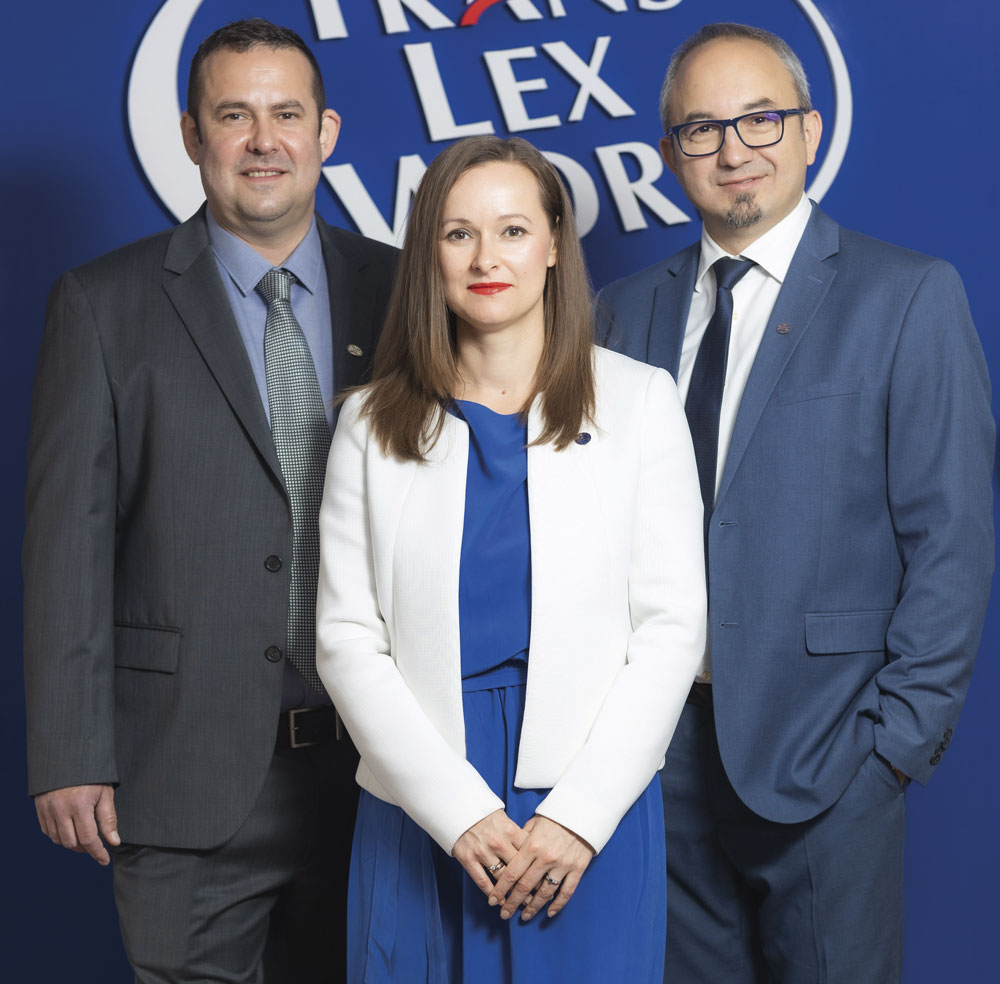
People often judge maintenance by cost rather than contribution. Yet the better it performs, the less visible its value becomes, notes Katalin Magyar, former banker and current co-director of family-owned Hungarian maintenance specialist Trans Lex Work (TLW).
For her, keeping machinery running means managing financial risk, preserving specialist knowledge and extending asset life.
But what does it really cost when a critical machine stops for a day?
“This is a question companies should always ask themselves when shaping their maintenance strategies,” Magyar stresses.
Magyar highlights that maintenance has an accounting problem: its costs are immediately visible in the accounts, while much of the value it creates is not. Inspections, spare parts, technicians and planned shutdowns all have a price.
The calculation needs to be viewed the other way around. Condition monitoring, efficient interventions and better-planned shutdowns may cost money today but prevent far larger losses tomorrow.
“If we had three unplanned stoppages this year, what did that cost? If the maintenance yearly budget had been 15% higher, maybe that would have been only 2% of the loss.”
For TLW, this is not an abstract financial calculation. The company specialises in maintaining large rotating equipment, including steam and gas turbines, compressors, pumps and fans, much of it decades old, which have been causing extra costs for clients due to unmatured maintenance strategy
Magyar describes maintenance as a “hidden bonus”: “It only appears when there is an unplanned stoppage and then the money just flows out,” she describes.
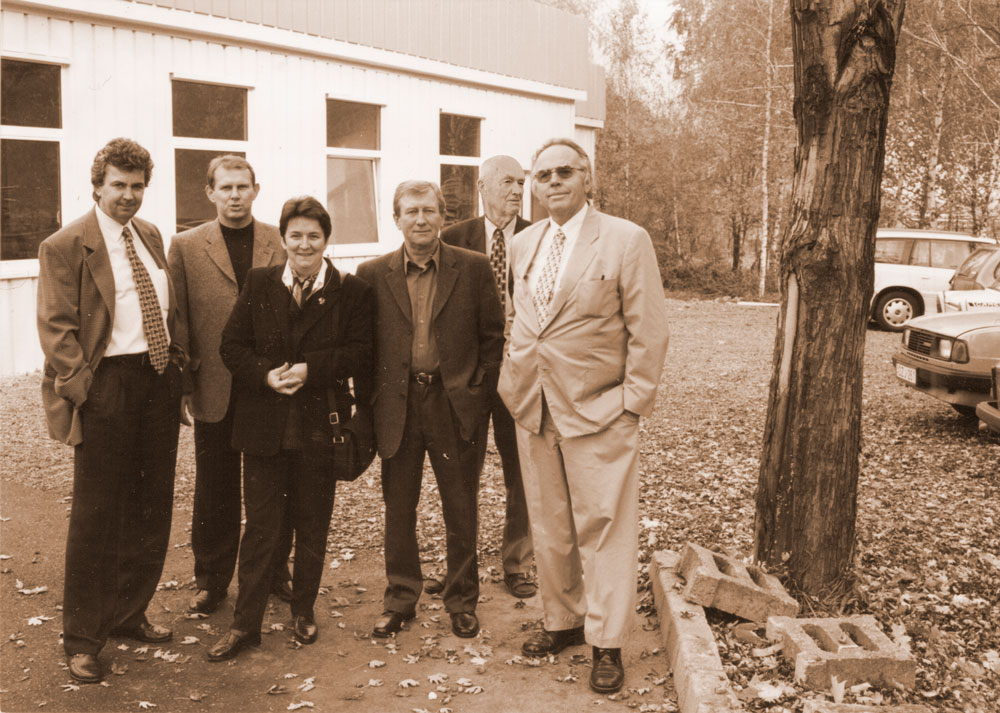
TLW’s origins date back to 1992, when Hungary was transitioning from a state-controlled economy to a market economy. Five engineers founded the company after helping rebuild an industrial plant in Iran, damaged during the Iran-Iraq War.
Magyar’s father was among the founders. The project drew on expertise developed in Hungary’s petrochemical sector and helped establish TLW’s reputation for providing industrial companies highly specialised technical work.
TLW began operating in Hungary in 1994 and gradually expanded its capabilities in vibration monitoring and rotating-equipment maintenance. By 2008, specialised maintenance had become the core of the business.
Today, the company employs around 40 people and focuses on rotating equipment, providing both ad hoc interventions and continuous maintenance services.
The age of the industrial equipment we help maintain makes experience particularly important, Magyar says.
“The Client’s machines are running from 30 to even 60 years, so experience is very important.
TLW has retained documentation going back decades: “We still have the documentation with us from 15 to even 30 years back,” Magyar says.
“When a machine has been modified, repaired and maintained over decades, its history can help determine what should happen next.”
Finding and retaining skilled people in an ageing workforce is one of the company’s biggest challenges in an increasingly competitive market.
Magyar notes that it can take three to five years for a new technician to become fully familiar with the equipment, customers and practical realities of the job. When an experienced employee leaves, the company loses both knowledge and its investment in training.
“Training is a very big investment and also a cost if we lose someone. And usually, they go to our clients.”
TLW is therefore working actively to transfer knowledge between generations. Magyar cites a 73-year-old specialist who works alongside a younger engineer, passing on decades of hands-on experience and machine-specific know-how.
For a company working with machines that can be up to 60 years old, that knowledge is not simply a human resource — it is part of the asset’s history.
Magyar’s route into the maintenance business was unconventional. With a background in economics and finance, she had to build her understanding of an industry dominated by engineers and technicians.
Today, she oversees finance, international relations, marketing and contracting, while family members lead projects and operations.
In Hungary, women remain relatively uncommon in field maintenance. But Magyar believes being a woman can sometimes help when discussions become difficult, allowing her to ease tensions and bring a broader perspective to the table.
Ultimately, however, the measure of success is the same for everyone.
“In Hungary, women remain relatively uncommon in field maintenance.”
“At the end of the day, the machine has to be running,” she says.
Keeping the machine running can require spending that is difficult to justify when budgets are under pressure. Magyar says the tension between maintenance costs and the cost of failure becomes particularly clear when customers want to cut spending or shorten shutdowns.
The key question, she says, is what those apparent savings could cost if the machine fails.
She recalls a power-plant customer with a 30-year-old machine. The customer wanted TLW to guarantee vibration limits after a minor overhaul or bearing replacement. However, based on the machine’s history and previous modifications, TLW’s specialists noted that the machine needed a more extensive inspection.

“They wanted only minor maintenance,” Magyar says. “But we knew that this maintenance would not improve the condition of the machine.”
The cheaper option may sometimes look attractive on paper, but the calculation changes completely if the machine fails. This is one of the paradoxes of maintenance: the decision that costs least upfront can carry the greatest financial risk.
“If everything goes smoothly, it’s the cheapest. But if there is an outage or a production failure, that can cost a lot. And this cost is never shown in the balance figures.”
This is why maintenance decisions need to be linked more closely to their operational and financial consequences. Lower maintenance costs may look like a saving, but the real cost can emerge later in lost production, extended downtime, and unexpected repairs.
TLW’s more than 20-year relationship with Birla Carbon Hungary Ltd. shows the value of long-term maintenance partnerships.
Under a fixed-price 24/7 call-out agreement, TLW has a direct incentive to keep the machinery running rather than rely on emergency repairs. TLW uses vibration monitoring and works closely with the customer to identify and address problems before they develop into failures.
“It is in our utmost interest to have as few interventions on the machines as possible. If we only work a little but very efficiently, then we also make more profit,” Magyar stresses.
“For that reason, there really are not any unplanned stoppages. For both of us, the cooperation is very beneficial.”
This points to a broader role for maintenance providers.
“The service provider should be more strategically involved in the customer’s operations,” she says.
Instead of being called in when something breaks, maintenance specialists should be involved earlier to assess equipment condition, plan maintenance and manage risks before they become costly failures.
Magyar sees a similar need for closer cooperation within industrial companies.Maintenance, operations, procurement and finance often have very different priorities. Procurement may focus on immediate purchase price, while maintenance professionals focus on reliability and long-term performance.
For critical equipment, she believes the people who understand the machinery should have greater influence over purchasing decisions.
“KPIs should not focus only on lowering costs or securing the contract. They should also reflect how the project performed — whether the maintenance objectives were achieved and what the outcome was for the customer.”
Magyar recalls a case in which her company lost a tender to a lower-priced contractor. The turbine was subsequently damaged during start-up, resulting in a 10-month shutdown.
“And there were no consequences for the procurement,” she says.
The example highlights a broader problem: the price of a procurement decision is easy to measure, while its consequences may emerge much later — and be felt elsewhere in the organisation.
Technology offers another way to preserve and extend accumulated knowledge.
“Maintenance, operations, procurement and finance often have very different priorities.
TLW operates its own remote monitoring system and is exploring how artificial intelligence could assist with the preliminary analysis of monitoring data. Another practical application is helping engineers find relevant information more quickly.
“We have so much documentation on our server. Sometimes, finding all the documentation takes hours.”
Instead of relying solely on individuals to remember what happened to a machine in the past, engineers can use historical records to identify relevant information and patterns more quickly.
“The aim is not to replace experienced engineers, but to help them identify relevant information and patterns more efficiently,” Magyar says.
The same logic increasingly applies to industrial assets themselves.
Magyar says customers today are seeking to extend operating periods between stoppages, particularly in a more uncertain economic environment.
“Most of our clients try to lengthen the operational time between stoppages. And that can only be served by monitoring and appropriate maintenance.”
When investment in new equipment is not financially viable, extending the productive life of existing assets becomes increasingly important.
For assets that have already operated for decades, extending their life depends on understanding their condition and retaining the knowledge of the people who know them best.
That brings the argument back to the fundamental paradox of maintenance.
Finance focuses on costs. Procurement seeks competitive prices. Operations want uninterrupted production. Maintenance focuses on reliability.
Yet all four ultimately depend on the same physical asset.
And when maintenance is done well, little appears to happen. Production continues, equipment performs as expected, and potential failures never materialise.
“The machine has to be running,” Magyar says.
That, Magyar stresses, is maintenance’s hidden value: its greatest successes are often the events that never happen.
The Second Life of Industrial Machinery
Hungary’s economy has been through a prolonged period of sluggish growth: GDP grew by just 0.5% in 2025, while investment fell by 18% between 2022 and 2024 after strong growth in the preceding years.
Against this backdrop, Katalin Magyar of TLW says industrial clients are increasingly looking at how long they can keep existing machinery in productive operation rather than replacing it.
“And that can only [be] served by monitoring and appropriate maintenance.”
Magyar also sees potential for a stronger second-hand market for industrial machinery. She points to equipment bought with EU funding that can end up being discarded after only a few years if the company operating it goes bankrupt or can no longer use it.
“There should be a second-hand market for that,” she says.
In her view, EU and national funding could also support the reuse of existing machinery — for example, by helping companies repair and return second-hand equipment to productive use. Tax incentives or other forms of public support could make such reuse more economically attractive.
For maintenance companies, this could create another opportunity to assess, repair and refurbish equipment, extending its productive life rather than seeing it replaced or scrapped.
As the Hungarian market slows, TLW is also expanding its international footprint. The company has already worked in Norway, Spain and Ukraine and is now exploring opportunities in neighbouring markets, including Austria, Slovakia and the Balkans.
“We’re shifting our focus towards international opportunities,” Magyar says. “We want to build on decades of expertise and relationships with industrial customers and partners to expand our business across the region.”
Katalin Magyar’s 4 tips for making maintenance value visible
1. Measure the cost of failure, not just the cost of maintenance.
2. Protect and transfer maintenance knowledge before it is lost.
3. Treat maintenance providers as strategic partners, not emergency contractors. Plan together!
4. Bring asset and reliability engineers to the decision table for investments, procurement, and performance verification after major maintenance.
Subscribe to the free Maintworld newsletter here!
Why Maintenance Teams Need Better Inspection History, Not Just More Data

Maintenance teams rarely suffer from a complete lack of information. In many industrial organizations, the opposite is true. Work orders, inspection checklists, condition notes, photographs, vibration readings, oil analysis results, temperature logs, spare parts records, safety observations, and failure reports are created every day. The amount of maintenance data keeps growing, but the practical value of that data depends on whether it can explain what is happening to assets over time.
A single inspection record can show what was found on a specific day. It can confirm that a technician inspected a pump, motor, gearbox, compressor, conveyor, fan, valve, or production line. It may include a condition rating, a note, a photo, or a recommended corrective action. Yet by itself, that record may not show whether the same issue has appeared before, whether a repair solved the problem, or whether the asset is slowly becoming less reliable.
This is where many maintenance programs lose value. The organization has data, but the data does not always form a usable history. One technician sees a vibration concern. Another records an oil leak. A third closes a corrective action. A supervisor reviews a work order. Each record may be accurate, but if the information is scattered across systems, spreadsheets, PDFs, email, or paper forms, the larger pattern can remain hidden.
Recurring failures often look ordinary when they are reviewed one event at a time. A pump seal is replaced. A bearing temperature is monitored. A fan is cleaned. A conveyor is adjusted. A valve is repaired. The asset returns to service, the job is closed, and the team moves on. A few weeks or months later, the same asset requires similar attention. Without connected history, the new event may be treated as a new problem.
That cycle is expensive. Repeat failures consume labour, parts, contractor time, planning capacity, and production attention. They also create uncertainty. Is the asset failing because of age, operating conditions, installation, contamination, lubrication, loading, environment, design, or maintenance practice? If previous inspection findings and corrective actions are not easy to review, the team may spend valuable time rediscovering what the organization already knows.
Useful inspection history connects the finding to the asset, component, location, condition, severity, photo evidence, corrective action, and follow-up result. It helps a technician or reliability engineer understand not only what was found, but whether the same condition has appeared before. The record should be consistent enough to compare across time, assets, sites, and similar equipment. A note that says “pump repaired” may close a task, but it does not explain enough for future troubleshooting. A stronger record shows what was found, what was done, whether the repair was verified, and whether the condition returned.
This matters because many maintenance problems are not isolated technical events. A recurring pump issue may involve suction conditions, alignment, seal selection, installation, contamination, or operating practice. A recurring bearing issue may involve load, lubrication, vibration, temperature, access, or cleaning frequency. A repeated electrical finding may involve heat, dust, moisture, enclosure condition, torque, or process changes. The asset history gives maintenance teams a way to ask better questions.
Good inspection history also supports better prioritization. Maintenance teams rarely have unlimited time or resources. They must decide which issues require immediate attention, which can be planned, and which need deeper engineering review. A single low-severity finding may not require escalation. The same finding repeated several times on a critical asset may deserve a different response. History helps teams distinguish isolated issues from patterns that are consuming reliability.
Corrective actions should close the loop, but they often close only the task. A problem is identified, work is assigned, and the record is marked complete. That process may be administratively correct, but it does not always prove that the underlying condition has been resolved. If the same issue returns, the organization should be able to see what was tried before and whether the action was effective.
A complete corrective-action history helps answer practical questions. Was the root cause identified correctly? Was the action fully completed? Did the condition change after the repair? Did a similar problem appear on comparable assets? Is this a maintenance issue, an operating issue, or an engineering issue? These questions are difficult to answer when past findings are disconnected from the asset record.
The value of inspection history is not limited to the maintenance department. Operations teams need to understand how equipment condition affects production. Reliability teams need to see trends across assets and sites. Safety teams need visibility into repeat findings that may create risk. Engineering teams need evidence when deciding whether to redesign, replace, or modify equipment. Finance and asset managers need better support for repair-versus-replace decisions. A shared history improves the quality of all these conversations.
Digital tools can make this easier, but the goal is not digitization for its own sake. A paper checklist converted into a digital form is only a starting point. The greater value comes when inspection findings, photos, corrective actions, work orders, asset records, and reports remain connected in a way that can be searched, compared, and reviewed over time. Guidance on inspection data management describes how inspection records, asset condition histories, corrective actions, photos, and reports can be organized in a more consistent workflow. (source: Field Eagle)
This kind of structure also affects the future use of analytics and artificial intelligence. AI is often discussed as a way to predict failures, rank maintenance priorities, or identify patterns across large volumes of operational data. However, AI cannot compensate for poor history. If asset names are inconsistent, defect descriptions are vague, photos are not connected to the correct equipment, and corrective actions do not show outcomes, advanced analysis will have limited value.
AI-supported maintenance depends on reliable history. If asset names are inconsistent, defect descriptions are unclear, and corrective actions do not show outcomes, AI tools have little meaningful context to analyze. Better inspection records improve current maintenance decisions and create a stronger foundation for future analytics. AI can support preventive maintenance when it has access to reliable inspection history, asset condition data, recurring defect records, and corrective-action outcomes. Resources on AI preventive maintenance discuss how inspection history and asset condition information can be used to identify risk patterns and support maintenance planning. (source: Field Eagle) The same principle applies more broadly to AI implementation. AI is more useful when connected to business workflows, structured data, and specific decision points rather than treated as a standalone model. (source: Konverge)
The practical work starts before any advanced analytics are introduced. Maintenance teams can begin by choosing a few assets that already consume repeated attention. These might include a pump with recurring seal problems, a fan with vibration findings, a compressor with repeat alarms, a conveyor with alignment issues, or a production asset that frequently generates corrective actions. Reviewing several months of inspection notes, work orders, photos, and closure comments can reveal whether the same conditions keep appearing.
The next step is consistency. Similar defects should be described in similar language. Findings should be tied to the correct asset and component. Photos should be attached to the right record. Corrective-action notes should explain what was done and whether follow-up is required. Maintenance, operations, and reliability teams should review repeat findings together, because the cause of a recurring issue may sit outside one department’s view.
Better inspection history does not eliminate maintenance work. Equipment will still wear, fail, drift, leak, vibrate, overheat, and require repair. The difference is that maintenance teams can respond with more understanding. They can see whether an issue is new or familiar. They can identify assets that require repeated attention. They can plan repairs under more controlled conditions. They can support improvement decisions with evidence rather than memory.
In the end, the most valuable maintenance record is not the one that simply proves an inspection was completed. It is the one that helps the next person understand what happened, what was done, and whether the condition is likely to return. For maintenance teams under pressure to improve reliability, reduce downtime, and use resources wisely, better inspection history may be more useful than more data.
Author introduction
Palak Sheth writes about inspection management, asset reliability, preventive maintenance, AI-enabled workflows, and the practical use of operational data in industrial environments. Her work focuses on how structured inspection records and corrective-action history can support better maintenance and reliability decisions.
Subscribe to the free Maintworld newsletter here!
Closing the Maintenance Execution Gap

Industrial companies have invested heavily in reliability engineering, preventive maintenance, condition monitoring and digitalisation. Yet many still struggle to realise the full value of those investments when they translate maintenance strategy into action on the machine.
According to maintenance and reliability practitioner and author of The Maintenance Execution Gap: Why RCM Cannot Close It and What Will, Peter J. Munson, the problem is often not a lack of technology or analysis, but what happens when maintenance strategy is put into practice at the machine.
Munson calls this the maintenance execution gap: the distance between what a maintenance strategy intends to achieve and what reaches the equipment.
“The maintenance strategy of a company may be excellent,” Munson says. “However, what reaches the technician, the instruction, the tools, the right lubricant, access to the machine, and a way to report what was found, is usually a thin and degraded copy of it.”
The problem can emerge when reliability analysis is translated into work orders. A study may identify failure modes, maintenance tasks and intervals. Still, the resulting work instruction may contain little of the technical reasoning behind them – or the criteria for deciding whether equipment is operating as it should. Meanwhile, equipment changes while task lists remain untouched.
At one large plant Munson analysed, 91% of more than 19,000 equipment task lists were more than five years old, and none contained detailed instructions for carrying out the work.
One of Munson’s clearest examples of a vague maintenance instruction is: “PM pump. Check oil.”
It may satisfy a CMMS requirement, but what does it actually tell the technician? What constitutes acceptable oil condition? What temperature is normal? What should be measured? Which failure history matters? And what should the technician do if something is outside the expected range?
“An instruction like that gives the technician no acceptance criteria, no search sequence, no failure history for the machine and no rule for what to do when something looks wrong,” Munson says.
“So, he checks what his experience tells him to check, writes ‘Oil level OK, no issues,’ and closes the order.”
Without clear criteria and actions, the technician largely relies on personal experience.
Munson describes the result as a paradox: compliance can be 100%, while detection is zero. The CMMS records a completed preventive-maintenance task, but the inspection may have generated little or no useful information about the equipment’s condition.
A more effective instruction could specify an acceptance criterion and the required response – for example, a drive-end bearing temperature limit of 82°C, with notification and vibration analysis required if the limit is exceeded.
The difference is that technical knowledge has been translated into an actionable instruction rather than left buried in a report or dependent on someone’s memory and experience.
The challenge extends beyond maintenance instructions to the way maintenance performance is measured, Munson says. Completing a maintenance task does not necessarily mean it was effective.
Effectiveness requires additional evidence.
Traditional measures often focus on activity: Was preventive maintenance completed on time? Has the backlog decreased? Is the workforce being utilised?
Munson argues that the more important question is whether the work reduces risk, prevents degradation or restores performance.
“Good asset management requires system views and system outcomes,” he says. “Is our work effective in efficiently reducing risk and restoring performance to assets that naturally degrade?”
That is a key question when measuring maintenance performance.
One useful measure, he notes, is findings yield, the proportion of PM tasks that produce at least one actionable finding. Other measures include measurement completion – whether an inspection produces an actual measured value rather than simply “OK” – and detection rate, showing how many failures are identified before equipment loses its function. Munson notes that identifying a problem is only useful if you do something about it.
“A finding that sits in the backlog for six months is a finding the organisation has chosen to ignore,” Munson says.
Munson highlights that maintenance can also introduce failure mechanisms through incorrect installation, contamination, poor lubrication, inadequate tools, or uncontrolled fastening.
He points to examples such as improperly stored bearings, contaminated lubricants and components installed without appropriate torque or alignment controls.
These may not be individual technician failures but weaknesses in the maintenance system. If a defect appears shortly after a maintenance intervention, the organisation needs to recognise the connection. Otherwise, the resulting failure may be treated as another equipment problem.
“If the repair introduces the next defect, the plant has paid for faster diagnosis of a failure it is about to recreate,” Munson says.
Munson’s Maintenance Execution Framework looks at what must be in place for a maintenance strategy to work when it reaches the machine. The starting point is a practical question: when the technician arrives at the equipment, do they have the information, resources and conditions needed to do the job correctly? One part of the framework is what Munson calls an Execution Reference.
Rather than a generic instruction such as “PM pump. Check oil”, it should tell the technician what to look for, what constitutes an acceptable result and what to do if the result falls outside the expected range. Relevant failure history can also help the technician recognise recurring problems.
But good instructions are only one part of execution. The technician also needs the right tools, specified materials and lubricants, and equipment stored and prepared correctly. The machine must be safely accessible, isolated and permitted for work. If the job continues across shifts, relevant information and findings need to follow the work rather than being lost between handovers.
The framework also includes a feedback loop. Technicians should capture what they discover during maintenance and use it to improve future instructions, maintenance tasks, and decisions. In this way, field experience becomes part of the maintenance system rather than remaining with an individual technician.
The framework’s practical point is simple: a maintenance strategy is only as effective as the conditions that allow it to be executed correctly at the machine.
So how can companies close the maintenance execution gap? Munson recommends starting with the worst-performing assets rather than redesigning the entire maintenance system at once.
Take the last 20 completed PM tasks on a poor-performing asset. What was found? Did a finding generate a follow-up work order? Was it completed? Did the equipment perform better afterwards?
The investigation should also move beyond the CMMS and examine what happens at the machine. Are lubricants protected from contamination? Are the correct tools available? What happens when a technician reports a finding? At one plant Munson reviewed, nearly 70% of bad-actor locations had no PM at all.
He believes measurable progress can be made within six months by rebuilding Execution References for the top 10–20 bad actors and critical machines, adding findings yield and measurement completion to weekly maintenance discussions, improving lubrication practices and linking post-maintenance failures to the preceding job.
Munson says technicians should also receive feedback on what happened after they reported a finding. If a technician identifies a problem, they should know whether it was investigated, what action was taken and whether the action solved the problem. This closes the loop between inspection, maintenance and learning.
The maintenance industry has spent decades improving the analytical side of reliability. Munson argues that this knowledge creates value only when it reaches the machine in a form technicians can understand and act on, and when technicians’ field learning feeds back into the maintenance system.
Ultimately, reliability is not determined by the sophistication of an organisation’s analysis but by the quality of execution at the machine. The test is straightforward: does the maintenance system tell technicians what to do, give them what they need, and learn from what they find?
Four Ways to Close the Maintenance Execution Gap
• Focus first on your 10-20 worst-performing assets.
• Replace vague PM instructions with clear acceptance criteria and required actions.
• Measure findings yield and detection rate, not just PM completion.
• Link post-maintenance failures to the maintenance work that preceded them.

Peter J. Munson
Peter J. Munson is founder of SamOS Industrial Execution and has nearly 30 years of experience in maintenance, reliability and operations across industries including refining, chemicals, utilities and mining. A former U.S. Marine Corps maintenance officer and pilot, he holds CRE, CMRP and CRL credentials and is the author of The Maintenance Execution Gap: Why RCM Cannot Close It and What Will.
Text: Nina Garlo-Melkas Photos: Peter J. Munson
Subscribe to the free Maintworld newsletter here!