AI “Time Machine” Refines Renewable Energy Forecasting
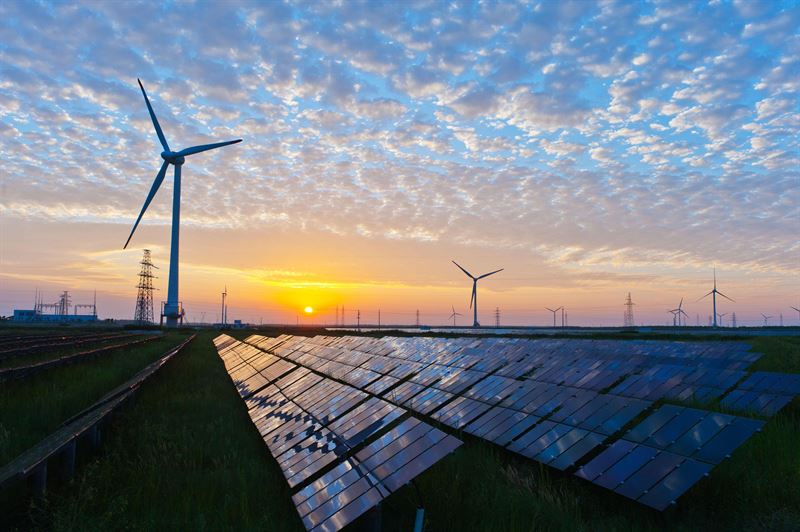
A new AI-based computational “time machine” provides a more accurate assessment of trends in wind and solar power usage.
The “time machine” outperforms current forecasting methods by using AI techniques to analyze historical growth models from different countries. Predicting the future is particularly challenging for technologies such as wind and solar power, where rapid cost reductions are offset by growing obstacles such as public opposition, infrastructure constraints, and policy changes.
“Current models are very good at identifying what needs to be done to achieve climate goals, but they don’t tell us which development paths are most likely. This is precisely the gap we wanted to fill,” says Jessica Jewell, a professor at Chalmers University of Technology.

The researchers observed a recurring pattern in the growth of wind and solar power across more than 200 countries: long periods of relatively steady growth, often interrupted by sudden spikes triggered by policy changes.
“Most models assume a smooth S-shaped growth curve, but in reality, that’s not the case. Growth often occurs in bursts, and if this is ignored, the pace of technology adoption can be misjudged,” says Avi Jakhmola, a doctoral student at Chalmers University of Technology.
13,000 virtual worlds for the future
To improve forecasts, Jakhmola created a model based on 13,000 virtual worlds. In each of these worlds, solar and wind power develop in different ways—from the fastest possible growth to the slowest—and everything in between. A machine learning algorithm was then trained using all of these worlds to learn how to predict global outcomes from early national trends.
“When we apply the model to real-world data, it can tell us what the most likely outcome will be in the future—taking into account what we’ve seen so far and all the virtual worlds the model has seen,” Jakhmola says.
Onshore wind power share to rise to over a quarter
According to the model’s forecast, by 2050 onshore wind power will account for about 26 percent of the world’s electricity (range: 20–34 percent), and solar power for about 21 percent (15–29 percent). These figures are roughly in line with the 2°C target but fall short of the requirements of the 1.5°C target.
The projections also put the pledge made at COP28 to triple renewable energy capacity by 2030 into proper perspective. The pledge falls near the 95th percentile, meaning it would require growth rates rarely observed.
“The pledge to triple renewable energy production isn’t impossible, but it would require everything to go extremely well in every country,” Jewell says.
The researchers also tested what achieving the 1.5°C target would actually require.
“If we start now, the required growth rates are demanding but not unprecedented. They are comparable to the wind power targets in the EU’s REPowerEU program and India’s solar power production plans,” says Jakhmola. “But if we delay until 2030, the required acceleration becomes much steeper and more abrupt. The window of opportunity for expanding production will close rapidly.”
Looking back to verify the model’s reliability
The researchers also used the model to test the reliability of the forecasts—by going back in time.
“We wanted to know if our forecasts would hold true ten or twenty years from now. When we fed only 2015 data into the model, we found that it correctly predicted the developments that occurred afterward. This is what we mean by a ‘computational time machine,’ and it gives us real confidence in future forecasts,” says Jakhmola.
The research points to a broader goal of developing scientifically rigorous methods to predict the most likely growth trajectories for other low-carbon technologies as well, not just wind and solar power.
Jessica Jewell says: “The poor quality of technology forecasts has long been a running joke. But if you’re a decision-maker trying to figure out how aggressively the transition should be driven, you need a realistic starting point. Our study is the first step toward developing such a realistic vision of the future.”
More information about the study
The article “Probabilistic projections of global wind and solar power growth based on historical national experience” has been published in the journal Nature Energy. The researchers have also created an online tool presenting the results, which is available on the Energy Technology and Policy website.
The authors of the article are Avi Jakhmola, Jessica Jewell, Vadim Vinichenko, and Aleh Cherp. They represent Chalmers University of Technology and Lund University in Sweden, the University of Bergen in Norway, the International Institute for Applied Systems Analysis (IIASA), and the Central European University in Austria.



Subscribe to the free Maintworld newsletter here!

Latest