Feature Engineering-Based Operational State Recognition of Rotating Machines
One might think that the era of large internal combustion engines (ICE) as electric power producers would soon be over due to the ongoing green transition.
Such an assumption is being proved wrong by the engineers who work hard on finding solutions to convert these fossil fuel-consuming machines to also operate on renewable fuels. ICE-based power plants have a crucial role in the green transition as a balancing element for the fluctuating nature of wind and solar energy production.
Vibration analysis and machine learning methods
The future goals impose new requirements and raise uncertainties considering the whole lifecycle of the power plants. They generate a need for the development of new tools and methods in a wide range. Within the operational phase of the lifecycle, particularly in the domain of structural condition monitoring, vibration analysis techniques have long been the cornerstone of getting precise insights into the health of rotating machinery and along with the operational data estimating their remaining useful life. On the other hand, increased computing power, and the emergence of the industrial internet of things (IIoT) have created a foundation for continuous operational monitoring in real-time, or at least in near real-time. In this context, vibration analysis (VA) and machine learning (ML) methods can be used to build precise and efficient state recognition models for rotating machines as shown in this case.

Vibration analysis techniques have long been the cornerstone of getting precise insights into the health of rotating machinery and estimating their remaining useful life.
Operational state recognition of a generating set
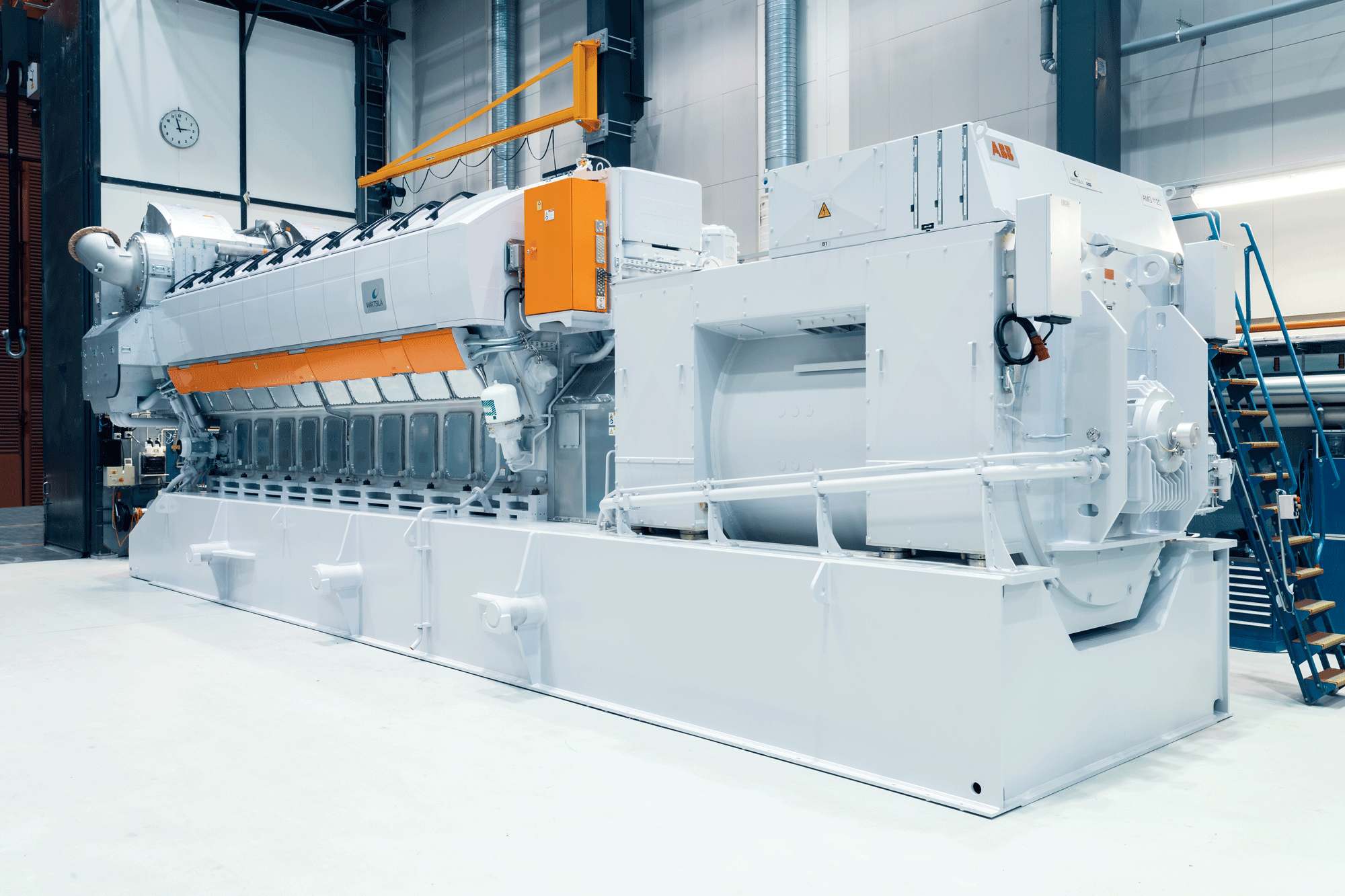
This article introduces simple and computationally light models for the operational state recognition of a generating set (genset). The models were developed in a research project (Digibuzz-VTT) forming part of a joint research effort called DigiBuzz financed by Business Finland and are thoroughly described in a master’s thesis [1]. DigiBuzz was led by LUT University between 10/2019 and 01/2022. One of the partner companies in DigiBuzz, Wärtsilä Finland Oy, provided the dataset for building the operational state recognition models. The data consists of accelerations acquired from a Wärtsilä 20V31SG genset measured at various constant power output levels, as well as during some occasional fault situations. Gensets combine an ICE and an electric generator. They are typically used for producing power to the electric grid. While the electric grids have constant frequency, the power demand fluctuates. As a result, the gensets operate at constant speeds but with variable power output. The grids may encounter occasional disturbances which cause abnormal operation of a genset. Thus, the dataset effectively covers the acceleration response of a genset within its typical operational range.
Inertia forces and gas forces
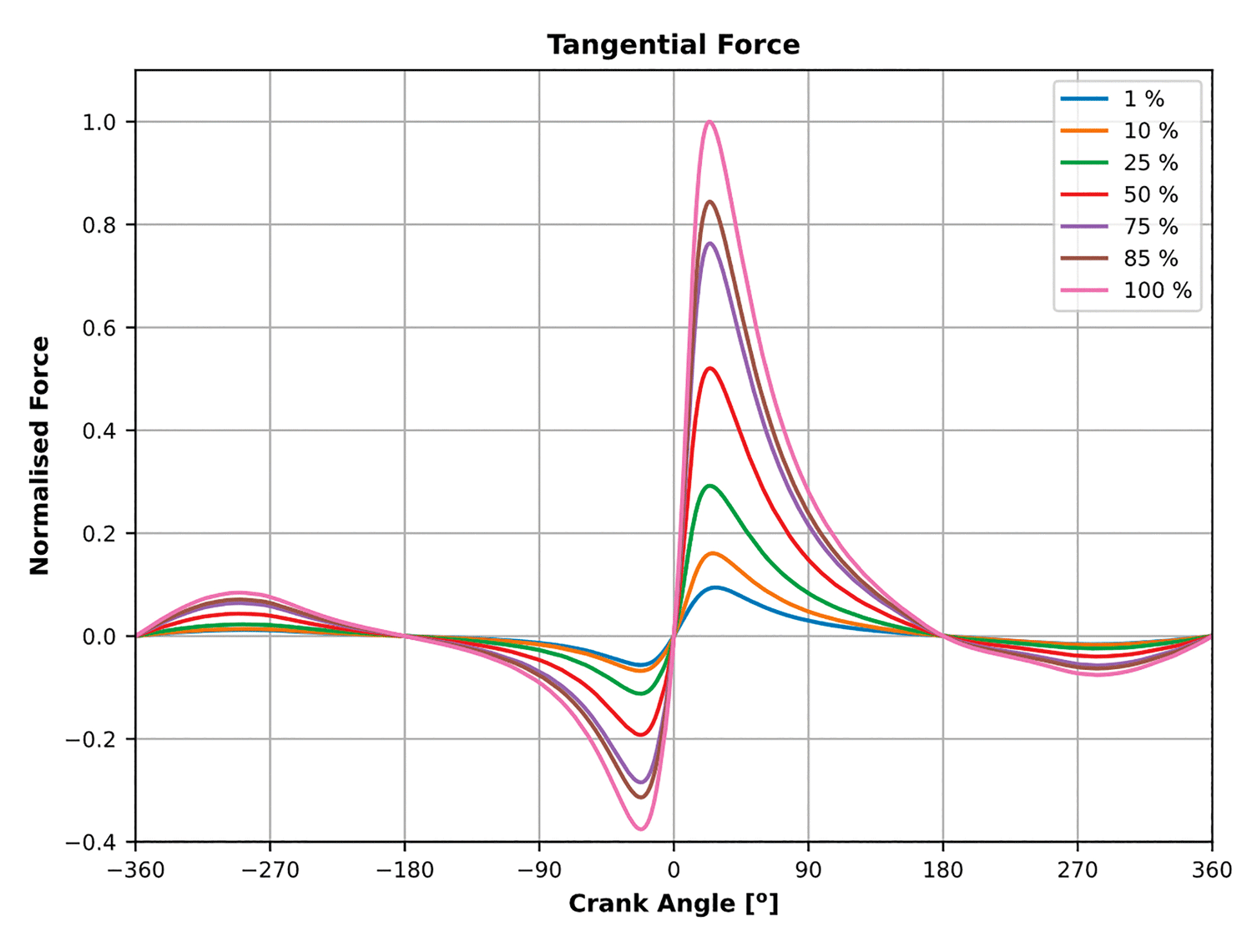
The operational state recognition models discussed in this article are built around the cyclic nature of the operation of ICEs. The general assumption is that the dynamic behaviour, at steady load and constant rotational velocity across engine cycles, repeats itself and that load variation can be seen as a notable change in the dynamic response. Thanks to Newton, most of us know that acceleration and vibration is caused by force, and think that the relation between them is linear. Considering ICEs, the principal forces exciting vibrations can be divided into inertia and gas forces. The origin of the inertia forces are the moving parts of the engine, namely the crank and piston mechanisms. Thus, at constant rotation speed the inertia forces remain periodically stationary. However, due to the virtual linearity between force and acceleration, the gas forces, provoked by the cylinder pressure, do vary in sync with load variations, even though the rotation speed remains constant, since they are responsible of making the engine run and they must adjust to the load demand. Normalized tangential forces at crank pin for different loads during one engine cycle (four-stroke) are presented in Figure 1.
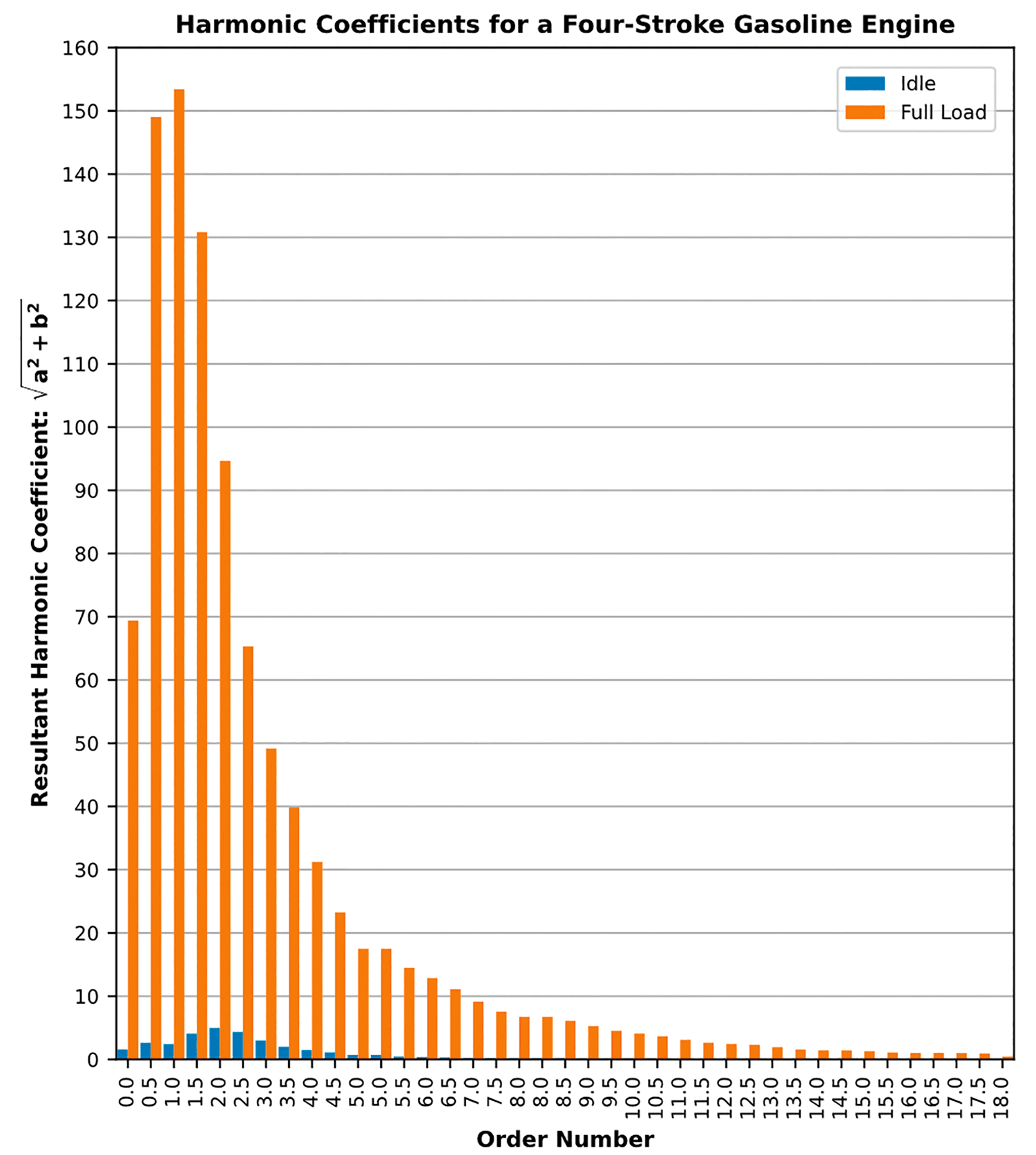
Therefore, if the detection of variations in the load is of interest, it is crucial to extract only the effect of the gas forces on the vibration response. Unlike the gas forces, the inertia forces have an analytic solution which happens to be periodic. It states that the inertia forces have cyclic components only at the frequency of rotation and its second multiple, which then leads to all the other frequency components of the vibration response to depend only on the gas forces. The harmonic frequency components of a signal can be efficiently computed using fast Fourier transform (FFT). The harmonic coefficients of the torque of a four-stroke gasoline engine at full load and at idle presented in Figure 2 were determined by Porter as early as in 1943 [2]. For a four-stroke engine one engine cycle equals two rotations of the crankshaft. In Figure 2 order 1.0 equals the rotation frequency and hence order 0.5 the engine cycle frequency.
Therefore, the right balance between the accuracy and timeliness of the model must be sought depending on the application and needs.
Smoothing out cyclic variations is possible
However, the operation of an ICE in practice is never perfectly constant between engine cycles even at steady load and therefore there is always cyclic variation in the acceleration response as well. This is typical especially considering spark ignited engines, such as the Wärtsilä 20V31SG, for which the peak cylinder pressure between consecutive cycles varies significantly. Considering the presented state recognition models the effect of the cyclic variation can be smoothened by extracting the feature values from signal segments that are multiple engine cycles long. By extending the length of the signal segment the prediction given by the model gets further away from real-time. Therefore, the right balance between the accuracy and timeliness of the model must be sought depending on the application and needs. In this case the accuracy is very high even when using signal segment length of two engine cycles. At the nominal operation speed of the genset, that is at 750 rpm, one engine cycle lasts 0.16 seconds.
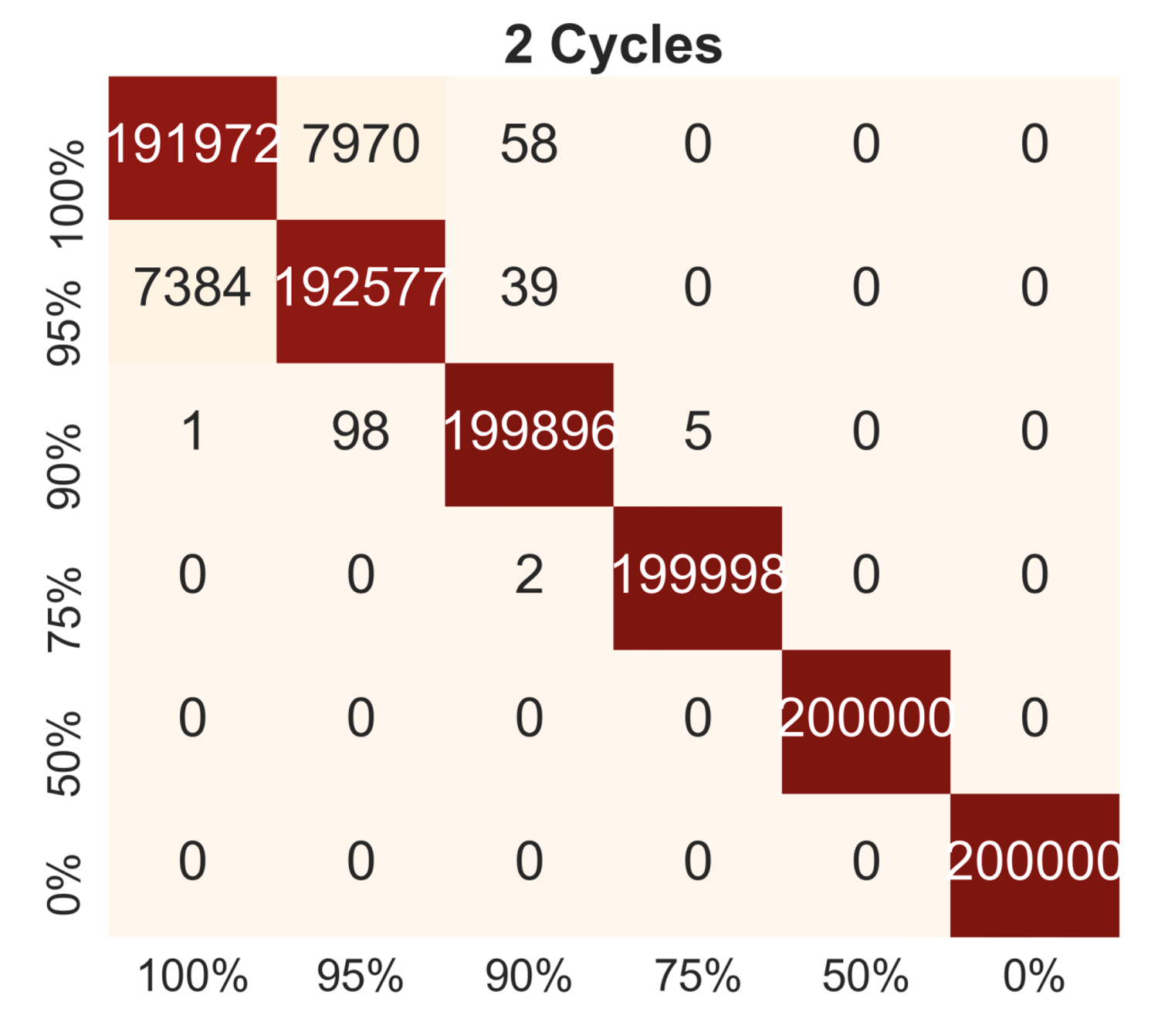
The confusion matrix of a classifier trained with features extracted from two engine cycles long signal segments is presented in Figure 3. Logistic regression was used as the classifier algorithm and the features were the acceleration amplitude at order 1.5 and the signal power extracted from the signals of one triaxial accelerometer. The classes are different power output levels givens as percentages of the rated power of the genset: 0 %, 50 %, 75 %, 90 %, 95 %, and 100%.
Novelty detection can recognise abnormal operation
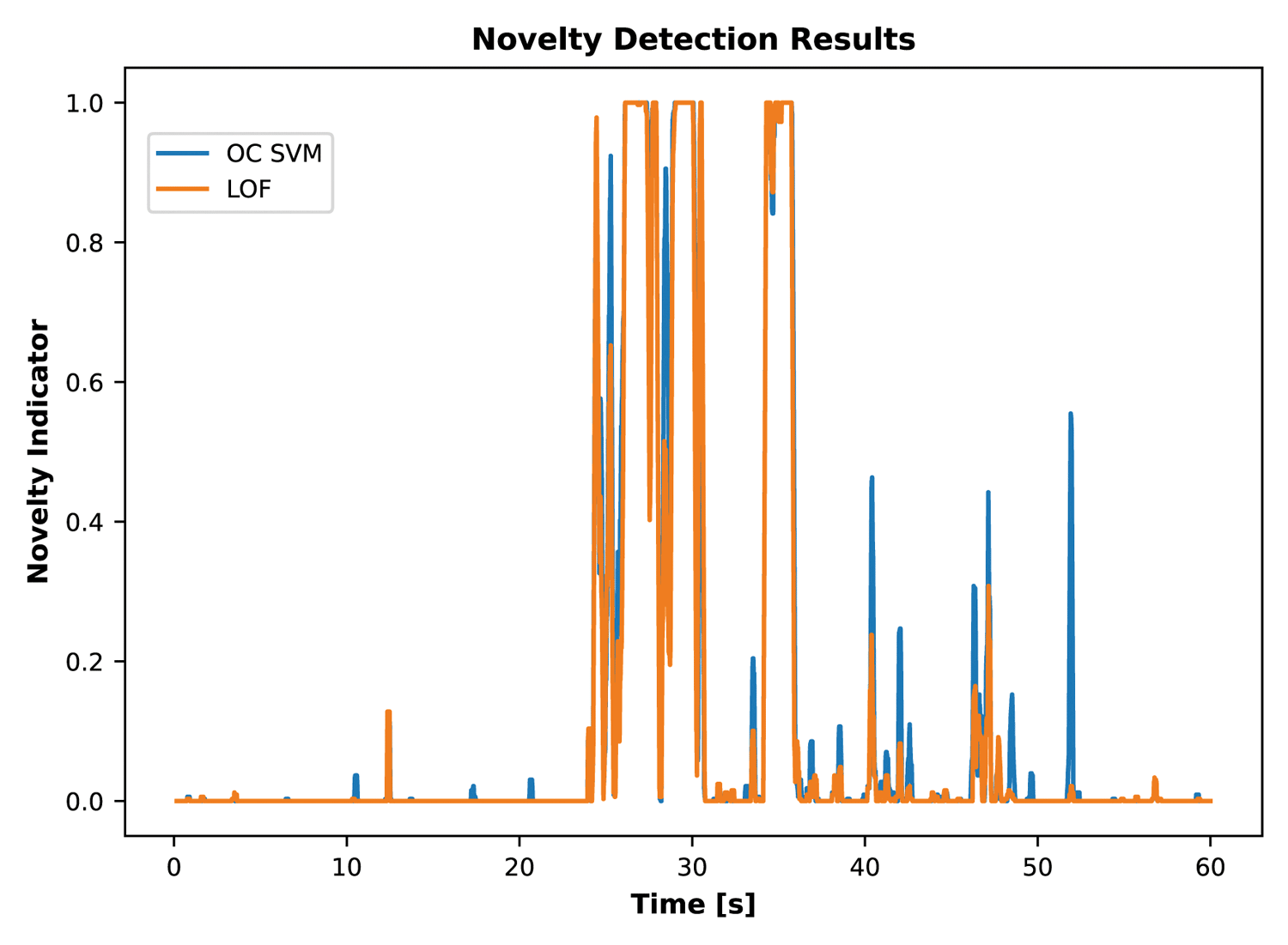
The recognition of abnormal operation can be done using novelty detection. Novelty detection is a subtype of binary classification in which a trained model predicts if a data sample belongs to the same class of the data it was trained with or not. The same features that were used for training the classifier model can be used for training the novelty detection models as well. Separate novelty detection models can be built for each power output level. The result of two novelty detectors trained using different algorithms, One-class support vector machine (OC SVM) and local outlier factor (LOF), are presented in Figure 4.
Further development of the recognition models
Jukka Junttila (MSE, MSE)

Jukka Junttila works as Research Scientist at VTT Technical Research Centre of Finland Ltd. He has over ten years of experience in structural analyses of rotating machines and other dynamic mechanical structures using finite element method. He has also come across research topics such as internal combustion engine technology, experimental structural analysis, topology optimisation, additive manufacturing and laser scanning during his studies and his career at VTT. During the last few years he has broadened his expertise into the fields of Big data analytics, machine learning and systems simulation.
Photo: Wärtsilä corporation
References
[1] Junttila, J., 2021, Operational State Recognition of a Rotating Machine Based on Measured Mechanical Vibration Data. Master’s thesis, Arcada University of Applied Sciences (2021)
[2] Porter, F.P., 1943, Harmonic Coefficients of Engine Torque Curves. In: ASME, Journal of Applied Mecchanics, 10(1): A33-A48. DOI: https://doi.org/10.1115/1.4009248
[3] Junttila, J., Sillanpää, A. Lämsä, V.S., 2022, Validation of Simulated Mechanical Vibration Data for Operational State Recognition System, 2022 IEEE 23rd International Conference on Information Reuse and Integration for Data Science (IRI), San Diego, CA, USA, 2022, pp. 138-143, doi: 10.1109/IRI54793.2022.00040.



Subscribe to the free Maintworld newsletter here!

Latest